Valo Surge Review: Is a $6,499 Full-Body Red Light Panel Worth It?
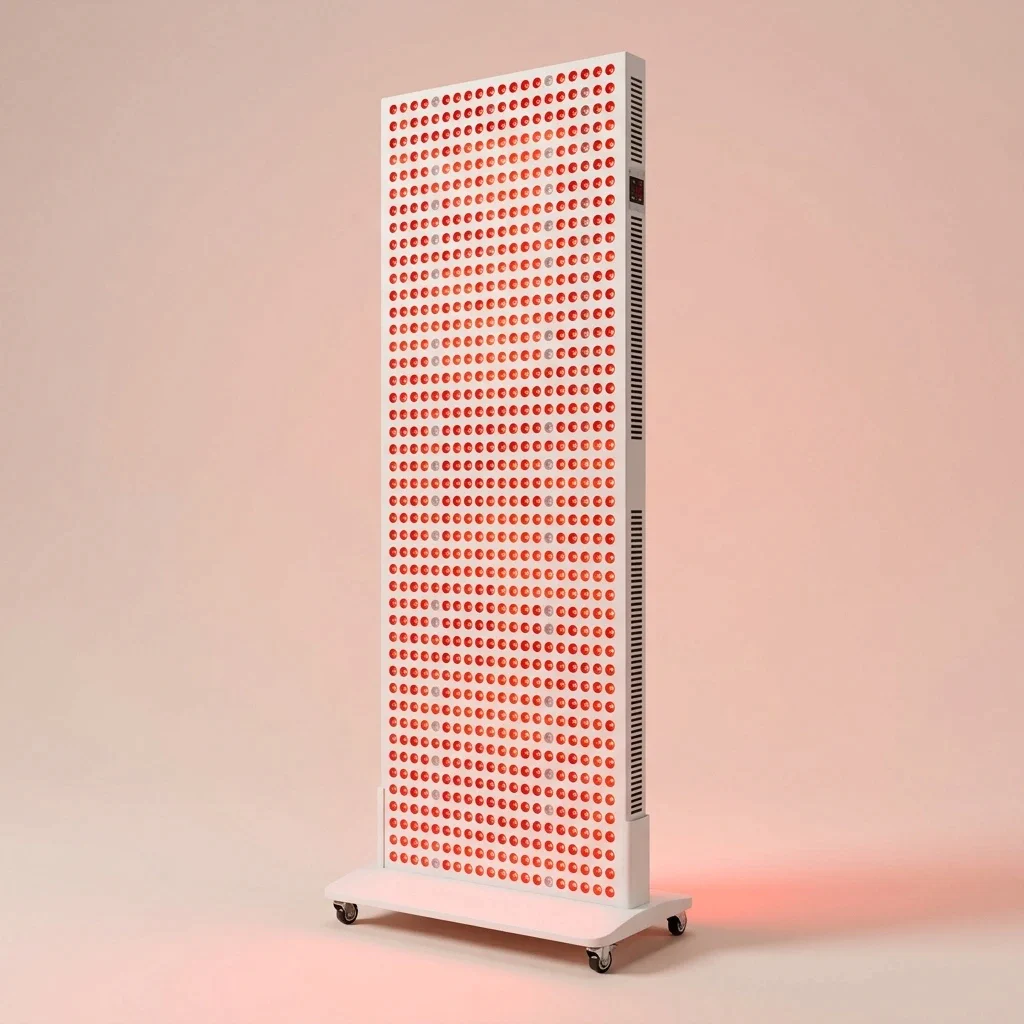
Valo Surge is the panel Valo built for people who want true head-to-toe coverage without buying a bed. It’s 71 inches tall and 23 inches wide, with 900 LEDs, eight wavelengths spanning red and near-infrared, and a brand-published 215 mW/cm² at 6 inches. The rolling floor stand is included, and the 8-year warranty is the longest in Valo’s lineup. It’s built to order (about 30 days), and Valo doesn’t yet publish its real power draw or weight. Best for serious home gyms, recovery rooms and people who already know red light works for them.
Who Should Buy the Valo Surge (And Who Shouldn’t)
Buy Valo Surge if:
- You want head-to-toe coverage in one position. At 71 inches tall, Surge covers most adults from head to feet in a single standing position. Valo itself notes that exact coverage depends on your height and distance. No stacking panels, no second pass.
- You treat your whole body most days. Serious training, pain in several areas, or a daily recovery routine. This is where one large panel beats juggling a smaller one.
- You’ve already used red light and know it works for you. Surge is an upgrade, not an experiment. If you’ve had a Beam or Blaze for a while and want more coverage, this is the logical next step.
- You want a long warranty on a big purchase. Eight years is unusually long in this category. Joovv’s modular panels come with two.
Skip Valo Surge if:
- You’re new to red light. Start with the Beam ($599) or Blaze ($1,499). Spending $5,200 before you know how your body responds isn’t a smart first move.
- You mainly treat one area. Knee, shoulder or face: a smaller panel does the same job for a fraction of the price.
- You need it next week. Surge is built to order, with roughly a 30-day lead time.
- Your space or wiring is tight. It’s a 71-inch panel on a rolling stand, and Valo doesn’t publish its actual power draw yet. See the setup checklist below.
Is $6,499 Actually Worth It?
The honest answer — broken down by who you are
For first-time red light users:
No. Start smaller, give it 8–12 weeks, and upgrade once you know what red light does for you.
For athletes and serious home gyms:
Yes, if you’ll use it most days. One position, 10 minutes, whole body. Over a year, that consistency matters more than any single spec.
For people managing pain in several areas:
Probably. Back, hips and knees in one session instead of three separate positions. Less friction means you’re more likely to keep doing it.
For people deciding between Surge and a red light bed:
Surge is the value pick. Valo’s Halo bed is $17,999.99 and gives you lie-down, 360° coverage. Surge gets you most of the full-body benefit standing up, for about a third of the price. More in our Valo Halo review.
The real cost calculation:
With our link, Surge is $5,199.99, stand included. Spread over the 8-year warranty, that’s about $1.78 a day. Over three years, it’s about $4.75 a day. In-office full-body red light sessions often cost $50 or more. At three a week, that habit runs about $7,800 a year. See what red light therapy really costs.
One thing to know first: Valo allows returns within 60 days, but customer-choice returns carry a 15% restocking fee. On Surge, that’s roughly $780, and shipping costs can be deducted too. Treat this as a purchase you’re sure about.
Specs That Actually Matter
Eight Wavelengths: What Each One Is For
630nm and 660nm (red): absorbed in the first few millimeters of skin. This is the skin-quality range: collagen, fine lines, tone. 660nm is the most studied red wavelength in photobiomodulation research.
810nm and 850nm (near-infrared): travel deeper, into muscle, tendons and joints. This is the range behind most of the recovery and pain research.
940nm and up (longer near-infrared): these extend the spectrum, but the research behind them is much thinner than for 660nm and 850nm. Think of them as a bonus, not the reason to buy.
480nm (blue), if your unit has it: visible blue light. It’s not the 415nm blue used in most acne research, so don’t buy Surge as an acne device.
All wavelengths run at the same time. Valo doesn’t say whether individual channels can be switched off. More in our 660nm vs 850nm guide.
What 71 Inches Actually Covers
Valo lists a 30° lens angle, so the light spreads a little as it travels. Our rough math from that figure: at 6 inches, Surge’s light field is about 74 inches tall and 26 inches wide. At 12 inches, it’s about 77 by 29. That’s enough to cover most adults from head to feet, shoulders and arms included, depending on how high the panel sits on its stand.
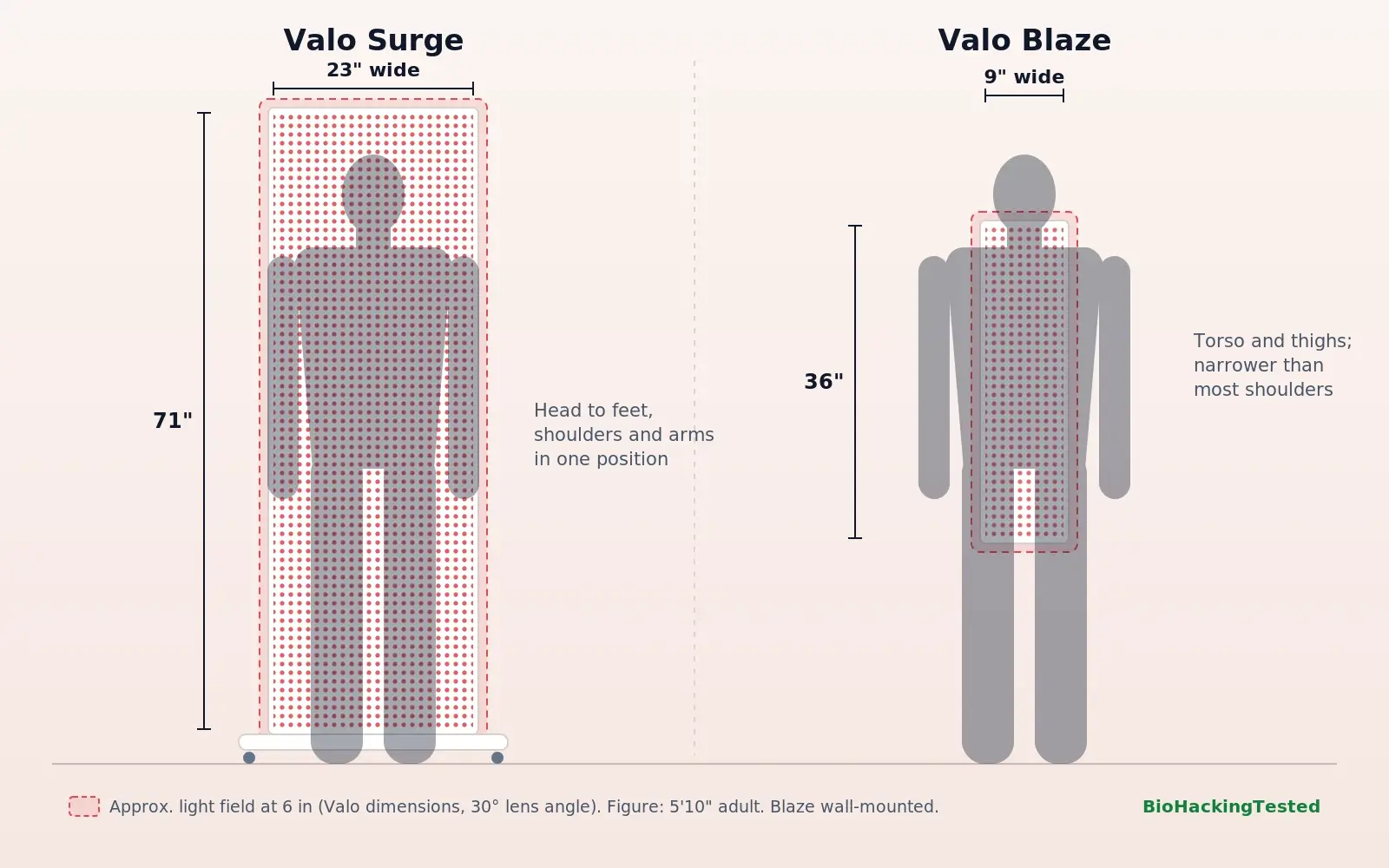
Light is strongest in the center and weaker toward the edges, so the top of your head and your feet get less than your torso. That’s normal for any panel.
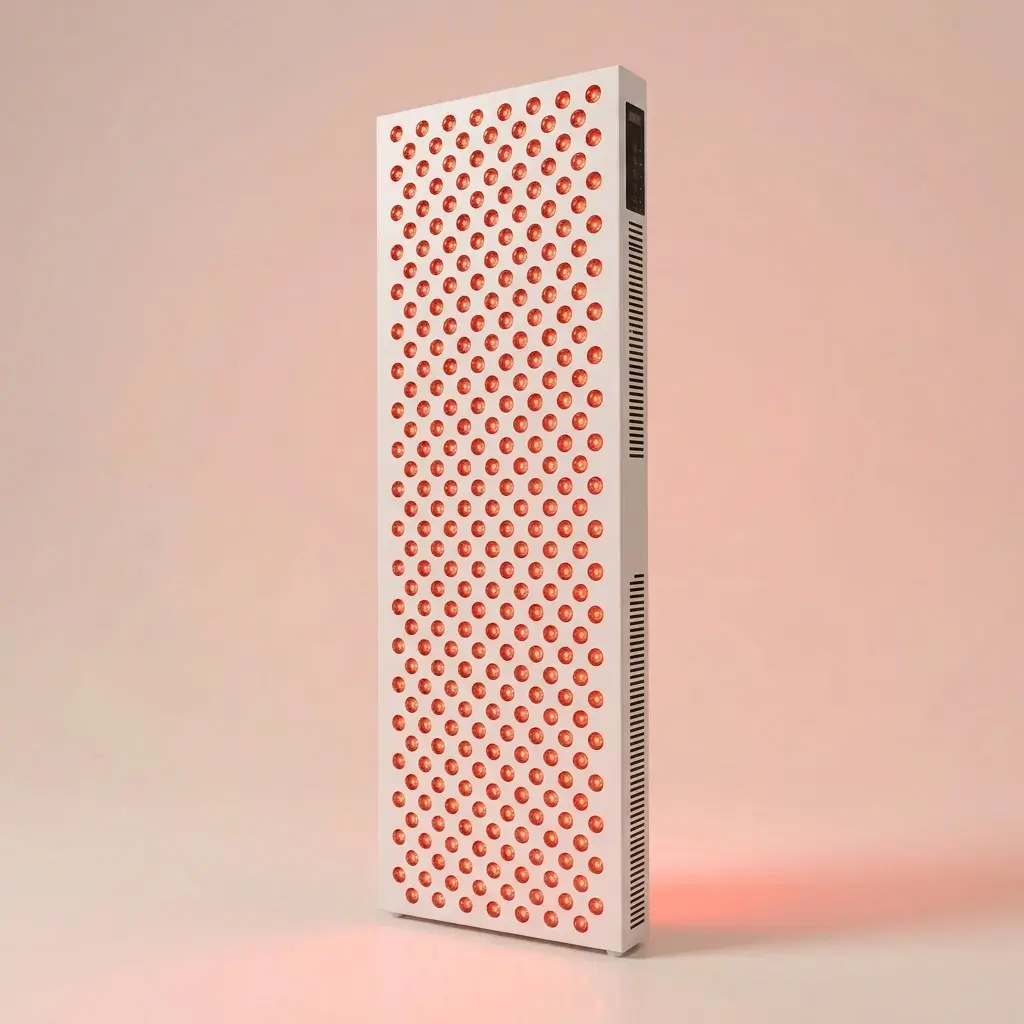
Compare that with the Blaze: 36 by 9 inches, or roughly 39 by 12 at 6 inches. That’s narrower than most people’s shoulders, which is why we call the Blaze a large-area panel rather than a full-body one.
How Valo Surge Compares to Full-Body Alternatives
Prices from brand websites, October 2026. — = we couldn’t confirm this from the brand’s product page.
| FEATURE | THIS REVIEW Valo Surge Best full-body value | Hooga ULTRA4500 Lowest price, 900 LEDs | Joovv Duo 3.0 Tall but narrow | Joovv Elite 3.0 Biggest brand | Valo Blaze Large-area pick |
|---|---|---|---|---|---|
| Price |
$6,499.99 ($5,199.99 with our link) |
$3,999 |
$3,699 |
$11,099 |
$1,499 ($1,199 with our link) |
| Panel size |
71" × 23" |
Single full-height panel |
72" × 8.75" |
72" × 26.25" |
36" × 9" |
| LEDs |
900 |
900 |
300 |
900 |
200 |
| Wavelengths |
8 (red + NIR) |
4 (630–850nm) |
2 (660, 850nm) |
2 (660, 850nm) |
4 (630–850nm) |
| Irradiance at 6" |
215 mW/cm² |
— |
Not published |
Not published |
194 mW/cm² |
| Head-to-toe, one position |
✅ Yes |
✅ Yes |
⚠️ Narrow strip |
✅ Yes |
❌ No |
| Stand |
✅ Included |
— |
Sold separately |
Sold separately |
❌ Sold separately |
| Warranty |
8 years |
3 years |
2 years |
2 years |
3 years |
Honest Notes on Each Competitor
vs Hooga ULTRA4500: The closest thing to Surge on paper, for $1,200 less: one full-height panel, 900 LEDs, four wavelengths, a 3-year warranty. If you only care about the red and near-infrared basics, it’s a serious alternative. Surge’s extra money buys more wavelengths, an 8-year warranty and an included stand.
vs Joovv Duo 3.0: Cheaper and just as tall, but it’s two 8.75-inch Solo panels stacked into a narrow strip. It won’t cover your shoulders and arms as evenly as a 23-inch-wide panel. Two wavelengths, 2-year warranty, stand extra.
vs Joovv Elite 3.0: Wider than Surge and the biggest brand name in the category. But at $11,099 it’s more than twice the price, with two wavelengths, no published irradiance and a 2-year warranty. Unless you specifically want Joovv’s ecosystem, Surge is the better buy on paper.
vs Valo Blaze: Not really a competitor. Half the height, about a third of the width, under a quarter of the price. If head-to-toe isn’t a must, Blaze is the smarter spend.
Choosing Within Valo’s Lineup
Valo Lineup at a Glance
| Price | With our link | Format | Coverage per position | Stand | Warranty | Returns | Best for | |
|---|---|---|---|---|---|---|---|---|
| Beam | $599.99 | $480 | 20″ panel | Upper or lower body | Sold separately | 3 years | 60 days (15% fee) | First panel, targeted use |
| Blaze | $1,499 | $1,200 | 36″ panel | Torso and thighs | Sold separately | 3 years | 60 days (15% fee) | Several areas at home |
| Surge | $6,499.99 | $5,200 | 71″ panel | Head to toe | Included | 8 years | 60 days (15% fee) | Daily full-body routine |
| Halo | $17,999.99 | about $14,400 | Lie-down bed | Front and back at once | Not needed | See review | Final sale | Dedicated wellness room |
Full reviews: Valo Beam · Valo Blaze · Valo Halo
Transparency first: We haven’t independently measured Surge. Everything here comes from Valo’s published specs and policies, checked in October 2026, and from competitors’ own websites.
What Valo doesn’t publish (yet):
- Actual wall power draw. “4,500W” is the LED rating (900 × 5W), not necessarily what it pulls from the outlet.
- Weight and delivery method
- FDA clearance status for Surge specifically. Valo lists it for Blaze, but not on the Surge page.
- HSA/FSA eligibility. Valo’s HSA/FSA page lists Spark, Beam and Glow.
- Which wavelength list is correct, and whether channels can be switched off
We’ve asked Valo and will update this review when we hear back.
Surge vs two Blazes: You could mount two Blazes one above the other and reach 72 inches for about $2,400 with our link, plus mounting. But that’s a 9-inch-wide strip, 400 LEDs, four wavelengths and two devices to manage. Surge is 23 inches wide with 900 LEDs. For full-body use, width matters as much as height.
The dose math: 215 mW/cm² at 6 inches for 10 minutes works out to about 129 J/cm². That’s a strong dose at close range. Start at 12 inches with shorter sessions and work up. The dosing guide explains the math, and the RLT dose calculator does it for you.
Pros & Cons
- 71-inch panel — head-to-toe coverage for most adults in one position
- 23 inches wide — covers shoulders and arms, not just a strip
- 900 LEDs and eight wavelengths across red and near-infrared
- 8-year warranty — the longest in Valo’s lineup
- Rolling floor stand included
- 215 mW/cm² at 6 inches (brand-published)
- About a third of the price of Valo’s Halo bed
- Built to order — about a 30-day wait
- 15% restocking fee on customer-choice returns
- Valo doesn’t publish actual power draw or weight
- HSA/FSA eligibility not confirmed for Surge
- Valo’s materials list two different wavelength sets
- Longer NIR wavelengths (940nm+) have thin research behind them
Before You Order: Setup Checklist
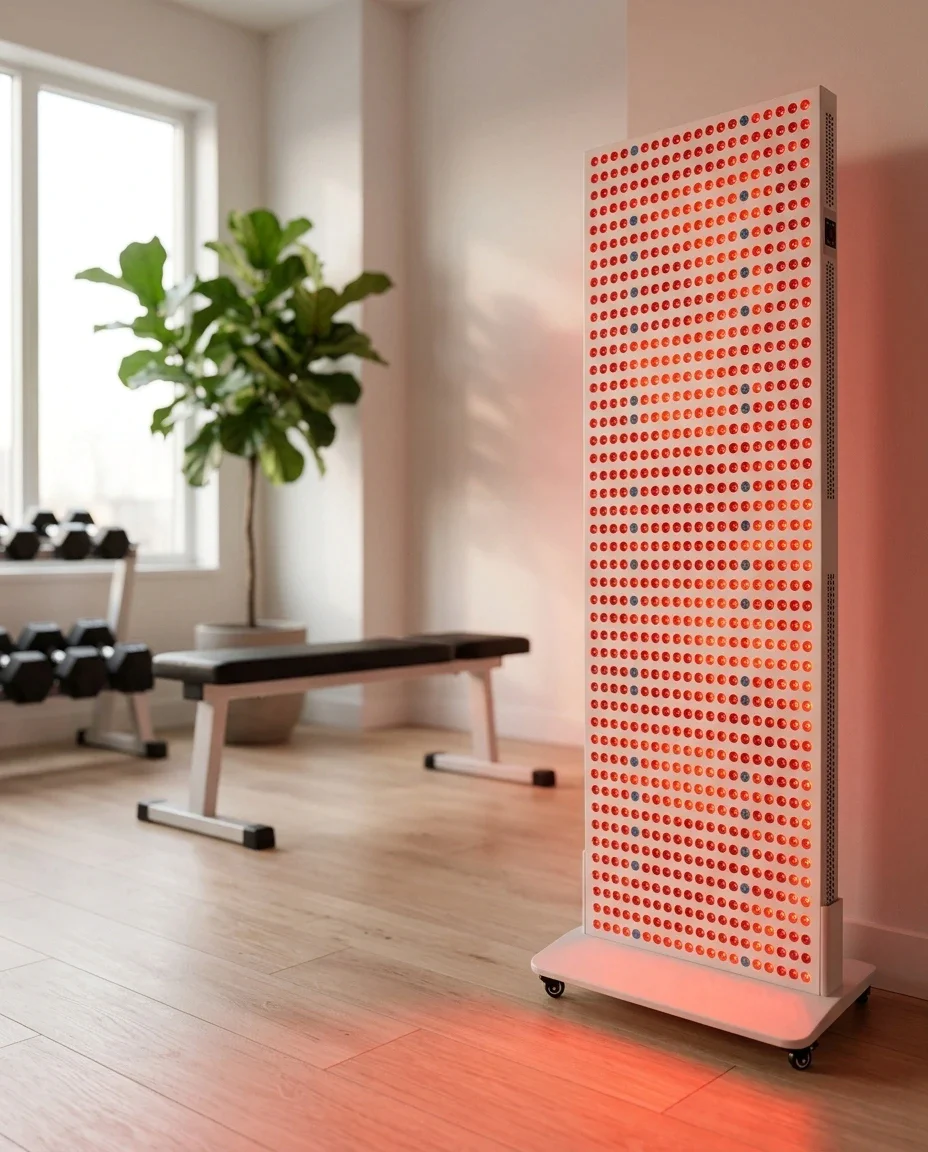
- Floor space: the panel is 23 inches wide on a rolling base. Leave about 3 feet in front so you can stand at 6–12 inches and turn around.
- Ceiling: a 71-inch panel on a stand fits under a standard 8-foot ceiling with room to spare.
- Flooring: casters roll easiest on hard floors. On thick carpet, plan to leave it in one spot.
- Power: place it near an outlet and skip extension cords. Ask Valo about the actual power draw before you order (see below).
- Eye protection: have goggles ready. This is a lot of bright light at close range. See our eye safety guide.
- Packaging: keep the box until your 60-day window closes. Valo can refuse or reduce refunds on returns that come back improperly packaged.
Questions to Ask Valo Before You Buy
- What’s the actual wall power draw, and does it need a dedicated circuit?
- How much does it weigh, and how is it delivered?
- Is Surge FDA-cleared? Can you share the 510(k) number?
- Which wavelength list is correct: the spec sheet or the product graphic?
- Can individual channels (like blue) be turned off? Is there a built-in timer?
- Is Surge HSA/FSA eligible through Flex?
- Does the 8-year warranty cover the LEDs, the electronics and the stand? Does it cover commercial use?
How to Use Valo Surge — Protocol by Goal
The Standard Surge Protocol
Roll Surge into place, stand 6–12 inches away and run a 10-minute session. That’s Valo’s recommended protocol. Facing the panel is enough for most goals. Add 10 minutes facing away if back pain or full-body recovery is the target. In your first week, start at 12 inches and 5–8 minutes. Wear eye protection.
Protocol by Goal
| Goal | Distance | Duration | Frequency | Guide |
|---|---|---|---|---|
| Full-body recovery | 6–12 in | 10 min front (+10 back) | Daily or post-workout | Athletes guide |
| Chronic pain / inflammation | 6–12 in | 10 min per side | 3–5x/week, daily for chronic pain | Inflammation guide |
| Back & joint pain | 6–12 in | 10 min back-facing | 3–5x/week | Back pain protocol |
| Skin & collagen | 12 in | 10 min front | 3–5x/week | Face protocol |
| Morning energy / circadian | 12 in | 10 min | Within an hour of waking | Sleep protocol |
A note on evening use: if your Surge includes 480nm blue, keep evening sessions a few hours before bed. Blue light close to bedtime can work against sleep.
Using Surge in a Gym or Studio
Valo pitches Surge for home gyms, recovery rooms and wellness spaces. If you’re buying for a business, ask Valo whether the 8-year warranty covers commercial use before you order. For businesses that want a lie-down, full-body experience, Valo also sells the Aura bed. That’s a different class of equipment, at a very different price.
Common Questions
How we evaluate health technology
Every review starts with the science, not the marketing. We compare published research, device specifications, safety information, warranty terms, pricing, and real-world usability factors before making a recommendation.When a product has been physically tested, we label it as hands-on tested. When a review is based on published specifications and research analysis, we label it as spec-analysis. That distinction matters — especially in health technology.
Peer-reviewed research first
We start with published clinical literature, not manufacturer claims. Mechanisms, wavelengths, dose ranges, and limitations are checked against peer-reviewed research whenever possible.
- PubMed and clinical databases
- Mechanism and dose plausibility
- Evidence strength and limitations
Device specification verification
We compare product specifications against what the research suggests matters: wavelength range, irradiance disclosure, treatment area, session time, safety features, warranty, and return policy.
- Wavelengths: red, blue, NIR, deep NIR
- Irradiance transparency
- Price, warranty, and practical value
Safety & regulatory audit
We flag aggressive marketing claims, unclear FDA language, missing safety guidance, photosensitivity concerns, and situations where users should seek medical advice first.
- FDA-cleared vs FDA-registered wording
- Contraindications and safety notes
- Brand-reported vs independently verified claims
Structured real-world testing
A device can look good on paper and still fail in daily use. We consider setup time, comfort, portability, coverage, session consistency, and whether the product fits the user’s actual goal.
- Ease of daily use
- Coverage and comfort
- Best-fit use cases and limitations
Should You Buy the Valo Surge?
If you already know red light works for you and want true head-to-toe coverage without a bed: yes. 71 inches, 900 LEDs, eight wavelengths, stand included, 8-year warranty. If you’re new to red light or treating one area, start with the Blaze or Beam. And before you order, know the trade-offs: a 30-day build time, a 15% restocking fee on returns, and a few specs Valo still doesn’t publish.