Does red light therapy reduce inflammation? Yes — it’s actually one of the best-supported mechanisms in the entire photobiomodulation literature. 630–850nm wavelengths reduce pro-inflammatory cytokines (TNF-α, IL-1β, IL-6) at the cellular level, with measurable effects confirmed across dozens of controlled studies.
Best wavelengths: 660nm for surface and superficial tissue inflammation. 850nm for deeper joint, muscle, and systemic inflammatory targets. Dual-wavelength devices cover both.
Protocol: 10–20 minutes per target area, 4–6 inches from skin, 5x per week. Systemic effects require larger coverage areas or multiple zones per session.
Timeline: Texture and tone improvements visible around week 4–6. Fine line depth reduction measurable at week 8–10. Firmness and laxity — 12–16 weeks minimum.
What it actually fixes: Acute inflammatory flares (injuries, overuse), chronic low-grade inflammation in accessible tissue (joints, muscles, skin), and inflammatory components of conditions like arthritis, tendinitis, and post-exercise muscle soreness.
What it won’t fix: Inflammation driven by unresolved root causes — chronic infections, autoimmune diseases actively flaring, dietary inflammatory load, obesity-related inflammation. Red light reduces the inflammatory signaling. It doesn’t eliminate the source generating it. That distinction matters enormously for realistic expectations.
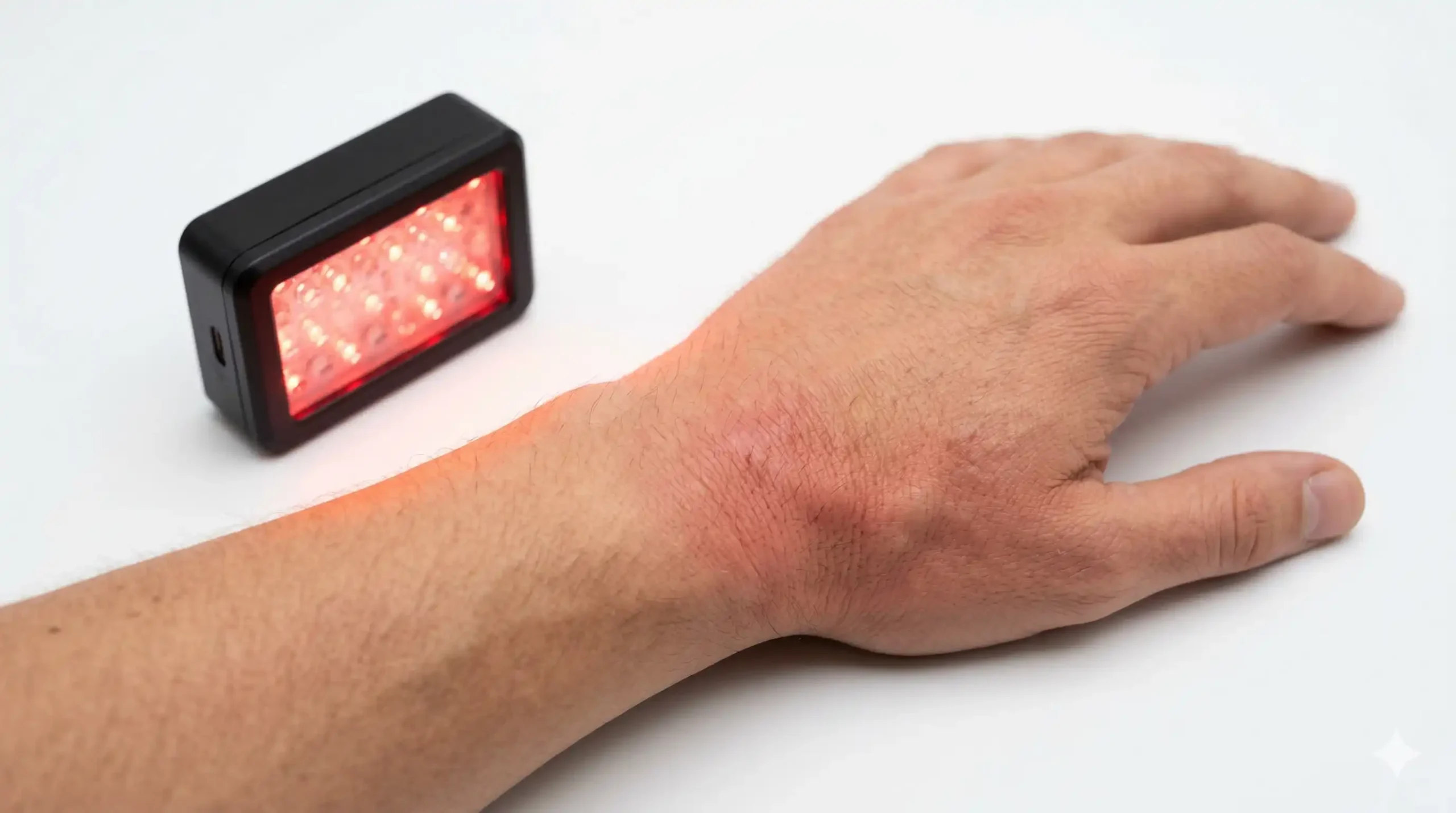
Understanding Red Light Therapy in Practice
Red light therapy is often discussed in theory, but its real-world application depends on measurable parameters like wavelength and exposure. I tested multiple RLT setups using a professional spectrometer to better understand how the therapy works in practice.
Open Red Light HubAcute vs Chronic Inflammation — Why the Distinction Matters for Protocol
Most people use “inflammation” as a single concept. It isn’t. The type of inflammation you’re dealing with determines which protocol applies, what timeline to expect, and whether red light therapy is even the right primary tool.
Acute inflammation is short-term, localized, and purposeful. When you sprain an ankle or strain a muscle, your immune system floods the area with inflammatory cells and signaling molecules to begin repair. This is the right biological response — you don’t want to suppress it entirely in the first 24–48 hours, or you may slow the initial healing cascade.
Chronic inflammation is the opposite problem: a low-grade, persistent inflammatory state where the initial trigger may be long gone but the immune activation hasn’t resolved. This is what drives most chronic pain conditions, skin issues, and accelerated tissue aging. It’s also where red light therapy has the most clinically meaningful impact.
Why this matters for timing:
For acute injuries — sprain, muscle tear, acute tendinitis flare — start RLT after the first 24–48 hours. Using it immediately in the inflammatory peak may not be harmful, but there’s a reasonable argument for letting the initial acute phase proceed before introducing anti-inflammatory photobiomodulation.
For chronic conditions — osteoarthritis, chronic back pain, persistent skin inflammation, post-exercise soreness patterns — start immediately and commit to a minimum 4–6 week protocol. The cellular mechanisms that produce results in chronic inflammation are cumulative, not immediate.
The Mechanism: How Red Light Reduces Inflammation
The photobiomodulation anti-inflammatory mechanism is one of the most thoroughly documented in the field, and it operates at multiple levels simultaneously.
Cytokine Modulation
Pro-inflammatory cytokines are signaling proteins that coordinate the immune response. In acute inflammation they serve a purpose. In chronic inflammation, they’re stuck in a loop — perpetuating tissue damage and sensitizing pain receptors without resolving the underlying issue.
Red and near-infrared light at 630–850nm consistently reduces expression of the primary pro-inflammatory cytokines:
| Cytokine | Role in Inflammation | Effect of RLT |
|---|---|---|
| TNF-α | Master regulator of inflammatory response, activates other cytokines | Significantly downregulated |
| IL-1β | Drives joint inflammation, fever, pain sensitization | Reduced expression |
| IL-6 | Acute phase response, chronic inflammatory conditions | Reduced levels |
| IL-8 | Recruits neutrophils to inflamed tissue | Decreased |
| IL-10 | Anti-inflammatory — suppresses immune overactivation | Increased |
| NF-κB | Transcription factor that activates inflammatory gene expression | Inhibited |
The net result: a shift in the inflammatory balance from pro-inflammatory to resolution-promoting. This isn’t suppression in the pharmaceutical sense — it’s a normalization of signaling that was dysregulated.
Mitochondrial Activation
The upstream driver of all these downstream effects is mitochondrial. When 630–850nm photons are absorbed by cytochrome c oxidase, the electron transport chain functions more efficiently, producing more ATP. Cells with adequate energy production regulate inflammation more effectively — inflammatory states are partly a cellular energy crisis where stressed cells default to cytokine overproduction.
Nitric Oxide and Microcirculation
Near-infrared light triggers nitric oxide release from mitochondria and endothelial cells. Nitric oxide dilates blood vessels, improving oxygen and nutrient delivery to inflamed tissue — and critically, improving removal of inflammatory metabolic waste products. Stagnant tissue around a chronically inflamed joint heals poorly partly because circulation is compromised. NIR directly addresses this.
Reactive Oxygen Species Regulation
In small amounts, reactive oxygen species (ROS) serve as signaling molecules. In chronically inflamed tissue, ROS production is excessive and contributes to cell damage and pain sensitization. Photobiomodulation at appropriate doses reduces excessive ROS production while preserving the low-level signaling function — another mechanism by which it reduces inflammation without eliminating the immune response entirely.
What Conditions Respond to Red Light for Inflammation
Not every inflammatory condition responds equally. Here’s an honest breakdown based on the research and clinical experience.
Strong Evidence
Osteoarthritis (knee, hip, hand): Peer-reviewed evidence is extensive. Near-infrared light reaches joint tissue, reduces synovial inflammation, and slows cartilage degradation markers. Clinically meaningful pain reduction in 4–8 weeks of consistent treatment. The knee pain protocol covers this in detail.
Muscle-dominant back pain: Chronic lumbar inflammation responds predictably to NIR protocols. Covered in depth in the back pain guide.
Tendinitis and tendinopathy: Patellar, Achilles, rotator cuff — inflamed tendon tissue responds well. Tendons have poor vascularity and heal slowly without intervention. NIR improves local circulation and reduces the cytokine loop that keeps tendon inflammation active.
Post-exercise muscle soreness (DOMS): One of the best-studied acute applications. Multiple RCTs confirm reduced muscle soreness scores, faster recovery of strength, and lower blood markers of muscle damage (CK, LDH) when red light is applied before or immediately after exercise. The before or after workout guide covers timing in detail.
Acne and inflammatory skin conditions: 660nm red light reduces the inflammatory response that drives acne severity, redness, and post-inflammatory hyperpigmentation. Detailed protocol in the acne guide.
Wound healing and post-surgical inflammation: One of the oldest and most established applications. Burn units and wound clinics have used photobiomodulation for decades because the anti-inflammatory and tissue repair effects on wound tissue are well-documented.
Moderate Evidence
Rheumatoid arthritis: RLT reduces local joint inflammation and pain scores in RA, but RA is an autoimmune condition with systemic drivers. RLT manages inflammatory symptoms in affected joints — it doesn’t alter the underlying autoimmune process. Useful as an adjunct, not a primary treatment.
Inflammatory skin conditions (eczema, psoriasis, rosacea): Case series and smaller studies suggest benefit for reducing flare severity and inflammation. Not enough large RCTs to call evidence strong, but mechanistically plausible and low-risk to try.
Peripheral neuropathy: Inflammation around peripheral nerves contributes to neuropathic pain. NIR shows promise for nerve healing and pain reduction, but the evidence base is less robust than for musculoskeletal applications.
Limited Evidence (Theoretical or Early-Stage)
Systemic inflammation (gut, brain, cardiovascular): The idea that local RLT application produces systemic anti-inflammatory effects through circulatory distribution of photobiomodulation byproducts is biologically plausible and has some animal model support. Human evidence for meaningful systemic effects from localized application is limited. Don’t expect treating your knee to resolve gut inflammation.
Protocol for Inflammation
Wavelength Selection by Target Depth
| Inflammation Target | Depth | Optimal Wavelength | Notes |
|---|---|---|---|
| Skin — acne, rosacea, wounds | 0–10mm | 630–660nm | Red light sufficient, NIR unnecessary |
| Superficial tendons and ligaments | 10–20mm | 660nm + 850nm | Dual wavelength preferred |
| Muscles — back, quads, hamstrings | 15–30mm | 850nm primary | 660nm adds surface benefit |
| Joints — knee, hip, shoulder | 20–50mm | 850nm essential | 660nm alone insufficient |
| Deep tissue — SI joint, lumbar facets | 30–50mm | 850nm high irradiance | Distance matters critically here |
Session Parameters
| Parameter | Acute Inflammation | Chronic Inflammation |
|---|---|---|
| Start timing | After 24–48h from injury onset | Begin immediately |
| Wavelength | 660nm + 850nm | 850nm primary, 660nm secondary |
| Distance | 4–6 inches | 4–6 inches |
| Session time | 10–15 min per zone | 15–20 min per zone |
| Frequency | Daily for 1–2 weeks | 5x per week, 4–6 weeks minimum |
| Target dose | 10–20 J/cm² | 20–40 J/cm² |
Getting the dose right is the variable most people underestimate. The dosing guide walks through how distance, irradiance, and time interact — and why treating through clothing silently kills your dose. The through clothes breakdown shows exactly how much you lose per fabric type: thin cotton alone blocks 50–60% of therapeutic wavelengths. Always bare skin.
Multi-Zone Sessions for Wider Inflammation
For people dealing with inflammation in multiple areas — both knees, full back, shoulder plus neck — session structure matters.
Treat the most painful or primary target zone first. The initial 15–20 minutes of a session are your highest cellular response window. Move to secondary zones after, keeping total session under 45–50 minutes. Don’t try to cover everything in one session at the expense of adequate dose per zone — two solid 15-minute sessions on one area beats four 8-minute sessions spread thin.
The Research
Key studies on photobiomodulation and inflammation:
| Study | Condition | Finding |
|---|---|---|
| Chow et al., Lancet (2009) | Acute neck pain | 70% reduction in pain at 22-week follow-up with LLLT vs sham |
| Bjordal et al., Physical Therapy Reviews (2010) | Meta-analysis, joint inflammation | Consistent reduction in inflammatory markers and pain across arthritis studies |
| Leal-Junior et al., Lasers in Medical Science (2015) | DOMS / muscle inflammation | Significantly reduced CK levels and pain scores post-exercise with RLT pre-treatment |
| Hamblin M.R., AIMS Biophysics (2017) | Mechanism review | Comprehensive review of cytokine modulation and NF-κB inhibition by photobiomodulation |
Hamblin’s 2017 mechanistic review is the most cited single reference for understanding why photobiomodulation works across such a wide range of inflammatory conditions — the mechanism is upstream enough to affect multiple pathways simultaneously. Worth reading if you want to go deep on the biology.
Common Mistakes
Treating over clothing. Already covered, but worth repeating in the context of inflammation: if you’re treating joint or muscle inflammation and wearing even a thin layer of fabric, you’re potentially dropping below the therapeutic threshold entirely. Fabric blocks 50–90% of dose depending on material — detailed breakdown here.
Using 660nm only for deep targets. Red light penetrates 8–10mm. If your inflammatory target is a hip joint, a lumbar disc, or a deep muscle belly, 660nm is not reaching it. The wavelength guide has the penetration depth data with tissue composition context.
Starting RLT in the first 24 hours of acute injury. Not a dangerous mistake, but potentially a counterproductive one. The acute inflammatory phase immediately post-injury coordinates the first wave of tissue repair. Suppressing it too early may slow the initial healing response. Give it 24–48 hours, then start your protocol.
Expecting RLT to fix inflammatory root causes. Photobiomodulation reduces inflammatory signaling. If the source of that signaling is still active — poor diet, chronic sleep deprivation, metabolic dysfunction, an unresolved infection — RLT provides symptomatic improvement that may mask rather than resolve the underlying issue. Use it alongside root cause work, not instead of it.
Inconsistent dosing. The anti-inflammatory mechanisms from photobiomodulation accumulate over weeks of consistent exposure. The ultimate guide to RLT explains the cumulative dose principle — erratic sessions prevent the sustained cytokine normalization that produces lasting results.
Frequently Asked Questions
How quickly does red light reduce inflammation?
Acute inflammation in accessible tissue — post-exercise soreness, minor injury, skin flare — often responds within 1–3 sessions. Pain scores and swelling can reduce noticeably in 48–72 hours with consistent acute protocol use. Chronic inflammation takes longer: 2–3 weeks for first meaningful changes, 4–6 weeks for substantial reduction in baseline inflammation. The cells need repeated signaling over time to shift gene expression patterns, not just a single session.
Can red light therapy replace anti-inflammatory medications?
For mild-to-moderate inflammatory conditions, some people do reduce their NSAID use after 4–6 weeks of consistent RLT — particularly for osteoarthritis and chronic back pain. This should be done with physician knowledge, not unilaterally. The mechanisms are complementary rather than identical: NSAIDs block COX pathways acutely, while RLT works upstream on cytokine signaling over time. They can be used together.
Does it work for autoimmune inflammatory conditions?
For localized joint inflammation in rheumatoid arthritis and similar conditions, yes — there’s evidence for symptom reduction in affected joints. But autoimmune inflammation has systemic drivers that RLT doesn’t address. It’s an adjunct that can meaningfully reduce local pain and swelling, not a disease-modifying treatment.
Is more treatment time better for inflammation?
No — the biphasic dose-response curve means there’s an optimal dose range above which you get diminishing returns or even reduced benefit. For most inflammation applications, 15–20 minutes per zone per session is the ceiling. Doubling the time doesn’t double the effect. Consistent sessions at the right dose outperform sporadic long sessions every time.
What’s the difference between red light and infrared sauna for inflammation?
Different mechanisms, different depth of action, different evidence base. Infrared sauna works primarily through heat — raising core temperature, increasing circulation, inducing a hormetic stress response. Red light works through photobiomodulation — direct cellular activation without significant heat. They’re complementary rather than competing. The sauna and RLT stacking guide covers how to combine them safely for maximum anti-inflammatory effect.
🔴 For Targeted Inflammation Treatment
Valo Spark — The Device That Makes Targeted Protocols Practical
Treating specific inflamed areas — a single joint, a trigger point, a localized tendon — requires positioning a device precisely at 4–6 inches over the target zone, ideally while you stay still for 15–20 minutes.
A large wall panel is designed for full-body coverage. For targeted inflammation work, a compact high-irradiance device does the job better: you can hold it over a knee, position it on a stand over the lower back, or direct it at a shoulder joint without the session becoming an exercise in awkward positioning.
The Valo Spark outputs verified 850nm at therapeutic irradiance, is compact enough to use on any target zone, and has enough battery life for full protocol sessions without interruption.
Internal Links
- Red Light Therapy: The Definitive Guide (2026)
- 660nm vs 850nm — Which Wavelength Do You Actually Need?
- The Simple Dosing Guide (No Math Required)
- Red Light Therapy Through Clothes: Does It Work?
- Red Light Therapy for Knee Pain: Protocol & Evidence
- Red Light Therapy for Back Pain: Protocol & Evidence
- Red Light Therapy Before or After Workout?
- Red Light Therapy for Acne: Protocol, Evidence & Results
- Red Light Therapy & Sauna — How to Combine Them Safely
- Valo Spark Review — Best Portable RLT Device
Sources
- Chow R.T. et al. — The Lancet, 2009. RCT: low-level laser therapy for acute neck pain — 70% pain reduction at 22-week follow-up vs sham.
- Bjordal J.M. et al. — Physical Therapy Reviews, 2010. Meta-analysis of LLLT for joint inflammation: consistent reduction in inflammatory markers across arthritis studies.
- Leal-Junior E.C. et al. — Lasers in Medical Science, 2015. RCT: RLT pre-exercise reduces DOMS, CK levels, and pain scores in muscle inflammation.
- Hamblin M.R. — AIMS Biophysics, 2017. Mechanistic review: cytokine modulation, NF-κB inhibition, and anti-inflammatory cascades from photobiomodulation.