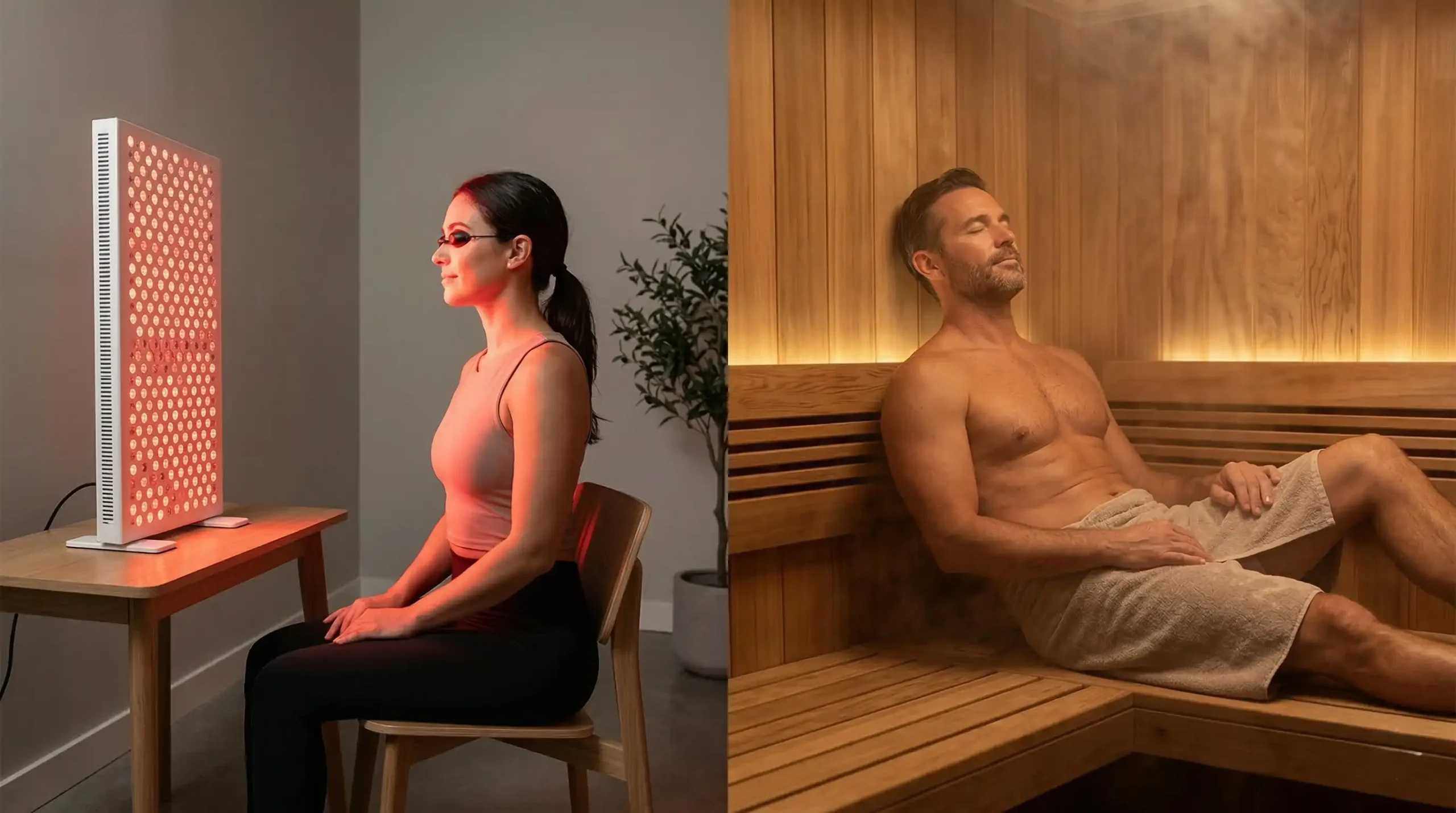
Are they the same thing? No — this is one of the most common misconceptions in the biohacking space. Red light therapy and infrared sauna use different parts of the electromagnetic spectrum, work through completely different biological mechanisms, produce different primary benefits, and have different evidence bases behind them.
Red light therapy (630–850nm): Works through photobiomodulation — specific wavelengths are absorbed by mitochondria, triggering cellular energy production, anti-inflammatory cascades, and tissue repair. Minimal heat. The benefit is photochemical, not thermal.
Infrared sauna (1,000–100,000nm far infrared): Works through heat. Raises core body temperature, induces sweating, drives cardiovascular response, and creates a hormetic heat stress. The benefit is primarily thermal. The word “infrared” refers to a completely different part of the spectrum than therapeutic red and near-infrared light.
Which one should you choose?Depends entirely on your primary goals, budget, and practical constraints. Neither is universally better — they target different physiological levers. In many cases, the answer is both, sequenced correctly.
The budget reality: A quality red light therapy panel runs $200–600. A quality infrared sauna runs $1,500–8,000+. This isn’t a minor consideration.
Understanding Red Light Therapy in Practice
Red light therapy is often discussed in theory, but its real-world application depends on measurable parameters like wavelength and exposure. I tested multiple RLT setups using a professional spectrometer to better understand how the therapy works in practice.
Open Red Light HubThe Fundamental Confusion: Why People Mix These Up
The word “infrared” appears in both terms, which is where the confusion starts. But the infrared spectrum spans an enormous range — from 700nm to 1mm — and the therapeutic near-infrared light used in RLT (700–850nm) and the far-infrared radiation that heats an infrared sauna (8,000–14,000nm) are so far apart on that spectrum that they share almost nothing in terms of biological mechanism.
Think of it this way: visible red light (660nm) and far-infrared sauna radiation (10,000nm) differ by a factor of roughly 15x in wavelength. That’s a larger proportional difference than the gap between visible light and X-rays. Calling them similar because both contain the word “infrared” is like calling a bicycle and a jet similar because both have wheels.
Near-infrared light (700–850nm) — used in RLT:
- Penetrates tissue 20–40mm
- Absorbed by mitochondrial chromophores (cytochrome c oxidase)
- Triggers photochemical biological responses
- Minimal heat generation in tissue
- Precise wavelength-dependent effects
Far-infrared radiation (8,000–14,000nm) — used in infrared sauna:
- Absorbed almost entirely at skin surface
- Converts directly to heat
- Raises skin and core body temperature
- Effects are thermal, not photochemical
- No wavelength-specific molecular target
A traditional sauna and an infrared sauna produce different heating mechanisms but the same primary output: elevated body temperature. A red light therapy panel and an infrared sauna produce fundamentally different primary outputs. This is why the comparison requires understanding both before choosing between them.
Head-to-Head: Mechanism, Benefits & Evidence
Mechanism Comparison
| Factor | Red Light Therapy | Infrared Sauna |
|---|---|---|
| Active spectrum | 630–850nm (red + near-infrared) | 8,000–14,000nm (far infrared) |
| Primary mechanism | Photobiomodulation — mitochondrial activation | Thermal — core temperature elevation |
| Heat generated | Minimal | Significant (core temp raises 1–3°C) |
| Tissue penetration | 20–40mm (NIR) | Surface-level (absorbed at skin) |
| Cellular target | Cytochrome c oxidase in mitochondria | No specific molecular target — heat stress |
| Session temperature | Room temperature | 45–65°C (113–150°F) |
| Session duration | 10–20 minutes | 20–45 minutes |
Benefits Comparison
| Benefit | Red Light Therapy | Infrared Sauna | Evidence Quality |
|---|---|---|---|
| Inflammation reduction | ✅ Strong — cytokine modulation | ✅ Moderate — heat shock proteins | RLT: Multiple RCTs. Sauna: Observational + some RCTs |
| Muscle recovery | ✅ Strong — DOMS reduction confirmed | ✅ Moderate — improved circulation | Both have RCT support |
| Collagen / skin anti-aging | ✅ Strong — fibroblast activation | ⚠️ Weak — primarily sweating/pore cleansing | RLT: Multiple RCTs. Sauna: Limited skin-specific evidence |
| Cardiovascular health | ⚠️ Indirect — circulation support | ✅ Strong — mimics moderate exercise cardiovascular response | Sauna: Robust Finnish cohort data |
| Detoxification | ❌ No direct mechanism | ⚠️ Sweat-based — contested evidence | Neither has strong detox evidence |
| Joint pain | ✅ Strong — multiple RCTs | ✅ Moderate — heat-based pain relief | Both reduce pain; different mechanisms |
| Sleep improvement | ✅ Moderate — melatonin support | ✅ Moderate — temperature drop post-session | Both show sleep quality benefit |
| Weight loss | ❌ No direct mechanism | ⚠️ Minimal — caloric burn from sweating | Neither is a weight loss tool |
| Mental health / mood | ⚠️ Emerging — neuroinflammation reduction | ✅ Moderate — endorphin release, stress reduction | Sauna has more evidence here |
| Hair growth | ✅ Moderate — follicle stimulation | ❌ Heat may worsen hair loss at high temp | RLT only |
| Wound healing | ✅ Strong — established in clinical settings | ❌ Contraindicated over open wounds | RLT only |
Cost and Practicality Comparison
| Factor | Red Light Therapy | Infrared Sauna |
|---|---|---|
| Entry price | $150–600 (panel) | $1,500–8,000+ (unit) |
| Space required | Minimal — any room | Dedicated space, 4×4 ft minimum |
| Session prep | None — immediate use | Preheat time 15–30 min |
| Maintenance | Near zero | Cleaning, wood treatment, electrical |
| Portability | High (portable panels) | None |
| Electricity cost | Very low | Moderate — 1–2kWh per session |
| Session tolerance | Anyone can do it | Heat-sensitive individuals may struggle |
| Contraindications | Minimal | Pregnancy, heart conditions, heat intolerance |
Where Each Has a Clear Advantage
Red Light Therapy Wins For:
Skin and collagen goals. The fibroblast activation and collagen synthesis evidence for RLT is specific, well-replicated, and mechanistically direct. Infrared sauna doesn’t produce this effect — sweating and elevated skin temperature don’t stimulate fibroblasts the way photobiomodulation does. If anti-aging, wound healing, acne, or scar reduction is your primary goal, RLT is the relevant tool. Detailed protocol in the face and anti-aging guide.
Targeted pain and inflammation. For specific tissue targets — a knee joint, a lumbar muscle, a tendon — RLT’s ability to deliver a precise photobiomodulation dose to a defined area is more targeted than the whole-body heat of a sauna. The inflammation protocol and knee pain guide cover the specifics.
Hair loss and follicle stimulation. Near-infrared photobiomodulation has clinical evidence for stimulating dormant hair follicles. High sauna temperatures, conversely, may not be beneficial for hair — heat stress can potentially worsen certain types of hair thinning.
Budget and practicality. A quality panel at $300–500 delivers the research-supported therapeutic parameters. The equivalent investment in sauna infrastructure doesn’t get you a complete unit. For most people without dedicated wellness spaces, RLT is the more accessible intervention.
Daily use protocol. You can run an RLT session in 10–15 minutes with zero prep, in any room, daily. Daily sauna use requires significant time, heat tolerance, and infrastructure.
Infrared Sauna Wins For:
Cardiovascular conditioning. The Finnish sauna cohort studies — tracking tens of thousands of people over decades — show robust associations between regular sauna use (4–7x per week) and reduced cardiovascular mortality. The cardiovascular response to heat stress — increased heart rate, improved vascular function — is a meaningful benefit RLT doesn’t replicate. This is perhaps the single strongest evidence base sauna has over RLT.
Systemic stress response and heat shock proteins. Heat induces production of heat shock proteins (HSPs), which act as cellular chaperones — refolding damaged proteins, protecting cells from subsequent stressors, and supporting immune function. This hormetic benefit requires genuine heat stress. Photobiomodulation doesn’t trigger the same HSP cascade.
Mental health and parasympathetic activation. The combination of heat, forced stillness, and endorphin release from sauna sessions produces measurable improvements in mood and stress markers. Many people find the subjective relaxation from sauna deeper than from RLT sessions. For stress and mood as primary goals, sauna has an experiential and evidence edge.
Sweating and skin pore cleansing. Whatever the contested claims about “detoxification,” sauna does produce genuine deep sweating that clears skin pores. Not the same mechanism as the collagen and anti-inflammatory effects of RLT, but a real benefit for skin cleanliness and some people’s inflammatory skin conditions.
Can You Combine Them?
Yes — and there’s a case for combination being more powerful than either alone for recovery and inflammation goals. The sauna and RLT stacking guide covers this in detail, but the summary:
Sequence matters. Red light before sauna is the protocol supported by the available evidence and biological logic. RLT primes cellular energy production and anti-inflammatory cascades before heat stress. The heat then drives circulation and systemic stress adaptation on top of already-activated cellular repair mechanisms.
Red light after sauna risks competing with the heat-induced responses — some evidence suggests cold or sub-therapeutic light application after heat may blunt the adaptive response.
The practical combination: 10–15 minute RLT session, then transition to sauna for 20–30 minutes, then cool down gradually. Total time investment is significant — this is a protocol for people with serious recovery goals and time to allocate, not a daily minimum effective dose approach.
If you only have budget and space for one, choose based on your primary goals using the benefits table above. If you have both, the combination produces complementary physiological effects that don’t fully overlap.
Which One Should You Choose?
| Your Primary Goal | Better Choice | Reason |
|---|---|---|
| Skin anti-aging, collagen, acne | Red Light Therapy | Direct fibroblast mechanism; sauna doesn’t replicate this |
| Targeted joint or muscle pain | Red Light Therapy | Precise dose delivery; better tissue-specific evidence |
| Cardiovascular health | Infrared Sauna | Heat stress cardiovascular response; Finnish cohort data |
| General recovery, stress, relaxation | Infrared Sauna | Systemic heat response; parasympathetic activation |
| Hair growth | Red Light Therapy | Follicle stimulation evidence; heat may be counterproductive |
| Budget under $1,000 | Red Light Therapy | Full setup $200–600; sauna unavailable at this budget |
| Daily use protocol | Red Light Therapy | Zero prep, 10–15 min, no heat tolerance required |
| Serious athlete — full recovery stack | Both, sequenced | Complementary mechanisms for inflammation + adaptation |
Common Misconceptions
“Infrared sauna IS red light therapy.” No. Far-infrared sauna radiation and near-infrared photobiomodulation light are separated by roughly 15x in wavelength and operate through entirely different mechanisms. Some sauna manufacturers have started adding RLT panels inside sauna cabins to offer both — this is legitimate, but the two components are still doing different things simultaneously.
“Red light therapy heats tissue like a sauna.” Therapeutic RLT produces minimal tissue heating. The biological effects come from photochemical activation of mitochondria, not thermal stress. If your red light panel is getting hot enough to noticeably warm your skin surface significantly, it may be outside standard therapeutic parameters — or you’re very close to a high-powered device.
“Sauna detoxifies the body.” The liver and kidneys perform detoxification. Sweating eliminates a small amount of certain compounds, but the “detox sauna” marketing claim significantly overstates the mechanism. Sauna’s real benefits — cardiovascular, stress response, recovery — are substantial enough without the detox framing.
“More wavelengths in an RLT device means better.” Devices marketing 5, 7, or 10 different wavelengths aren’t necessarily superior to well-calibrated dual-wavelength (660nm + 850nm) devices. The research is built on specific wavelengths with established mechanisms. Adding green, yellow, or other wavelengths may be beneficial for specific applications, but isn’t a straightforward upgrade over verified red and NIR output. The ultimate guide covers wavelength selection in full.
Frequently Asked Questions
Can I use a regular sauna instead of infrared for the same benefits?
Traditional (Finnish) saunas operate at higher temperatures (80–100°C) primarily through convective heat. Infrared saunas achieve similar core temperature elevation at lower ambient temperatures (45–65°C), which some people tolerate better. The cardiovascular and heat shock protein benefits come primarily from the temperature elevation, not the infrared radiation specifically — so a traditional sauna at adequate temperature produces many of the same systemic benefits. The practical difference is mostly about comfort and accessibility.
Does red light therapy raise body temperature at all?
Minimally. High-powered NIR panels at very close range produce some surface warming — you may feel mild warmth during a session. But this is superficial and doesn’t produce the core temperature elevation or systemic heat stress response of sauna. If significant warming is what you’re experiencing from a consumer RLT device, check your distance — you may be closer than the therapeutic protocol recommends, which means you’re also getting a higher irradiance than intended.
I’ve seen saunas with red lights inside. Are those doing both?
Some manufacturers install photobiomodulation panels inside sauna cabins, so yes — those are delivering both far-infrared heat and red/NIR photobiomodulation simultaneously. Whether the combination is sequenced optimally is debatable (the research on simultaneous vs sequential application is limited), but it’s not misleading marketing — they are genuinely different systems operating concurrently.
Which is better for post-workout recovery?
Both have RCT evidence for reducing DOMS and accelerating muscle recovery, but through different mechanisms. RLT reduces inflammatory cytokines and accelerates cellular repair at the tissue level. Sauna improves circulation and induces heat shock protein production. For someone with access to both, RLT immediately post-workout (when the inflammatory response is active) followed by sauna 30–60 minutes later is the evidence-informed sequence. For someone choosing one: RLT has faster session time, zero prep, and can be done immediately post-exercise — practical advantages that matter for consistency. The before or after workout guide covers RLT exercise timing in detail.
Are there situations where I shouldn’t use either?
Infrared sauna has meaningful contraindications: pregnancy, recent cardiovascular events, heat intolerance conditions, certain medications that impair thermoregulation. RLT contraindications are minimal — photosensitizing medications warrant caution, existing retinal pathology warrants ophthalmologist consultation before facial use, and active cancer requires physician consultation. For most healthy adults, RLT is usable without significant restriction.
🔴 Start With Red Light — Upgrade From There
Valo Spark — The Practical Entry Point Into Evidence-Based Recovery
If you’re deciding between building out an RLT protocol and investing in a sauna setup, the practical and financial case for starting with RLT is strong — especially for targeted pain, inflammation, and skin goals where the photobiomodulation evidence is more specific.
The Valo Spark delivers verified 660nm and 850nm at therapeutic irradiance in a compact format that you can use daily, anywhere, with zero prep time. It’s what I use for targeted recovery sessions before considering whether a session warrants the full sauna commitment on top.
Internal Links
- Red Light Therapy: The Definitive Guide (2026)
- Red Light Therapy & Sauna — How to Combine Them Safely
- 660nm vs 850nm — Which Wavelength Do You Actually Need?
- The Simple Dosing Guide (No Math Required)
- Red Light Therapy for Inflammation: Protocol & Evidence
- Red Light Therapy for Face: Anti-Aging Protocol & Evidence
- Red Light Therapy for Knee Pain: Protocol & Evidence
- Red Light Therapy Before or After Workout?
- Valo Spark Review — Best Portable RLT Device
Sources
- Laukkanen J.A. et al. — JAMA Internal Medicine, 2015. Finnish cohort: 4–7x weekly sauna use associated with 50% reduction in cardiovascular mortality over 20-year follow-up.
- Hamblin M.R. — AIMS Biophysics, 2017. Mechanistic review: photobiomodulation vs thermal therapy — distinct mechanisms, complementary applications.
- Leal-Junior E.C. et al. — Lasers in Medical Science, 2015. RLT for muscle recovery: reduced CK, LDH, and DOMS scores vs sham in RCT.
- Hussain J., Cohen M. — Evidence-Based Complementary and Alternative Medicine, 2018. Review of infrared sauna health effects: cardiovascular, pain, mental health evidence quality assessment.