Does red light therapy improve sleep? Yes — but not the way most people think. Red light doesn’t sedate you. It works by not suppressing melatonin the way white and blue light does, and there’s emerging evidence it may actively support melatonin production and circadian rhythm entrainment with consistent evening use.
Best wavelength for sleep: 630–660nm. Near-infrared (850nm) is neurologically neutral for circadian purposes — it doesn’t suppress melatonin, but the sleep-specific evidence is primarily for the visible red range.
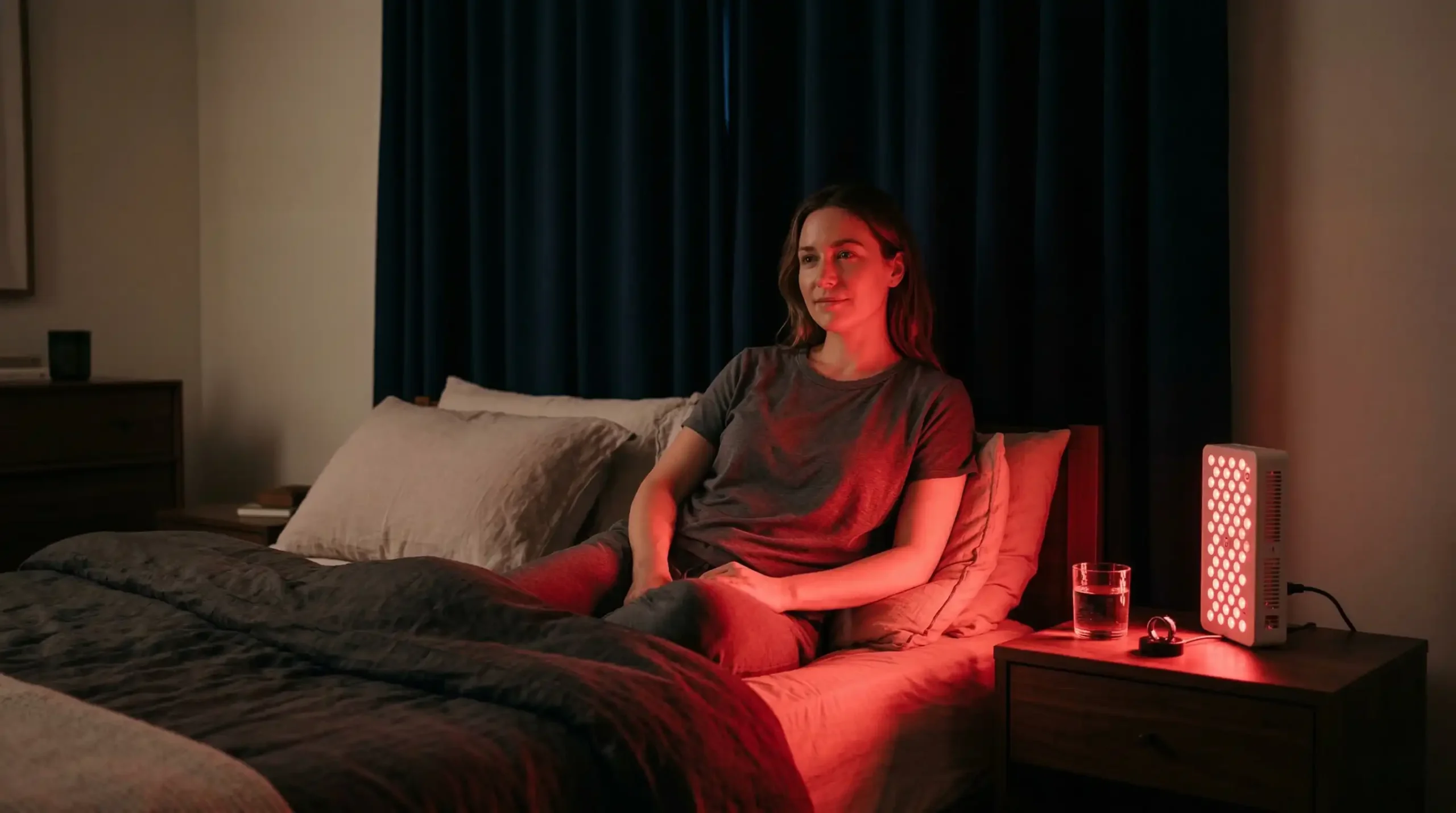
Protocol: 10–20 minutes in the 60–90 minute window before bed. Low-irradiance is fine here — you’re not trying to hit a therapeutic tissue dose, you’re working with your circadian biology.
What it won’t do: Override poor sleep hygiene, fix stress-driven insomnia, or replace the fundamentals. Red light in a bright, noisy room with a phone in your hand is still a bright, noisy room with a phone in your hand. It works as part of a stack — not as a standalone fix.
What it won’t do: Eliminate decades of UV damage in a month. Replace retinoids or sunscreen. Fix volume loss from fat redistribution. Red light works at the cellular level and produces real, measurable results — but it operates on biology’s timeline, not marketing’s.
Why this page exists separately from the Sleep Optimization hub: The mechanism here is different from general sleep hygiene. This is specifically about light biology — how wavelength affects the retinohypothalamic tract, the suprachiasmatic nucleus, and downstream melatonin production. That’s a photobiomodulation question as much as a sleep question, and the protocol looks different from everything else in the RLT cluster.
Understanding Red Light Therapy in Practice
Red light therapy is often discussed in theory, but its real-world application depends on measurable parameters like wavelength and exposure. I tested multiple RLT setups using a professional spectrometer to better understand how the therapy works in practice.
Open Red Light HubThe Light-Sleep Connection Most People Get Backwards
The conversation about light and sleep is almost entirely focused on what to avoid — blue light from screens, bright overhead lighting, LEDs after dark. This is correct and important. But it misses the second half of the equation: what kind of light actually supports sleep biology rather than disrupting it.
Your circadian rhythm is set primarily by light. Specifically, it’s set by light hitting intrinsically photosensitive retinal ganglion cells (ipRGCs) in your eyes, which feed directly into the suprachiasmatic nucleus (SCN) — your brain’s master clock. The SCN then signals the pineal gland to either suppress or produce melatonin based on what wavelengths it’s receiving.
Blue light (450–490nm) is the most potent suppressor. It directly activates melanopsin in the ipRGCs, which interprets it as daylight and suppresses melatonin production aggressively. A 2017 study from Harvard found that blue light suppresses melatonin for roughly twice as long as green light of the same intensity. Standard white LED bulbs, phone screens, and overhead office lighting are heavy in this range.
Red light (630–660nm) sits at the opposite end of the visible spectrum. Melanopsin has very low sensitivity to red wavelengths — meaning red light doesn’t trigger the same melatonin suppression signal. You can be in a red-lit environment in the evening and your pineal gland largely continues what it was doing.
This is the foundational reason red light therapy in the evening is compatible with sleep — and potentially supportive of it — while the same duration of white or blue light exposure would be actively harmful to your sleep onset.
What the Research Shows
The sleep-specific RLT research is smaller than the pain and inflammation literature, but the available studies are consistent and the mechanistic rationale is strong.
Key studies:
| Study | Population | Protocol | Key Finding |
|---|---|---|---|
| Zhao et al., J. Athletic Training (2012) | 20 female basketball athletes | 630nm, 30 min/night, 14 nights | Significantly improved sleep quality (PSQI scores), increased melatonin levels vs control |
| Tähkämö et al., Chronobiology International (2019) | Review of light exposure and circadian rhythm | Various | Red/long-wavelength light has minimal melanopsin activation — least disruptive to melatonin of visible wavelengths |
| Figueiro et al., Lighting Research & Technology (2011) | Healthy adults | Blue vs red evening exposure | Blue light suppressed melatonin 40–50%, red light showed no significant melatonin suppression |
| Zhao et al., Evidence-Based Complementary Medicine (2018) | Chronic insomnia patients | 650nm, 30 min, 8-week protocol | Improved sleep onset latency, total sleep time, and daytime fatigue vs control group |
The Zhao 2012 athlete study is the most cited in the RLT-sleep space, and it’s worth understanding what it actually measured: not just subjective sleep quality, but serum melatonin levels taken via blood draw. The RLT group showed measurably higher melatonin at bedtime compared to control — suggesting active support of melatonin production, not just absence of suppression.
The mechanism proposed for this active effect involves near-infrared penetration to the pineal gland through thin skull tissue — a theory that remains debated in the literature. What’s less debated is the absence of melatonin suppression, which alone gives red light a meaningful advantage over standard evening lighting environments.
Red Light vs Blue Light: What’s Actually Happening to Your Melatonin
Understanding this comparison is what makes the protocol make sense.
| Light Type | Wavelength | Melanopsin Activation | Melatonin Effect | Circadian Impact |
|---|---|---|---|---|
| Blue light (screens, LEDs) | 450–490nm | Very high | Strong suppression | Delays sleep phase, reduces total production |
| Green light | 510–550nm | Moderate | Moderate suppression | Some disruption |
| White light (mixed) | Broad spectrum | High (blue component) | Suppression | Disrupts evening wind-down |
| Red light | 630–660nm | Very low | Minimal to none | Compatible with sleep onset |
| Near-infrared | 850nm | None | No effect | Neutral |
| Darkness | — | Zero | Maximum production | Optimal |
The practical implication: replacing your evening lighting environment with red light sources — including using your RLT panel as ambient light — creates conditions that allow melatonin to rise naturally without competing with bright white or blue light suppression.
This is different from taking a melatonin supplement. Exogenous melatonin bypasses your own production system. Supporting your endogenous melatonin rhythm through light environment management maintains the full natural melatonin curve — including the precise timing that regulates not just sleep onset but sleep architecture, immune function overnight, and cortisol timing the following morning.
The Evening Protocol: How to Use Red Light for Sleep
Two Ways to Use RLT for Sleep — Different Goals, Different Protocols
Mode 1: Ambient replacement lighting Use your red light panel as the primary light source in your living space for the 60–90 minutes before bed. Low irradiance setting if available, or position it farther away than your therapeutic protocol distance. The goal isn’t tissue dosing — it’s replacing melatonin-suppressing white light with a spectrally compatible alternative.
Mode 2: Active photobiomodulation session A dedicated 10–20 minute RLT session in the evening window, at standard therapeutic distance (4–6 inches), primarily targeting the face, chest, or back. This delivers both the tissue-level anti-inflammatory and recovery benefits of standard RLT plus the circadian-compatible light environment during the session itself.
Most people combine both — an active session followed by continued red-light-only ambient lighting while they wind down.
Protocol Parameters
| Parameter | Ambient Mode | Active Session Mode |
|---|---|---|
| Wavelength | 630–660nm | 630–660nm primary |
| Irradiance | Low — distance 3–6 feet | Standard — 4–6 inches |
| Duration | 60–90 min pre-bed | 10–20 minutes |
| Timing | Start 90 min before target sleep time | 60–90 min before bed |
| Eye exposure | Indirect — don’t stare directly | Eyes closed or goggles |
| Goal | Replace white/blue light environment | Tissue benefits + circadian support |
Integrating Into an Evening Routine
This is where most sleep-focused protocols fall apart — not in the theory but in the execution. Here’s a sequence that works practically:
90 minutes before bed: Switch off overhead white lighting. Turn on red light panel or red-spectrum bulbs as ambient lighting. Begin wind-down activities — reading, low-stimulation conversation, light stretching.
75–60 minutes before bed: If doing an active RLT session, run it now. 10–20 minutes at standard distance. This is also when most people in the sleep optimization stack take their evening supplements — magnesium glycinate pairs particularly well with this window, supporting the nervous system relaxation that red light is simultaneously promoting through its circadian mechanism.
45–30 minutes before bed: Continue in red-light-only environment. No screens, or screens with aggressive warm-color filtering at minimum. If you’re using sleep tracking (Oura Ring, for example), this is the window where baseline HRV and temperature start shifting toward sleep preparation — your tracker data will show the difference after a few weeks of consistent evening protocol.
Bedtime: Darkness. Red light off. Room as dark as possible — even low red light is better than white light, but full darkness is the optimal signal for peak melatonin production.
How This Connects to the Broader Sleep Stack
Red light for sleep doesn’t exist in isolation. It’s most powerful as one component of a complete sleep environment and circadian protocol.
| Sleep Lever | Mechanism | Red Light Synergy |
|---|---|---|
| Light environment (RLT) | Melatonin protection, circadian signal | Primary focus of this article |
| Temperature (cool room, 65–68°F) | Core body temperature drop signals sleep onset | Compatible — RLT doesn’t raise core temp significantly |
| Darkness (blackout curtains) | Maximum melatonin production during sleep | Complementary — RLT in the pre-bed window, then full dark |
| Magnesium glycinate | GABA activation, muscle relaxation, melatonin cofactor | Stack in the same evening window |
| Sleep tracking | Measures actual sleep architecture, not just duration | Quantifies RLT protocol impact objectively |
| Consistent wake time | Anchors circadian rhythm via cortisol morning peak | RLT morning use supports this (different mechanism) |
The sleep optimization cluster covers each of these levers in detail. The point here is that red light works best when the surrounding environment supports the same circadian goal — you can’t out-light-therapy a bedroom full of blue light screens and irregular sleep timing.
Morning Red Light: A Different Mechanism Worth Knowing
Evening RLT and morning RLT do different things for sleep, and both have a role.
Morning use (within 30 minutes of waking): Supports cortisol awakening response — the natural cortisol peak that sets the circadian clock for the day. Bright light exposure in the morning advances your circadian phase, making evening melatonin onset earlier and sleep onset easier. Red light in the morning isn’t the primary tool for this (bright natural light or a daylight lamp is more effective for phase-setting), but it provides tissue-level anti-inflammatory and recovery benefits that complement morning routines.
Evening use (60–90 min pre-bed): The circadian application covered in this article. Melatonin protection and potential active support, plus anti-inflammatory recovery benefits from the session itself.
Using both creates a full-day circadian light support protocol — morning light advances the phase, evening red light protects melatonin onset. This is what consistent Oura Ring data shows after 3–4 weeks: improved HRV trends, reduced sleep onset latency, and in some cases increased deep sleep percentage. The how long does RLT take to work guide covers what realistic sleep metric improvements look like on a timeline.
Common Mistakes
Using RLT immediately before getting into bed. The circadian benefit is in the 60–90 minute pre-sleep window. Running a high-irradiance active session and then immediately lying down may actually cause a slight alerting effect from the light stimulation — give it 30–45 minutes between your active session and sleep.
Using high-irradiance settings for ambient lighting. When using your panel as ambient room lighting (not a targeted session), the goal is a spectrally compatible low-intensity environment. A 100 mW/cm² panel blasting at 6 inches in a bedroom is not the same as a comfortable red ambient light. Back it off significantly — 4–6 feet for ambient mode.
Keeping screens on during RLT session. Running a red light session while watching TV or scrolling a phone partially defeats the melatonin-protection purpose. The blue light from the screen continues to activate melanopsin regardless of what the RLT panel is doing. Treat the session as a screen-free wind-down.
Expecting sedation. Red light doesn’t make you drowsy the way an antihistamine does. It supports the conditions for your own melatonin to rise. If you’re running on high cortisol from a stressful day, one RLT session won’t override that. Consistent nightly use over 2–3 weeks is what shows in the sleep quality data — not one session.
Skipping the dosing fundamentals. Even for sleep use, the basics of wavelength and dose matter. A device that doesn’t actually output 660nm (verify with spectrometer or from a trusted source) isn’t providing the wavelength that the research used. The complete RLT guide covers how to evaluate what your device is actually delivering versus what the marketing claims.
Frequently Asked Questions
Can red light therapy help with insomnia?
It depends on the insomnia type. For sleep onset insomnia driven partly by light environment — evening screen exposure, bright artificial lighting, delayed circadian phase — red light therapy as part of an evening light protocol can meaningfully help. For insomnia driven primarily by anxiety, hyperarousal, or medical conditions, red light addresses the circadian component but not the root cause. It’s a useful adjunct, not a primary treatment for clinical insomnia.
How long before I notice better sleep?
The melatonin protection effect starts the first night — you’re not suppressing melatonin the way white light would. But subjective improvements in sleep quality, sleep onset time, and morning readiness typically show up after 1–2 weeks of consistent evening protocol. Measurable HRV and deep sleep percentage improvements on wearables tend to appear at the 3–4 week mark. Consistency of timing matters as much as consistency of sessions.
Does near-infrared (850nm) also help sleep?
850nm doesn’t suppress melatonin — that’s the important negative. But the positive circadian support evidence is primarily for visible red (630–660nm). If your device outputs both, evening use is still fine. The tissue-level recovery benefits of 850nm (anti-inflammatory, muscle recovery) are genuinely useful for sleep quality — better recovered tissue means lower baseline inflammation and more favorable sleep architecture. Just don’t expect the same direct circadian signal from NIR that you get from visible red.
Should I use red light before or after my evening walk?
Either works, but after is slightly preferable. Exercise in the evening raises core temperature, which then needs to drop for sleep onset. RLT after your walk — during the natural cool-down period — aligns with that temperature trajectory rather than adding heat input at the wrong moment. Then continue the red-light ambient environment through the rest of your wind-down.
Can I use red light therapy if I take melatonin supplements?
Yes, no interaction. They work through different mechanisms. If anything, supporting your light environment alongside exogenous melatonin improves conditions for sleep — the supplement raises melatonin levels, while the light environment prevents it from being suppressed immediately by subsequent light exposure.
🔴 The Device for Evening Use
Valo Spark — Compact Enough for Bedroom Protocol
A large wall-mounted panel in a bedroom creates a clinical atmosphere that works against the wind-down goal. For evening sleep-focused use, a compact device that you can position comfortably on a nightstand or small stand — close enough for an active session, then backed off for ambient red light — fits the protocol better.
The Valo Spark is what I use in the evening window: small footprint, sufficient irradiance for a proper 10–15 minute active session, and manageable enough to reposition for ambient use in the same session. Battery-powered means no light from charging cables or adapters to manage.
Internal Links
- Red Light Therapy: The Definitive Guide (2026)
- 660nm vs 850nm — Which Wavelength Do You Actually Need?
- The Simple Dosing Guide (No Math Required)
- How Long Does Red Light Therapy Take to Work?
- 7 Red Light Therapy Mistakes Killing Your Results
- Red Light Therapy Through Clothes: Does It Work?
- Red Light Therapy for Inflammation: Protocol & Evidence
- Red Light Therapy & Sauna — How to Combine Them Safely
- Sleep Optimization Hub
- Valo Spark Review — Best Portable RLT Device
Sources
- Zhao J. et al. — Journal of Athletic Training, 2012. RCT: 630nm red light, 14 nights in female athletes — improved PSQI sleep scores and measurably higher serum melatonin vs control.
- Tähkämö L. et al. — Chronobiology International, 2019. Review: red and long-wavelength light shows minimal melanopsin activation — least circadian-disruptive of visible wavelengths.
- Figueiro M.G. et al. — Lighting Research & Technology, 2011. Blue light suppressed melatonin 40–50% vs red light showing no significant suppression in healthy adults.
- Zhao J. et al. — Evidence-Based Complementary and Alternative Medicine, 2018. 650nm, 8-week protocol in chronic insomnia patients: improved sleep onset latency, total sleep time, and daytime fatigue.