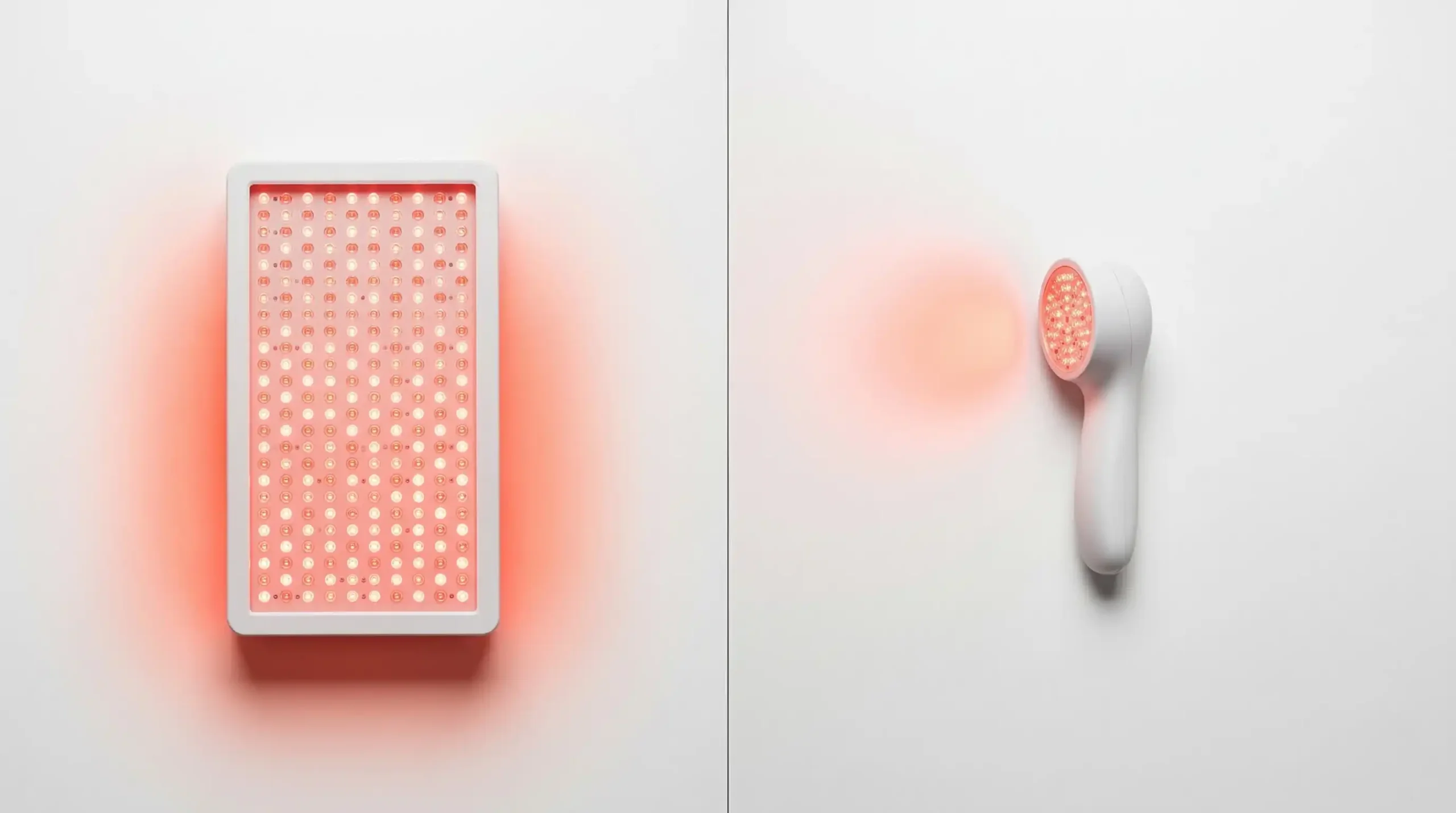
Panel or handheld — which is better? Neither is universally better. They’re built for different use cases, and choosing the wrong format for your goals is one of the more expensive mistakes in RLT. A panel optimized for full-body coverage does targeted knee treatment awkwardly. A handheld optimized for targeted treatment can’t efficiently cover a full back in one position.
Choose a panel if: Your primary goals involve full-body coverage — systemic recovery, large muscle groups, full back treatment, skin across multiple body zones simultaneously.
Choose a handheld if: Your goals are targeted — a specific joint, a facial protocol, travel use, or you want flexibility to treat different areas precisely without repositioning a large device.
The real question nobody asks:What will you actually use consistently for 8–12 weeks? The best device is the one that fits your routine. A panel collecting dust in a corner because setup is annoying beats a handheld you use daily by exactly zero.
On specs: Both formats can output therapeutic wavelengths and irradiance. The differences are coverage area, power output ceiling, price, and portability — not whether the underlying photobiomodulation is real. Both work when specs are right.
Understanding Red Light Therapy in Practice
Red light therapy is often discussed in theory, but its real-world application depends on measurable parameters like wavelength and exposure. I tested multiple RLT setups using a professional spectrometer to better understand how the therapy works in practice.
Open Red Light HubWhy Format Matters More Than Most Buyers Realize
Most RLT buying guides lead with brand comparisons and price tiers. Format — panel versus handheld — is the more fundamental decision, because it determines what’s physically possible with your device before you’ve even looked at specs.
A 1000W panel at 6 inches covers your entire back simultaneously and delivers a uniform irradiance dose across the full treatment zone in one 15-minute session. A handheld covering the same area requires you to move through multiple positions, either extending session time significantly or accepting uneven dosing across zones.
Conversely, a large panel trying to do targeted SI joint treatment requires awkward positioning — lying down while a full panel hovers over a specific lumbar zone isn’t impossible, but it’s less precise and less comfortable than a compact device designed for exactly that application.
This isn’t a minor ergonomic point. The dose-response relationship in photobiomodulation is real — if your format makes consistent positioning at correct distance difficult, you’re introducing variability into your dose that undermines the protocol over weeks.
Full Comparison: Panel vs Handheld
Technical Comparison
| Factor | Panel | Handheld / Compact |
|---|---|---|
| Coverage area | Large — full body zones in one position | Small — targeted area only |
| Total power output | High — 300W–1500W+ | Low-moderate — 30W–150W |
| Irradiance at 6 inches | 80–200+ mW/cm² | 40–120 mW/cm² |
| Session efficiency | High for large areas | High for targeted areas |
| Positioning flexibility | Low — needs stand, fixed setup | High — hand-held, any angle |
| Travel use | Not practical | Designed for it |
| Power source | Mains power only | Battery or mains |
| Footprint | Significant | Minimal |
| Price range | $300–2,000+ | $150–500 |
| EMF output | Higher at close range | Lower absolute output |
| Setup time | 1–2 minutes | Zero |
Use Case Comparison
| Use Case | Panel | Handheld | Notes |
|---|---|---|---|
| Full back treatment | ✅ Optimal | ⚠️ Multiple positions needed | Panel covers L1–S1 in one position |
| Knee or joint | ⚠️ Awkward positioning | ✅ Optimal | Handheld positions precisely |
| Facial anti-aging | ⚠️ Works, requires stand | ✅ Good (or use a mask) | Face mask better than either for face |
| Shoulder treatment | ⚠️ Requires creative setup | ✅ Optimal | Handheld reaches any angle |
| Post-workout full body | ✅ Optimal | ⚠️ Time-consuming | Panel covers multiple zones faster |
| Travel protocol | ❌ Not portable | ✅ TSA-approved options exist | Handheld only for travel |
| SI joint / sacrum | ⚠️ Usable lying down | ✅ Precise positioning | Handheld better for accuracy |
| Desk use (face/chest) | ✅ Panel on stand works well | ✅ Also works | Both viable |
| Hair growth scalp | ❌ Impractical | ✅ Designed for this | Handheld only realistic option |
The Coverage Area Problem: Why It’s Not Just About Power
The most common mistake in this comparison is treating total wattage as the primary metric. A 500W panel and a 60W handheld are doing different jobs — comparing their wattages directly misses the point.
What matters is irradiance at treatment distance (mW/cm²) and total coverage area per session.
Here’s the practical math:
A panel delivering 100 mW/cm² across a 900 cm² treatment zone deposits significantly more total energy per session than a handheld delivering 100 mW/cm² across an 80 cm² zone — even if irradiance per unit area is identical. For full-body protocols, this means panel users complete sessions that would take handhelds 3–4x longer to match in total energy delivered.
But for targeted treatment of a 10cm × 10cm knee area, a handheld delivering 100 mW/cm² at 4 inches and a panel doing the same are equivalent in dose delivery to that specific zone. The panel’s extra coverage area is irrelevant — you’re treating one joint, not a full leg.
This is why the format decision should start with treatment area, not power specs.
Device Quality Within Each Format: What to Verify
Whether you choose panel or handheld, the same device quality checks apply. The ultimate guide to RLT covers this in full, but the key verification points:
Wavelength accuracy: Does the device actually output 660nm and 850nm? Marketing claims and actual spectral output don’t always match. Third-party spectrometer verification or published lab testing data from the manufacturer is the standard to look for.
Irradiance at stated distance: Claimed mW/cm² and measured mW/cm² are frequently different. For handhelds especially, where total power is lower, irradiance at your actual treatment distance matters enormously. A handheld claiming 100 mW/cm² at 2 inches might deliver 25 mW/cm² at 6 inches — well below therapeutic threshold.
Flicker rate: High-flicker devices cause eye strain and may interfere with cellular response. This is harder to verify without equipment, but established brands publish flicker data.
EMF levels: At close range, higher-powered panels produce measurable EMF. Handhelds have lower absolute EMF output due to lower total power. Neither is at dangerous levels in standard use, but worth knowing if you’re EMF-sensitive.
The dosing guide explains how to calculate whether your specific device — panel or handheld — is delivering a therapeutic dose at your treatment distance, regardless of what the marketing claims.
Protocol Differences by Format
The underlying photobiomodulation parameters — target dose in J/cm², wavelengths, treatment frequency — are the same regardless of format. What changes is how you achieve them.
Panel Protocol Adjustments
Optimal distance: 6–12 inches for most panels. At 6 inches you’re in the high-irradiance zone — shorter sessions needed. At 12 inches you’re getting lower irradiance — longer sessions or accept lower total dose. The dosing guide has the inverse square law math laid out without the algebra.
Positioning: Panels work best on a stand. Holding a 300W+ panel for 15 minutes is impractical — invest in an adjustable stand if your panel doesn’t include one.
Multi-zone sessions: Front body first (15–20 min), then turn around for back (15–20 min). Many panel users build this into a morning routine — front during coffee, back during reading. Total time 30–40 minutes but active effort is minimal.
Clothing: Always bare skin. The through clothes breakdown shows 50–90% dose loss through fabric. With a panel producing 150 mW/cm² at 6 inches, a thin shirt drops you to 60–75 mW/cm² — still therapeutic but meaningfully reduced. With a handheld producing 60 mW/cm², the same shirt drops you below therapeutic threshold entirely.
Handheld Protocol Adjustments
Distance precision: Handhelds require you to hold the device at consistent distance throughout the session — harder than it sounds for 15 minutes. A table stand or prop keeps distance consistent without arm fatigue.
Targeted positioning: The advantage of handheld precision only materializes if you’re using it correctly. For knee treatment, the device should be positioned to cover the full joint — front, sides, and back of knee in sequence — not just the most painful point.
Movement between zones: For multi-zone treatment with a handheld, factor in 2–3 minutes per zone transition. A full back protocol with a handheld (lower lumbar → upper lumbar → thoracic) takes 45–55 minutes versus a panel’s 15–20 minutes for the same coverage.
Battery-powered handhelds: Check actual battery life versus claimed life at full power output. Many portable devices claim 6-hour battery at partial power — full therapeutic irradiance may give you 2–3 hours. Enough for daily sessions, but confirm before buying.
Who Should Buy a Panel
You’re doing full-body or large-area protocols. Back pain across multiple vertebral levels, full leg recovery, systemic anti-inflammatory protocol, chest and torso — panel coverage efficiency is the primary tool here.
You have a dedicated home space for it. A panel on a stand in a spare room or home gym is seamlessly integrated into a daily routine. A panel that needs to be assembled and stored each session creates friction that reduces consistency.
Recovery and performance are primary goals. Athletes doing daily recovery protocols typically need large-area coverage — full back, both legs, shoulders — in time-efficient sessions. Panels are built for this.
You’re treating sleep and circadian rhythm. Using RLT as ambient evening lighting works best with a panel that fills a meaningful portion of a room. A handheld as ambient lighting is impractical. Read the sleep protocol for how this works.
Who Should Buy a Handheld
Your goals are targeted. One joint, one area of chronic pain, a specific scar, scalp treatment for hair growth — these are precision applications where handheld format is more effective than a panel.
You travel regularly. A TSA-approved compact device that fits in a carry-on means your protocol continues whether you’re home or on the road. A panel is a stationary investment.
You want to try RLT before committing to a panel. Handhelds represent a lower financial entry point. Starting with a handheld and a specific target area lets you validate the protocol works for you before investing in full-panel infrastructure.
You want facial and targeted body use. If anti-aging and one or two specific body targets are your complete use case, a quality handheld covers both without the footprint and cost of a panel. For facial use specifically, a dedicated face mask covers that zone better than either — but for someone who wants face plus shoulder plus knee in one device, a handheld is more versatile than a panel.
Apartment or small living space. A full panel setup requires space. A handheld lives in a drawer and comes out when needed.
The Case for Having Both
For people serious about comprehensive RLT protocols, panel plus compact handheld is the optimal combination — not because either is insufficient alone, but because they complement each other for different parts of a protocol.
Panel in the morning for full back and chest (15–20 min standing). Handheld in the evening for targeted knee or shoulder (10–15 min while reading). Face mask for facial protocol (10 min hands-free while doing other things).
This isn’t necessary for most people starting out. But for athletes, biohackers running comprehensive protocols, or anyone treating multiple distinct conditions simultaneously, the format specialization of each device type serves different needs in the same day.
Frequently Asked Questions
Can a handheld device deliver the same results as a panel for targeted areas?
Yes — if irradiance specs are adequate and treatment distance is consistent, a handheld delivering 80–100 mW/cm² at 4–6 inches to a knee joint produces the same photobiomodulation response as a panel doing the same. The difference is coverage area and session efficiency for large zones, not the quality of the underlying therapeutic response for targeted application.
Are panels always more powerful than handhelds?
In terms of total wattage and total coverage, yes. In terms of irradiance at the treatment point (mW/cm²), not necessarily — a well-engineered handheld can match or exceed the irradiance per unit area of a larger panel at close range. What panels have is power across a larger area simultaneously.
Is a face mask better than a panel or handheld for facial use?
For dedicated facial anti-aging protocol, yes — a quality face mask maintains consistent 0–1 inch distance across all facial zones simultaneously, hands-free. Panels and handhelds require manual distance management and sequential zone coverage for the face. See the full breakdown in the face protocol guide and Valo Glow review.
How do I know if a handheld’s irradiance is adequate?
Ask for or look up third-party irradiance measurements at your target treatment distance (typically 4–6 inches). The minimum therapeutic threshold for most applications is 40–50 mW/cm² at treatment distance. Below this, session times extend significantly and efficacy drops. The dosing guide walks through the calculation.
Does a panel’s higher EMF matter?
At standard therapeutic distances (6+ inches) and standard session durations (15–20 min), measured EMF from consumer panels is well within established safety limits. If you’re EMF-sensitive or prefer to minimize exposure, handhelds produce lower absolute EMF due to lower total power. Practically, the difference is small at therapeutic distances — EMF drops rapidly with distance the same way irradiance does.
🔴 Our Pick for Targeted Treatment
Valo Spark — Built for Precision Where Panels Fall Short
For targeted joint pain, travel protocols, and precise area treatment, the Valo Spark is what I reach for when a full panel is either impractical or too broad for the application.
Compact enough to position over a knee, an SI joint, or a shoulder at correct therapeutic distance. TSA-approved for travel. Verified 660nm and 850nm at therapeutic irradiance confirmed with spectrometer. Six-hour battery at therapeutic output means a full week of daily sessions on one charge.
If your protocol involves specific targeted areas — or you want to start with RLT before committing to a full panel setup — this is the device that covers the use case panels don’t.
→ Read the Full Valo Spark Review
Internal Links
- Red Light Therapy: The Definitive Guide (2026)
- The Simple Dosing Guide (No Math Required)
- Red Light Therapy Through Clothes: Does It Work?
- 660nm vs 850nm — Which Wavelength Do You Actually Need?
- Red Light Therapy for Face: Anti-Aging Protocol
- Red Light Therapy for Inflammation: Protocol & Evidence
- Red Light Therapy for Back Pain: Protocol & Evidence
- Red Light Therapy for Sleep: Evidence & Evening Protocol
- Valo Glow Face Mask Review: Worth $300?
- Valo Spark Review — Best Portable RLT Device
Sources
- Hamblin M.R. — Photobiomodulation, Photomedicine, and Laser Surgery, 2018. Device parameters and dose-response relationships in photobiomodulation — irradiance, coverage area, and therapeutic thresholds.
- Jenkins P.A., Carroll J.D. — Photomedicine and Laser Surgery, 2011. Irradiance and dose delivery in low-level laser therapy: distance, power density, and clinical outcome correlation.
- Enwemeka C.S. — Photomedicine and Laser Surgery, 2009. Therapeutic efficacy of visible and near-infrared wavelengths: parameters that determine outcome in photobiomodulation.

1 thought on “Red Light Therapy Panel vs Handheld Device: Which One Do You Actually Need? (2026)”