Does it work for neck and shoulder pain? Yes — near-infrared light (850nm) reaches the depth of cervical muscles, trapezius, and shoulder joint tissue, with multiple RCTs showing 40–60% pain reduction after 4–6 weeks of consistent treatment.
Best wavelength: 850nm for deep muscle and joint targets. 660nm as secondary for surface inflammation and post-injury tissue repair. Dual-wavelength is optimal.
Protocol: 10–15 minutes per zone, device 4–6 inches from skin, 5x per week, minimum 4 weeks. Neck and shoulder typically need separate positioning — treat each zone sequentially.
Timeline: Reduced muscle tension in 1–2 weeks, meaningful pain reduction in 3–5 weeks, optimal results at 8–10 weeks.
Why neck and shoulder specifically respond well: The target tissue — cervical muscles, trapezius, levator scapulae, rotator cuff tendons — sits at 15–35mm below skin. That’s squarely within 850nm penetration range at adequate irradiance. Unlike lumbar treatment where device positioning requires lying down, neck and shoulder treatment works sitting upright — which makes daily protocol compliance significantly easier. That consistency advantage shows in results.
Understanding Red Light Therapy in Practice
Red light therapy is often discussed in theory, but its real-world application depends on measurable parameters like wavelength and exposure. I tested multiple RLT setups using a professional spectrometer to better understand how the therapy works in practice.
Open Red Light HubWhy Neck and Shoulder Pain Is Structurally Different From Back Pain
Most people with neck and shoulder pain are dealing with a combination of issues that overlap in ways that complicate treatment. Understanding which structures are involved changes both the wavelength priority and the device positioning.
Upper trapezius and levator scapulae: The muscles that run from the base of your skull to the top of your shoulder blade. Chronically overloaded in anyone who sits at a desk, drives long distances, or carries stress as physical tension. These sit 10–25mm below the skin surface — well within 850nm range. This is the most common neck/shoulder pain source and the strongest responder to photobiomodulation.
Cervical facet joints: Small joints between cervical vertebrae that become inflamed with poor posture, repetitive loading, or whiplash history. Located 25–40mm deep. Require high-irradiance 850nm at close distance to reach adequately.
Rotator cuff tendons: Four tendons stabilizing the shoulder joint — supraspinatus, infraspinatus, teres minor, subscapularis. Tendinopathy here is extremely common in athletes and anyone doing overhead work. Sits at varying depths depending on the specific tendon. Supraspinatus is the most commonly affected and responds well to NIR protocols.
Shoulder joint (glenohumeral): The ball-and-socket joint itself. Deeper target — 30–50mm depending on body composition. 850nm at 4 inches is needed to reach joint tissue meaningfully.
Cervical nerve roots: If your neck pain radiates into the arm, you’re dealing with nerve involvement. RLT shows evidence for peripheral nerve repair, but this is slower and less predictable than muscle and tendon responses. Set expectations accordingly.
Knowing which category your pain falls into determines where you position the device and what timeline to expect. Muscle-dominant pain responds fastest. Joint and nerve involvement takes longer.
The Research: What Clinical Studies Show
Neck pain is one of the most well-studied applications in the photobiomodulation literature — partly because it’s extremely common and partly because the tissue depth makes it an accessible target for NIR wavelengths.
Research overview:
| Study | Design | Wavelength | Duration | Key Result |
|---|---|---|---|---|
| Chow et al., The Lancet (2009) | Meta-analysis, 820 patients | 780–860nm | 4–8 weeks | 70% pain reduction at 22-week follow-up vs sham |
| Gur et al., Photomedicine & Laser Surgery (2004) | RCT, chronic neck pain | 904nm | 2 weeks / 10 sessions | Significant pain and disability reduction vs placebo |
| Altan et al., Rheumatology International (2005) | RCT, myofascial neck pain | 904nm | 3 weeks | Reduced tender point count and improved cervical ROM |
| Bjordal et al., Physical Therapy Reviews (2010) | Systematic review | 780–860nm | Various | Consistent evidence for neck pain, strongest for muscle-dominant presentations |
The Chow et al. 2009 meta-analysis in The Lancet is the most cited reference for photobiomodulation in neck pain — 820 patients across multiple RCTs, 70% pain reduction at 22-week follow-up. That effect size and duration of benefit are what distinguish RLT from pain management that only works while you’re doing it.
For shoulder specifically — rotator cuff tendinopathy — a 2014 systematic review in the Journal of Shoulder and Elbow Surgery found consistent evidence for pain reduction and improved function with NIR photobiomodulation across six RCTs, with the strongest effects in non-surgical tendinopathy.
The mechanism is the same as all photobiomodulation applications: 850nm absorbed by cytochrome c oxidase, increased ATP production, downstream anti-inflammatory cytokine modulation (TNF-α, IL-1β, IL-6), improved microcirculation via nitric oxide release. For tendons specifically, photobiomodulation also stimulates tenocyte activity — the cells that synthesize and maintain tendon matrix — which is particularly relevant for tendinopathy where collagen degradation exceeds repair.
Protocol: Exactly How to Treat Neck and Shoulder Pain
Device Requirements
Same core requirements as all deep tissue RLT applications:
- 850nm must be present — 660nm penetrates 8–10mm, your target tissue is at 15–40mm
- Irradiance at 6 inches: 50 mW/cm² minimum, 80–100 mW/cm² optimal
- Format: Handheld or compact panel works better than a large wall panel for neck and shoulder — you need precise positioning at close range for different zones, which is awkward with a large fixed panel
The panel vs handheld guide covers this in full. For targeted neck and shoulder treatment specifically, a compact device that you can position at different angles without repositioning a stand is significantly more practical than a large panel.
Session Parameters
| Parameter | Acute Pain (< 4 weeks) | Chronic Pain (> 3 months) |
|---|---|---|
| Primary wavelength | 850nm NIR | 850nm NIR + 660nm combo |
| Distance | 4–6 inches | 4–6 inches |
| Session time per zone | 10–12 min | 12–15 min |
| Frequency | Daily for 2 weeks, reassess | 5x per week, 4–6 weeks minimum |
| Target dose | 10–20 J/cm² | 20–35 J/cm² |
| Zones per session | 1–2 | 2–3 |
Positioning by Zone
This is the section that makes or breaks neck and shoulder protocols. Most guides ignore it.
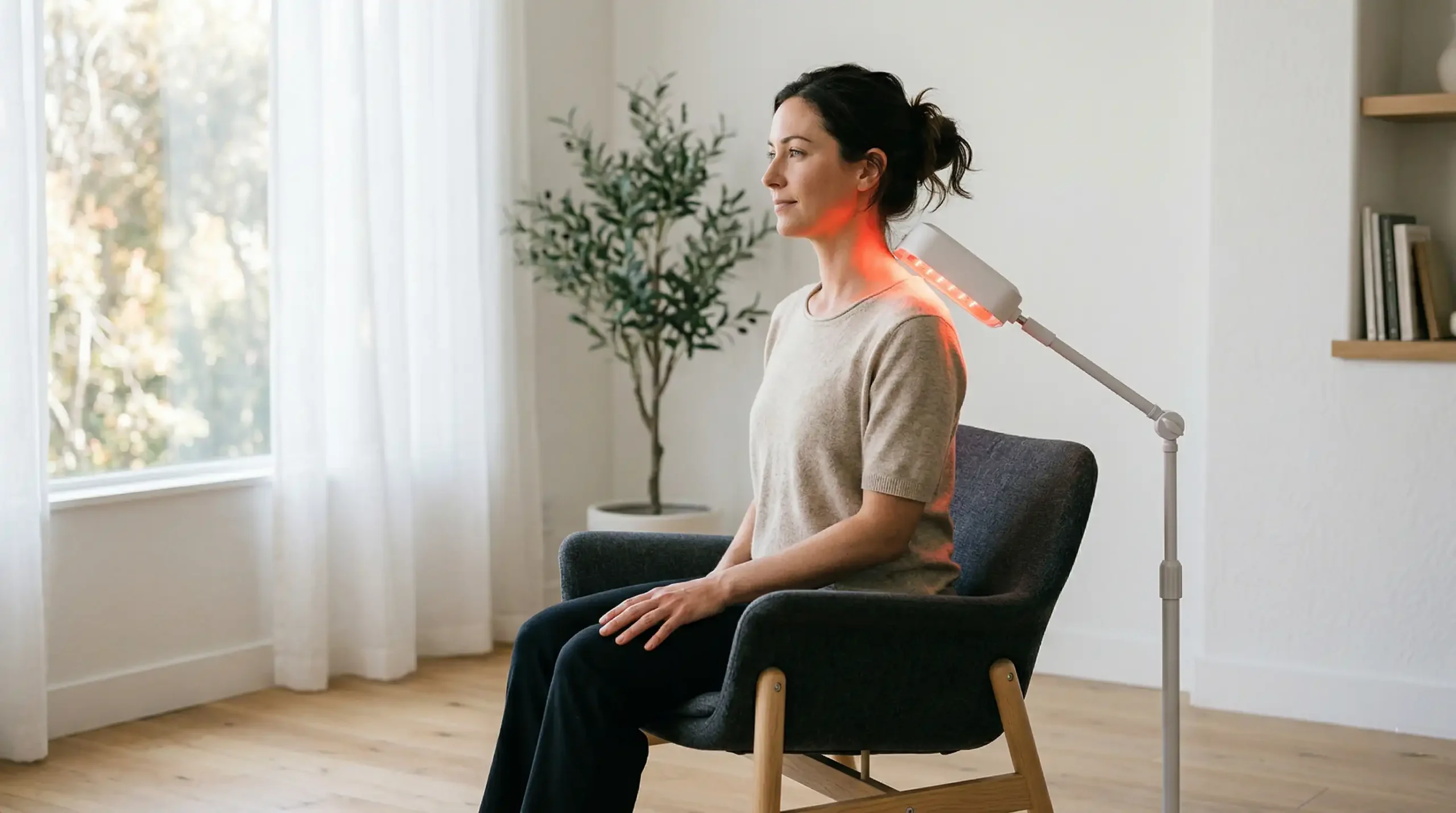
Upper trapezius (most common pain source): Sit upright. Device positioned 4–6 inches from the back of the neck and upper shoulder area, angled slightly downward. Cover the trapezius ridge from neck base to shoulder top. 12–15 minutes. This can be done sitting at a desk — the most sustainable setup for daily use.
Cervical spine (neck joints): Device positioned directly behind the neck, 4–6 inches, targeting C4–C7. Sitting or standing. Keep head in neutral position — don’t flex or extend the neck during treatment, which changes distance from the device inconsistently. 10–12 minutes.
Rotator cuff / shoulder joint: This is the most technically demanding positioning. The shoulder joint has four quadrants — anterior (front), posterior (back), superior (top), and lateral (side). For supraspinatus tendinopathy (top of shoulder): device aimed down at the top of the shoulder from 4–5 inches. For posterior rotator cuff: device positioned behind the shoulder from behind. 10–12 minutes per quadrant for acute issues, 8–10 minutes for maintenance.
Full neck and shoulder session (comprehensive protocol):
| Order | Zone | Time | Position |
|---|---|---|---|
| 1 | Upper trapezius | 12–15 min | Sitting, device behind/above shoulder |
| 2 | Cervical spine | 10–12 min | Sitting, device directly behind neck |
| 3 | Shoulder joint (primary pain quadrant) | 10–12 min | Adjust angle to affected zone |
| Total | 32–39 min |
For most people, treating the upper trapezius and one shoulder zone per session is more sustainable than running all three zones daily. Rotate focus based on where pain is most acute.
The Clothing Problem
The neck and shoulder area is particularly prone to the clothing mistake — people treat through shirt collars, bra straps, or undershirts without thinking about it. Fabric blocks 50–90% of 850nm depending on material and layer count.
Pull clothing down or remove it entirely for the treatment zone. Even a thin shirt collar over the cervical treatment area cuts your dose significantly. The through clothes guide has the transmission data by fabric type if you want the exact numbers.
Realistic Timeline
| Period | What to Expect |
|---|---|
| Days 1–7 | Minimal conscious change. Some people notice slightly easier head rotation or reduced morning stiffness by day 5–7. Most notice nothing yet. |
| Weeks 2–3 | Muscle tension reduction becomes noticeable. The constant “locked up” feeling in the trapezius starts easing. Active range of motion improves slightly. |
| Weeks 3–5 | Primary response window for muscle-dominant pain. 40–50% reduction in resting pain typical. Trigger points less sensitive. Fewer pain episodes per week. |
| Weeks 5–8 | Continued improvement. Rotator cuff tendinopathy typically shows meaningful improvement here — tendons are slower than muscle due to lower vascularity. |
| Weeks 8–12 | Approaching plateau for current protocol. If rotator cuff is involved, this is where structural tendon remodeling begins to produce lasting functional improvement. |
| After stopping | Benefits persist 4–8 weeks typically. Recurrence is common without addressing root causes — posture, desk setup, shoulder strengthening. |
Stacking With Other Interventions
Heat before session: Warm compress or heat pad on the neck and shoulder for 5–10 minutes before RLT. Increases local tissue temperature and blood flow, improving light penetration and priming the anti-inflammatory cascade. Particularly useful for chronically tight trapezius where blood flow is already compromised.
Cervical traction or stretching after session: The reduction in pain and muscle tension from RLT creates a window where manual techniques and stretching are more effective. Don’t stretch before — use the post-session window. Gentle cervical retraction, corner chest stretches for anterior shoulder capsule, and doorframe stretches for rotator cuff work well in this window.
Ergonomic correction: RLT reduces the inflammatory burden but doesn’t fix the postural loading that caused the problem. Monitor position, keyboard height, and head-forward posture at the desk. Without this, you’re treating a problem you’re continuously recreating.
RLT and sauna combination: For chronic neck and shoulder tension with significant muscle guarding component, the sauna and RLT stacking protocol works well — sauna first to drive heat into the tissue, RLT immediately after while circulation is elevated. Timing and sequencing details in that guide.
Common Mistakes
Treating only the painful spot, not the full muscle. Trapezius pain typically refers from trigger points that aren’t exactly where the pain is felt. Treat the full trapezius ridge — from neck base to shoulder top — not just the acutest point.
Wrong wavelength for depth. 660nm for trapezius and cervical joints is a common device mismatch. The 660nm vs 850nm guide covers penetration depth with tissue composition context. For anything deeper than superficial skin inflammation in this area, 850nm is the required wavelength.
Inconsistent distance. Holding a handheld device at varying distances across a 12-minute session is harder than it sounds — arm fatigue causes drift. Prop the device on a stack of books, a small stand, or a towel to maintain consistent 4–6 inch distance without holding it throughout.
Too many zones per session, undertreating each. Three zones at 6 minutes each is less effective than two zones at 12 minutes each. Adequate dose per zone beats broad coverage at sub-therapeutic dose. The dosing guide explains the J/cm² math.
Stopping at first improvement. Neck and shoulder pain commonly improves at week 2–3 and people stop. Then it returns within 2–4 weeks because the underlying inflammatory cycle wasn’t fully resolved. The research endpoints are at 4–6 weeks minimum — hit them.
Treating through clothing. Detailed above and in the through clothes breakdown. Always bare skin for the treatment zone.
Frequently Asked Questions
Can red light therapy help with tech neck?
Yes — tech neck is fundamentally a postural overload syndrome creating chronic cervical muscle tension and early facet joint inflammation. The upper trapezius, levator scapulae, and posterior cervical muscles are exactly the tissue types that respond well to NIR photobiomodulation. RLT reduces the inflammatory component and muscle tension, but the postural driver needs to be addressed simultaneously. Treating tech neck with RLT while continuing 8-hour forward-head posture at a screen is like bailing a boat while the hole stays open.
How is this different from a TENS unit or massage gun for neck pain?
Different mechanisms entirely. TENS (transcutaneous electrical nerve stimulation) works by interrupting pain signals — it’s analgesic, not anti-inflammatory or tissue-repairing. A massage gun mechanically breaks up adhesions and increases local circulation. Red light therapy works at the mitochondrial level — reducing cytokine signaling, increasing cellular energy production, stimulating tissue repair. None of these are mutually exclusive. Many people use all three in different contexts. RLT is the only one with evidence for actual tissue repair rather than temporary pain modulation.
My shoulder pain is from a rotator cuff tear. Will RLT help?
Partial tears with surrounding inflammation: yes, meaningful benefit. The anti-inflammatory effect reduces pain and the tenocyte stimulation may support partial healing. Full tears requiring surgical repair: RLT can help with pre and post-surgical inflammation management, but it doesn’t regenerate fully torn tissue. If imaging has confirmed a complete tear, RLT is a useful adjunct to treatment — not a replacement for appropriate medical management.
How long should I treat each zone per session?
For chronic pain, 12–15 minutes per zone at 4–6 inches from a device outputting 80–100 mW/cm². For acute pain, 10–12 minutes. Don’t exceed 20 minutes per zone per session — the biphasic dose-response means more than this can produce diminishing or neutral returns. Consistent adequate dose beats sporadic excessive dose every time. The ultimate guide has the full dose-response explanation.
Can I use it on my neck every day?
Yes for the first 4–6 weeks. Daily treatment during the initial phase allows the cumulative anti-inflammatory effect to build without gaps that allow the inflammatory cycle to reset. After 6 weeks, dropping to 4–5x per week for maintenance is sufficient for most people. Daily use long-term is fine but not meaningfully better than 5x per week once you’re past the initial treatment phase.
🔴 The Right Device for Neck & Shoulder Treatment
Valo Spark — Precision Positioning Where Large Panels Can’t Go
Neck and shoulder treatment requires a device you can angle precisely at cervical targets, hold comfortably behind your neck, and reposition between zones without adjusting a large stand setup.
A full wall panel works well for back and full-body protocols. For the precision angles that neck and shoulder treatment demands — especially rotator cuff quadrant work and cervical spine targeting — a compact high-irradiance device that you can move freely between positions is what the protocol actually requires.
The Valo Spark outputs verified 850nm at therapeutic irradiance, compact enough to position at any angle, with enough battery life to run a complete multi-zone session without interruption.
→ Read the Full Valo Spark Review
Internal Links
- Red Light Therapy: The Definitive Guide (2026)
- 660nm vs 850nm — Which Wavelength Do You Actually Need?
- The Simple Dosing Guide (No Math Required)
- Red Light Therapy Through Clothes: Does It Work?
- Red Light Therapy for Back Pain: Protocol & Evidence
- Red Light Therapy for Inflammation: Protocol & Evidence
- Red Light Therapy for Knee Pain: Protocol & Evidence
- Red Light Therapy & Sauna — How to Combine Them Safely
- Red Light Therapy Panel vs Handheld: Which to Buy?
- How Long Does Red Light Therapy Take to Work?
- Valo Spark Review — Best Portable RLT Device
Sources
- Chow R.T. et al. — The Lancet, 2009. Meta-analysis, 820 patients: photobiomodulation for neck pain — 70% pain reduction at 22-week follow-up vs sham.
- Gur A. et al. — Photomedicine and Laser Surgery, 2004. RCT: chronic neck pain, 904nm, 10 sessions — significant pain and disability reduction vs placebo.
- Altan L. et al. — Rheumatology International, 2005. RCT: myofascial neck pain, reduced tender point count and improved cervical range of motion.
- Haslerud S. et al. — Journal of Shoulder and Elbow Surgery, 2014. Systematic review: NIR photobiomodulation for rotator cuff tendinopathy — consistent pain reduction and improved function across 6 RCTs.