Is red light therapy safe for eyes? Generally yes — red and near-infrared light at therapeutic doses is non-ionizing and doesn’t damage the cornea, lens, or retina the way UV light does. But “generally safe” requires some conditions: correct distance, not staring directly into LEDs, and understanding where the actual risk thresholds are.
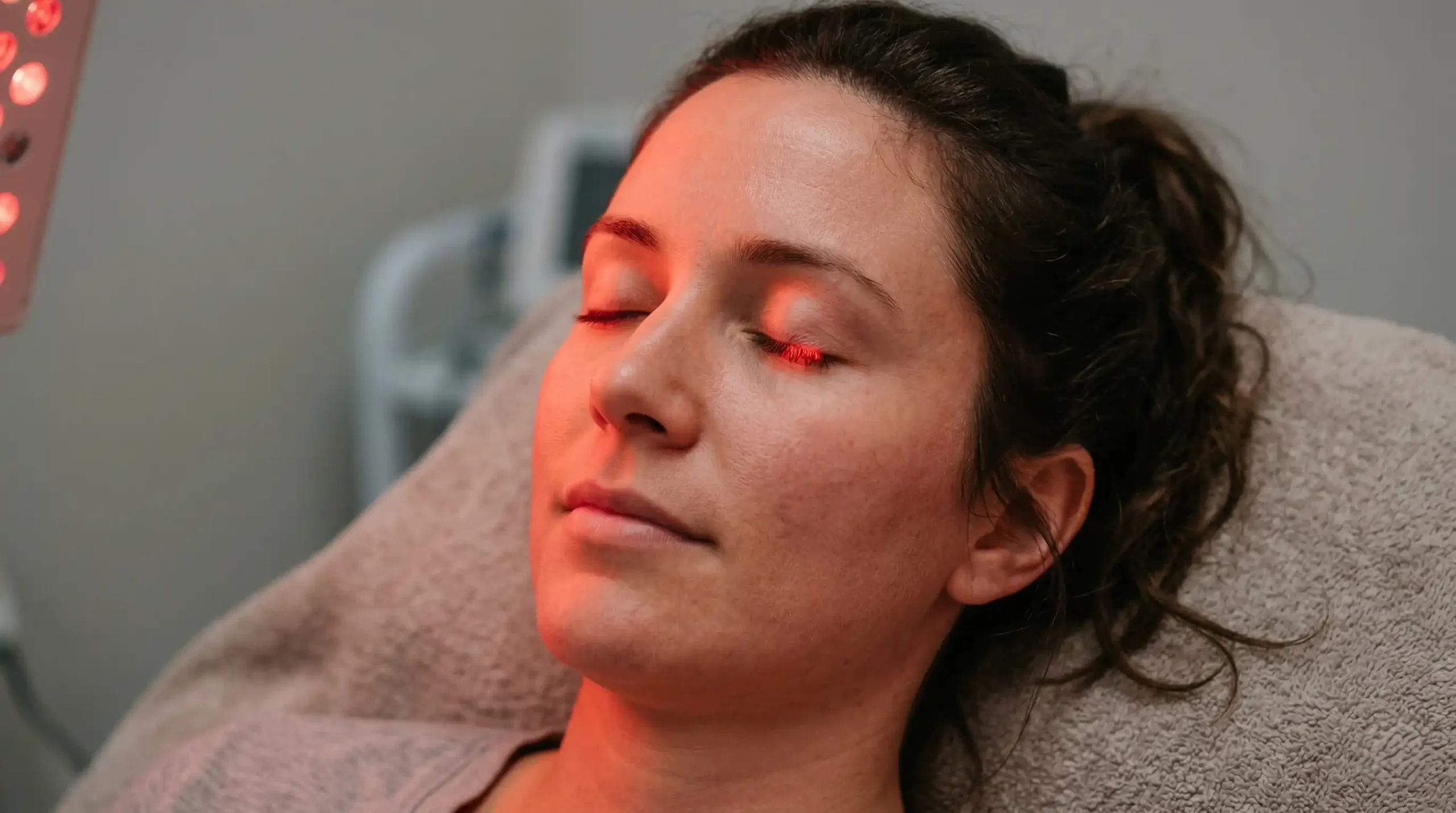
Do you need goggles? For most panel use with eyes closed — no. For close-range face mask use with eyes open — follow the manufacturer’s specific guidance. For direct prolonged gazing into high-powered LEDs at close range — yes, protect your eyes.
The real risk most people ignore: It’s not the wavelength causing damage — it’s the brightness. High-intensity LEDs at very close range can cause photochemical or thermal retinal damage regardless of wavelength if you’re staring directly into them for extended periods. The therapeutic protocols that produce the results in the literature are not the same as pointing a 200W panel at your open eyes from 2 inches away.
What ironically does damage eyes:UV light (below 400nm) and very high-intensity blue light. Red (630–660nm) and near-infrared (850nm) are on the opposite end of the spectrum — low photon energy, no ionizing capacity, and low melanopsin activation. The risk profile is fundamentally different from UV.
Understanding Red Light Therapy in Practice
Red light therapy is often discussed in theory, but its real-world application depends on measurable parameters like wavelength and exposure. I tested multiple RLT setups using a professional spectrometer to better understand how the therapy works in practice.
Open Red Light HubWhy People Are Confused About RLT Eye Safety
The confusion comes from conflating two different things: wavelength risk and intensity risk.
Wavelength risk is about whether the type of light can damage tissue at any intensity. UV light has high wavelength risk — even brief low-intensity UV exposure accumulates damage to DNA and proteins. This is why UV-based treatments require strict eye protection regardless of distance or duration.
Intensity risk is about whether the brightness of any light source — regardless of wavelength — can cause thermal or photochemical damage when concentrated on retinal tissue over time.
Red and near-infrared light have essentially zero wavelength risk. They’re non-ionizing, don’t damage DNA, and don’t cause the photokeratitis or cataract risk associated with UV. But they’re not exempt from intensity risk if you’re staring directly into a high-powered LED array from inches away for extended periods.
Most people doing RLT are nowhere near intensity risk territory. The protocol of closing your eyes and sitting in front of a panel at 6 inches for 15 minutes is not equivalent to staring into the sun. But understanding the distinction lets you apply appropriate caution without either ignoring real risks or being so afraid of imaginary ones that you can’t use the therapy effectively.
The Actual Biology: How Different Wavelengths Affect Eye Tissue
The eye is not uniformly sensitive to all wavelengths. Different structures absorb different parts of the spectrum, and the damage potential follows from those absorption characteristics.
| Wavelength Range | Primary Ocular Absorber | Damage Type | Threshold |
|---|---|---|---|
| UV-C (100–280nm) | Cornea | Photokeratitis, corneal damage | Very low — brief exposure dangerous |
| UV-B (280–315nm) | Cornea + lens | Cataracts, photokeratitis | Low threshold |
| UV-A (315–400nm) | Lens + retina | Cataracts, retinal damage | Moderate threshold |
| Blue light (400–490nm) | Retina (photoreceptors) | Photochemical retinal damage | Moderate — chronic exposure risk |
| Green/yellow (490–590nm) | Retina | Photochemical damage at high intensity | Moderate — intensity dependent |
| Red (630–660nm) | Retina (low absorption) | Thermal damage at very high intensity only | High threshold — intensity dependent |
| Near-infrared (750–850nm) | Minimal ocular absorption | Thermal damage at extreme intensity | Very high threshold |
The critical insight from this table: red and near-infrared light have high damage thresholds, meaning you need very high intensity concentrated on the retina over extended time to cause harm. Standard consumer RLT devices used as directed don’t approach these thresholds.
This is actually why there’s active clinical research into red and near-infrared light for treating eye conditions — not just avoiding harm to eyes, but actively using photobiomodulation therapeutically for conditions like age-related macular degeneration, glaucoma, and diabetic retinopathy. You don’t research a therapy for treating the organ you’re simultaneously warning people it damages.
Red Light Therapy for Eye Health: The Emerging Research
This is the part that surprises most people. While the safety question focuses on avoiding harm, there’s a growing body of research using red and near-infrared light therapeutically on the eyes themselves.
| Study | Condition | Protocol | Finding |
|---|---|---|---|
| Merry et al., J. Gerontology (2020) | Age-related decline in color vision | 670nm, 3 min/day | Significant improvement in color contrast sensitivity after 2 weeks |
| Chitnis et al., Nature (2021) | Mitochondrial function in aging retinal cells | 670nm | Improved ATP production in retinal photoreceptors — same mitochondrial mechanism as body RLT |
| Ivandic & Ivandic, Photomedicine & Laser Surgery (2008) | Age-related macular degeneration | 780nm NIR | 95% of patients showed stabilization or improvement vs 36% control |
| Albarracin et al., Acta Ophthalmologica (2011) | Retinal degeneration | 670nm | Reduced photoreceptor cell death and preserved retinal function in degeneration model |
The Merry et al. 2020 study from University College London received significant mainstream attention — it found that 3 minutes of 670nm red light in the morning improved color contrast sensitivity in adults over 40 by an average of 17%. The proposed mechanism is the same mitochondrial activation that underlies all photobiomodulation — retinal cells, like all cells, have mitochondria that respond to specific wavelengths.
This research is preliminary and not yet clinical guidance. But it reframes the question from “is red light dangerous to eyes” to “what are the actual conditions under which it could cause harm” — which is the more useful question for someone trying to build a safe protocol.
When Goggles Are and Aren’t Necessary
This is where the practical guidance breaks down in most RLT content — either vague (“consult your device manual”) or excessively cautious (“always wear goggles for all RLT”). Here’s the actual risk-stratified guidance:
No Goggles Needed
Standard panel use, eyes closed, 6+ inches distance: Closing your eyes provides meaningful protection. Eyelids attenuate approximately 30–40% of incident light, and the remaining light hitting your closed eyelid surface is far below the intensity threshold for retinal damage at standard panel distances. This is the most common use case and doesn’t require goggles.
Full-body panels at standard distance: Same principle applies. Standing 6–12 inches from a full-body panel with eyes closed during a 15-minute session is within safe parameters for the retina.
Low-irradiance ambient use (sleep protocol, mood lighting): Indirect red light in a room environment at irradiance levels typical of ambient lighting is not an eye safety concern at any distance.
Goggles Recommended
Direct eye-level panel exposure with eyes open: If you’re positioning a panel at eye level and keeping your eyes open — working on a computer adjacent to a panel, for example — wearing goggles is a reasonable precaution for extended sessions. Not because the wavelength is inherently dangerous, but because prolonged direct brightness at close range from high-powered LEDs can cause discomfort and potentially exceed thermal thresholds over very long cumulative exposure.
High-power panels at very close range (under 4 inches) with eyes open: The closer you get, the higher the irradiance. Professional-grade devices at very close range with eyes open approach the territory where intensity becomes the limiting factor. Use protection.
Photosensitizing medications: Certain medications increase light sensitivity across wavelengths — some antibiotics (tetracyclines, fluoroquinolones), psoralens, and certain cancer treatments. If you’re on photosensitizing medication, wear goggles for any close-range RLT session as a precaution regardless of panel type.
Any existing retinal pathology: Macular degeneration, retinal tears, history of retinal surgery — consult your ophthalmologist before any RLT near the eyes. Not because consumer RLT is established as dangerous for these conditions, but because you’re operating outside the studied populations and caution is warranted.
Face Masks: Specific Guidance
Face masks sit at 0–1 inch from the face, which puts LEDs closer to the eyes than any other RLT application. This is where eye safety requires the most specific attention.
| Mask Feature | Safe | Concern |
|---|---|---|
| Built-in opaque eye covers | ✅ Complete blocking of LEDs over eye zone | — |
| Eye zone LEDs shielded/recessed | ✅ Reduced direct irradiance at eye level | — |
| FDA-cleared with safety testing | ✅ Tested to ocular safety standards | — |
| No eye protection, LEDs over open eye zone | ⚠️ | Use provided goggles or keep eyes firmly closed |
| Unverified cheap mask, unknown LED specs | ⚠️ | Verify LED specs before use, use goggles |
Quality face masks designed for facial RLT — like the Valo Glow — are FDA-cleared and include built-in eye zone design that accounts for the proximity issue. The FDA clearance process includes ocular safety evaluation. An unbranded, uncertified mask from an unknown source with LEDs directly over the eye zone is a different risk category — not because red light is inherently dangerous to eyes, but because unknown LED specs and no safety testing means you don’t know what you’re actually exposing your retina to at contact distance.
The Practical Safety Protocol
Based on the above, here’s a clear, risk-stratified protocol for eye safety across different RLT applications:
For Standard Panel Use (Body, Back, Limbs)
- Eyes closed or averted during session ✅
- No goggles needed at standard therapeutic distances (4–12 inches) ✅
- Don’t stare directly into LEDs before or after session — treat them like any bright light source ✅
For Facial Panel Use
- Eyes closed throughout session ✅
- Position panel slightly above or below direct eye level if possible ✅
- If keeping eyes open for any reason, use provided goggles ✅
- Review the face protocol for full positioning guidance ✅
For Face Mask Use
- Use FDA-cleared masks with documented eye zone design ✅
- Follow manufacturer guidance exactly — built-in protection is designed for that specific device ✅
- If mask has no eye zone protection, keep eyes firmly closed throughout ✅
- Don’t use uncertified masks with unknown LED specs at eye contact distance ✅
If On Photosensitizing Medications
- Wear goggles for all close-range sessions ✅
- Consult prescribing physician before starting RLT ✅
- Start with shorter sessions and greater distance, assess tolerance ✅
What About Near-Infrared and the Eyes?
850nm near-infrared is invisible to the naked eye. This creates a specific practical consideration: you can’t see whether an 850nm device is on or off by looking at it, and you can’t judge its intensity visually.
For eye safety purposes, NIR follows the same intensity-dependent risk framework as red light — very high threshold for damage, non-ionizing, no photochemical risk at wavelength level. But because you can’t perceive it visually, applying the same closed-eye protocol for NIR sessions is sensible.
The deeper penetration of 850nm through tissue theoretically means slightly more light reaching retinal tissue compared to 660nm when at the same irradiance — but both are well within safe parameters at standard consumer device specs and therapeutic distances. The 660nm vs 850nm guide covers the full wavelength comparison including tissue penetration depth.
Frequently Asked Questions
Can red light therapy improve my eyesight?
There’s emerging research suggesting red light (particularly 670nm) may support mitochondrial function in aging retinal cells, with one 2020 UCL study showing improved color contrast sensitivity in adults over 40 after brief daily 670nm exposure. This is preliminary research — it’s not established clinical guidance and shouldn’t replace standard eye care. But the direction of evidence is interesting and mechanistically coherent with how photobiomodulation works in other tissues.
I accidentally looked directly at the LEDs during a session. Should I be worried?
Brief accidental glances at standard consumer RLT panels at normal therapeutic distances are not a clinical concern for red or NIR wavelengths. If you experience persistent afterimages, significant eye discomfort, or any vision changes after extended direct LED exposure at close range, consult an ophthalmologist. But brief accidental exposure at standard distance is not the equivalent of looking at a welding arc or UV lamp.
Are some devices safer for eyes than others?
Yes. Devices that are FDA-cleared have gone through a safety evaluation process that includes ocular safety parameters. Higher-powered professional devices at very close range represent a different risk profile than standard consumer panels at therapeutic distances. Face masks specifically should be evaluated for their eye zone design — whether LEDs are positioned over the eye area and what protection is built in.
Can I do red light therapy if I have macular degeneration?
Paradoxically, there’s more research suggesting potential benefit than harm for AMD from red and NIR light. However, any retinal pathology puts you in a population where extra caution is warranted — the research populations in RLT-eye studies are controlled environments. Consult your ophthalmologist before starting any RLT protocol targeting the face or eyes if you have existing retinal disease.
What about children’s eyes — are they more sensitive?
Children’s lenses are more transparent than adult lenses, allowing more light to reach the retina across all wavelengths. For body RLT on children (for wound healing, sports recovery), the eyes-closed protocol is sufficient. Direct facial RLT close to children’s eyes should use appropriate eye protection. This is a general caution about light intensity near children’s eyes, not specific to red light wavelengths.
Does the safe eye exposure change if I use RLT daily?
The damage thresholds for red and NIR are high enough that daily use at standard consumer device specs and therapeutic distances doesn’t represent meaningful cumulative retinal risk. This is different from UV exposure where cumulative dose is a primary concern. The research on daily therapeutic RLT protocols — including in proximity to the face — doesn’t show evidence of cumulative retinal damage at standard parameters.
🔴 Face Mask Eye Safety: What to Look For
Valo Glow — FDA-Cleared With Built-In Eye Zone Design
The closest-to-eye RLT application requires the most attention to safety design. The Valo Glow is FDA-cleared — meaning its safety parameters, including ocular safety at contact distance, have been through the FDA 510(k) evaluation process.
The mask’s eye zone is designed to account for LED proximity to the eyes: built-in coverage over the eye area, verified wavelengths that match the research protocols, not unknown LED arrays from unverified sources.
If you’re going to use a face mask for anti-aging or skin protocols, the difference between an FDA-cleared device with documented eye zone design and a cheap uncertified mask with unknown LED specs at 0 inches from your face is not trivial.
→ Read the Valo Glow Face Mask Review
Internal Links
- Red Light Therapy: The Definitive Guide (2026)
- 660nm vs 850nm — Which Wavelength Do You Actually Need?
- The Simple Dosing Guide (No Math Required)
- Red Light Therapy Through Clothes: Does It Work?
- Red Light Therapy for Face: Anti-Aging Protocol & Evidence
- Is Red Light Therapy Safe? (What You Need to Know)
- How to Use Red Light Therapy at Home
- 7 Red Light Therapy Mistakes Killing Your Results
- Valo Glow Face Mask Review: Worth $300?
Sources
- Merry G.F. et al. — The Journals of Gerontology, 2020. 670nm red light, 3 min/day — 17% improvement in color contrast sensitivity in adults over 40 after 2 weeks.
- Chitnis M. et al. — Nature Aging, 2021. 670nm improves mitochondrial ATP production in aging retinal photoreceptors via cytochrome c oxidase activation.
- Ivandic B.T., Ivandic T. — Photomedicine and Laser Surgery, 2008. 780nm NIR in AMD patients: 95% stabilization or improvement vs 36% in control group.
- ICNIRP Guidelines — International Commission on Non-Ionizing Radiation Protection. Optical radiation exposure limits for eyes and skin — wavelength-specific damage thresholds.