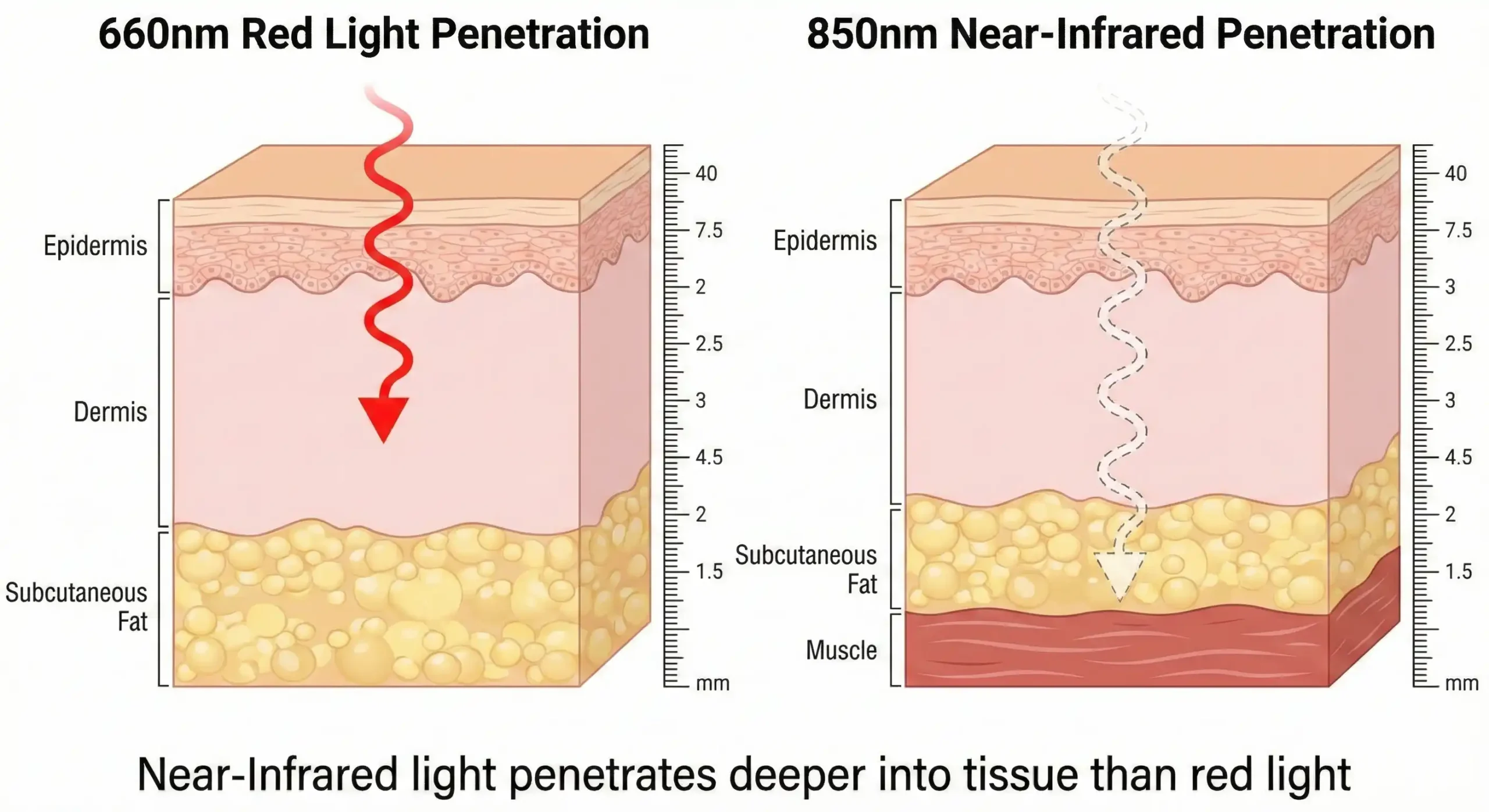
660nm red light primarily affects the skin and superficial tissues, while 850nm near-infrared light penetrates deeper into muscles and joints. Both wavelengths support photobiomodulation but serve different biological purposes.
Understanding Red Light Therapy in Practice
Red light therapy is often discussed in theory, but its real-world application depends on measurable parameters like wavelength and exposure. I tested multiple RLT setups using a professional spectrometer to better understand how the therapy works in practice.
Open Red Light HubWhy Wavelength Matters in Red Light Therapy
Wavelength determines depth of penetration and biological response.
If you are completely new to this technology, start with our Beginner’s Guide: What is Red Light Therapy? before diving into wavelengths.
According to studies on photobiomodulation mechanisms, specific wavelengths drive mitochondrial activity.
660nm — Skin & Surface Tissue
Best for:
- skin quality
- scars and stretch marks
- collagen signaling
💡 Related Protocol: How to Use Red Light Therapy for Scars & Stretch Marks
850nm — Muscles, Joints & Deep Tissue
Best for:
- muscle recovery
- joint discomfort
- deep inflammation
Scientific depth data:
“850nm penetrates deeper into muscle tissue to support recovery (Clinical Study: NIR Penetration Depth).”
Which One Should You Use?
- Skin & cosmetic → 660nm
- Recovery & pain → 850nm
- General wellness → both
⚠️ Don’t waste your time: Check our guide on Common Setup Mistakes & How to Fix Them.
Stop Guessing Your Session Time
10 minutes on a weak panel is nothing. 10 minutes on a pro panel is an overdose. Calculate your exact personalized dose.
FAQ
Is 850nm stronger than 660nm?
No — it penetrates deeper but is not “more powerful”.
Can near-infrared light damage tissue?
At correct doses, it is considered safe.
Is NIR visible?
No, near-infrared is invisible to the human eye.
Do studies support combining wavelengths?
Yes, many protocols use both.
Resources
- PubMed: https://pubmed.ncbi.nlm.nih.gov/30552956/
- PubMed: https://pubmed.ncbi.nlm.nih.gov/14666828/
- NIH: https://www.ncbi.nlm.nih.gov/pmc/articles/PMC5523874/