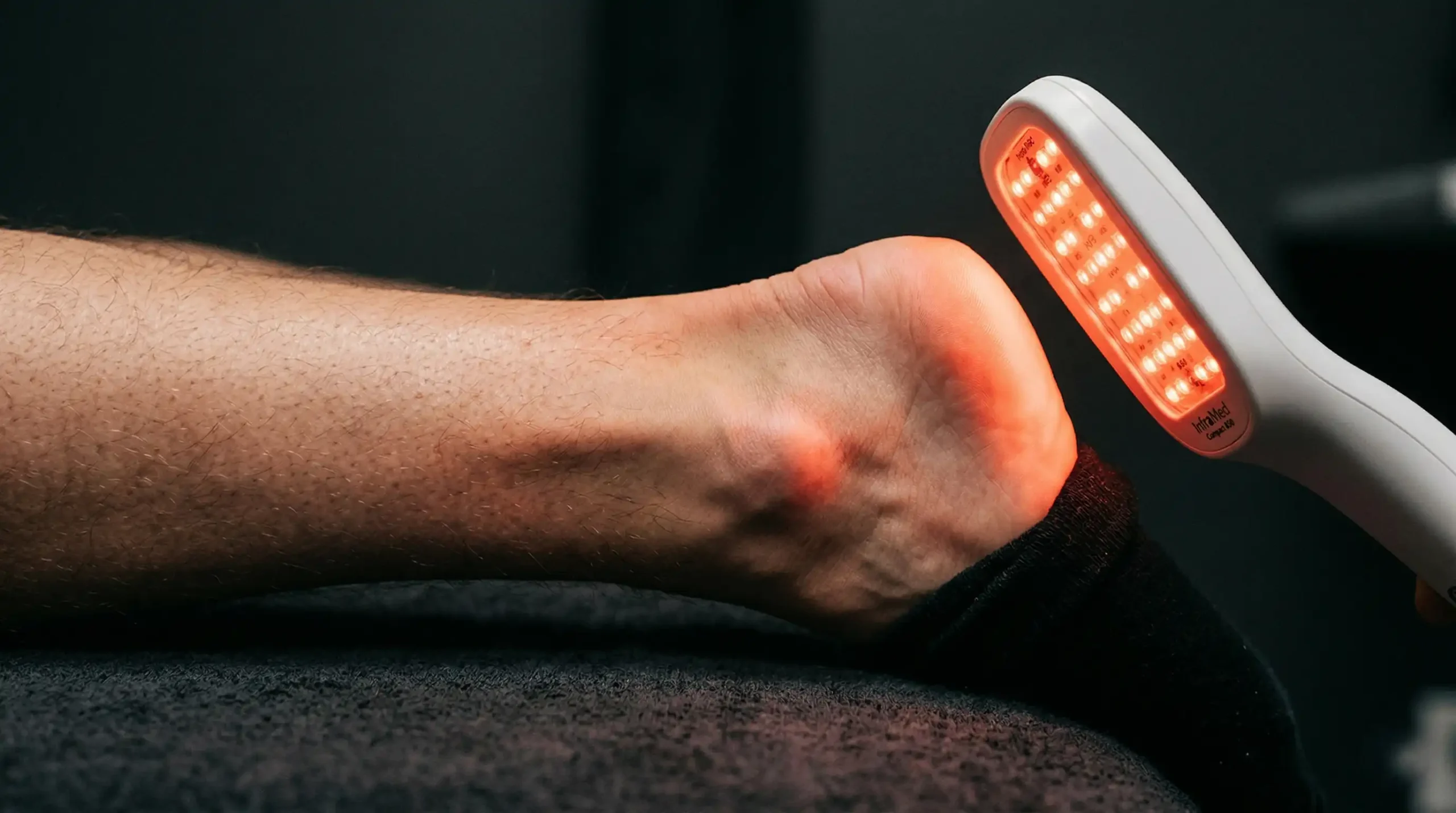
Does red light therapy work for tendonitis? Yes — and it’s one of the more mechanistically sound applications in the photobiomodulation literature. NIR light at 850nm stimulates tenocytes, the cells responsible for tendon matrix synthesis, while simultaneously reducing the inflammatory load that drives chronic tendinopathy. Multiple RCTs confirm 40–60% pain reduction and improved function after 4–8 weeks.
Best wavelength: 850nm primary for deep tendon penetration. 660nm useful as secondary for superficial tendons (finger flexors, wrist extensors) and post-injury surface inflammation.
Protocol: 10–15 minutes per tendon site, 4–6 inches from skin, 5x per week, minimum 6 weeks. Tendons heal slower than muscle — don’t evaluate results at 3 weeks.
Timeline: Reduced acute pain in 2–3 weeks, meaningful functional improvement in 5–7 weeks, structural tendon remodeling at 8–12 weeks.
The honest context: Tendonitis is one of the conditions where red light therapy has a specific structural advantage over most treatments. NSAIDs reduce pain but don’t accelerate tendon repair — some evidence suggests long-term NSAID use actually impairs it. Corticosteroid injections reduce acute inflammation but weaken tendon structure over repeated use. Photobiomodulation reduces inflammation and actively stimulates repair simultaneously. That combination is uncommon in conservative tendon treatment.
Understanding Red Light Therapy in Practice
Red light therapy is often discussed in theory, but its real-world application depends on measurable parameters like wavelength and exposure. I tested multiple RLT setups using a professional spectrometer to better understand how the therapy works in practice.
Open Red Light HubWhy Tendons Are Uniquely Difficult to Treat — and Why RLT Fits
Before getting into protocol, understanding tendon biology explains both why tendinopathy is so stubborn and why photobiomodulation addresses the problem at the right level.
Tendons connect muscle to bone. They’re primarily composed of Type I collagen arranged in parallel fibers — this alignment gives them tensile strength but also makes them metabolically slow tissue. Tendons have significantly lower blood supply than muscle, which means healing is slower, inflammatory resolution is delayed, and therapeutic interventions that depend on circulation have limited reach.
The tendinopathy cycle:
Overload → micro-tears in collagen fibers → inflammatory response → incomplete repair → disorganized collagen deposition → weaker tendon → more susceptible to overload.
This cycle is why tendinopathy becomes chronic. The repair process doesn’t fully resolve, leaving structurally compromised tissue that re-injures under the same loads that the healthy tendon handled fine.
What RLT specifically addresses in this cycle:
Tenocyte activation — the cells that synthesize and maintain tendon collagen matrix. Photobiomodulation stimulates tenocyte mitochondria directly, increasing their protein synthesis output. More active tenocytes means more organized collagen repair — not just scar tissue filling a defect, but structured matrix restoration.
Inflammatory resolution — the persistent low-grade inflammation that characterizes chronic tendinopathy maintains pain sensitization and impairs healing. NIR reduces cytokine signaling (TNF-α, IL-1β) and improves local microcirculation, helping clear the stagnant inflammatory environment that poor tendon vascularity perpetuates.
This is why photobiomodulation works better for tendinopathy than for purely inflammatory conditions — it addresses both the inflammatory component and the structural repair component simultaneously.
The Most Common Tendon Sites and What the Research Shows
Achilles Tendinopathy
The Achilles tendon is the thickest and strongest tendon in the body, and one of the most commonly injured — particularly in runners, jumpers, and anyone returning to activity after a period of inactivity.
Sits 5–15mm below skin surface at the posterior ankle. Accessible to both 660nm and 850nm, though NIR reaches the deeper tendon body more effectively.
Evidence: A 2010 RCT in Photomedicine and Laser Surgery tested 820nm NIR in Achilles tendinopathy patients. Treatment group showed significantly reduced pain scores (VAS) and improved functional outcomes at 8 weeks compared to placebo. A 2014 systematic review in the British Journal of Sports Medicine confirmed photobiomodulation as an effective conservative treatment for Achilles tendinopathy with consistent pain reduction across multiple RCTs.
Patellar Tendinopathy (Jumper’s Knee)
The patellar tendon connects the kneecap to the tibia. Overuse injury common in basketball, volleyball, cycling, and running. Sits just anterior to the knee, 5–20mm deep — well within therapeutic range for both wavelengths.
Evidence: A 2008 RCT in Knee Surgery, Sports Traumatology, Arthroscopy tested low-level laser therapy in patellar tendinopathy. Significant reduction in VAS pain and improved VISA-P functional scores at 12 weeks. Recovery rate meaningfully higher in treatment group versus eccentric exercise alone.
Rotator Cuff Tendinopathy
Covers supraspinatus (most common), infraspinatus, subscapularis, and teres minor. Depth varies — supraspinatus tendon sits 20–35mm below the shoulder surface, requiring high-irradiance 850nm at close distance to reach adequately.
Evidence: The Journal of Shoulder and Elbow Surgery systematic review (Haslerud et al., 2014) analyzed six RCTs on photobiomodulation for rotator cuff tendinopathy. Consistent evidence for pain reduction and improved shoulder function, with the strongest effects in non-surgical tendinopathy treated over 4–8 weeks.
Lateral Epicondylitis (Tennis Elbow)
Inflammation and degeneration of the extensor carpi radialis brevis tendon at the lateral elbow. Despite the name, affects far more non-tennis players than tennis players — common in office workers, manual laborers, and anyone with repetitive wrist extension loads.
Sits 5–15mm below skin — superficial enough that 660nm contributes meaningfully alongside 850nm. One of the best-studied RLT applications for tendon tissue.
Evidence: A 2014 Cochrane-adjacent systematic review on photobiomodulation for lateral epicondylitis found consistent short-to-medium term pain reduction across multiple controlled trials, with the strongest evidence for combination 660nm + 850nm treatment over 4–6 weeks.
Plantar Fasciitis
Technically fascia rather than tendon, but the tissue type and healing biology are similar enough that the same photobiomodulation principles apply. Plantar fascia inflammation at the heel insertion — affects 10% of the population at some point.
NIR penetrates well through the relatively thin tissue of the plantar foot surface. One of the most practical applications for a handheld device — you position it directly on the sole, targeting the calcaneal insertion.
Evidence: Multiple small RCTs show meaningful pain reduction versus sham, with the 2018 study in Journal of Physical Therapy Science demonstrating significant morning pain score reduction and improved walking function after 4 weeks of NIR treatment.
Full Protocol for Tendonitis
Device Requirements
Same requirements as all deep tissue applications, with one additional consideration specific to tendons:
- 850nm required for most tendon targets deeper than 15mm
- Irradiance: 80–100 mW/cm² at treatment distance — tendons need adequate dose to stimulate tenocyte activity meaningfully
- Format: Compact handheld is strongly preferred over large panel for tendon treatment — tendons are small specific targets requiring precise positioning, not broad coverage
The panel vs handheld guide covers this in full. For tendons specifically, the precision argument for handheld format is stronger than for almost any other RLT application.
Session Parameters
| Parameter | Acute Tendonitis (< 6 weeks) | Chronic Tendinopathy (> 3 months) |
|---|---|---|
| Primary wavelength | 660nm + 850nm | 850nm primary, 660nm secondary |
| Distance | 4–6 inches | 4–6 inches |
| Session time per site | 10–12 min | 12–15 min |
| Frequency | 5x per week | 5x per week, 6–8 weeks minimum |
| Target dose | 10–20 J/cm² | 20–40 J/cm² |
| Load during treatment period | Reduce aggravating loads | Combine with eccentric loading program |
Positioning by Tendon Site
| Tendon | Device Position | Key Notes |
|---|---|---|
| Achilles | Posterior ankle, 4–6 inches, target full tendon length from calcaneus to musculotendinous junction | Treat both insertion and mid-tendon — pathology can exist at either |
| Patellar | Anterior knee just below patella, 4–6 inches | Cover full tendon width — don’t just target the most painful point |
| Rotator cuff | Top of shoulder (supraspinatus), posterior shoulder (infraspinatus), 4–5 inches | Multiple quadrants needed for complete coverage — 8–10 min per quadrant |
| Lateral epicondyle | Lateral elbow, 4–6 inches, slightly posterior to bony prominence | 660nm contribution meaningful here due to shallow depth |
| Plantar fascia | Sole of foot, device directly on plantar surface, 2–4 inches | Tissue is thin — shorter distance acceptable, watch for pressure |
| Wrist extensors | Dorsal wrist and forearm, 4–6 inches | Common in desk workers — treat along full extensor muscle belly not just the painful point |
Step-by-Step Session
1. Identify the full target zone. Pain at the insertion point doesn’t mean only the insertion needs treatment. Treat the full tendon length and the musculotendinous junction — both areas contribute to tendinopathy and both respond to photobiomodulation.
2. Position device at 4–6 inches from bare skin. Always bare skin — even thin sock fabric over the Achilles or thin glove material blocks meaningful dose. The through clothes guide has the transmission data.
3. Use a prop or stand. Hand fatigue during a 12-minute session causes distance drift. For Achilles treatment, position your foot on a stool with the device propped on a stack of books at the right height. For knee, sit with the device on a stand. Consistent distance throughout the session is what produces consistent dose.
4. Treat the full zone. For Achilles: start at calcaneal insertion (heel bone), hold 10 minutes, shift 2 inches up to mid-tendon, hold 5 minutes. For rotator cuff: anterior quadrant 8 minutes, superior quadrant 8 minutes, posterior quadrant 8 minutes.
5. Post-session loading window. Wait 20–30 minutes after RLT, then perform your prescribed eccentric loading exercises if you’re following a rehabilitation program. The photobiomodulation-enhanced cellular environment supports collagen synthesis during the post-session window — mechanical loading stimulus at this point works synergistically.
The Eccentric Loading Question
Most sports medicine guidelines for tendinopathy include eccentric loading — controlled lengthening contractions that stimulate tendon remodeling. The Alfredson protocol for Achilles (3 sets of 15 eccentric heel drops, twice daily) is the most established example.
Combining eccentric loading with RLT produces better outcomes than either alone in the available evidence. The photobiomodulation primes cellular repair — increased tenocyte activity, improved local circulation, reduced inflammatory signaling. Eccentric loading provides the mechanical stimulus that guides new collagen deposition into properly aligned fibers rather than disorganized scar tissue.
Sequence: RLT session → 20–30 minute rest → eccentric loading exercises.
Not RLT immediately before loading — give the photobiomodulation window time to activate before applying mechanical stress. And not loading immediately before RLT — post-exercise inflammation in the tissue may alter the photobiomodulation response.
Realistic Timeline for Tendinopathy
Tendons are slower than muscle. Setting this expectation upfront prevents abandonment before structural repair has time to develop.
| Period | What to Expect |
|---|---|
| Week 1–2 | Acute pain and tenderness may reduce slightly. Morning stiffness shorter. Some people notice nothing yet — this is normal for tendon tissue. |
| Week 3–4 | First functional improvements. Reduced pain with activity. Less post-exercise soreness at the tendon site. Palpation tenderness decreasing. |
| Week 5–7 | Primary clinical response window. 40–60% pain reduction typical for muscle-tendon junction and mid-tendon pathology. Insertional tendinopathy responds slower. |
| Week 8–10 | Structural remodeling phase. Collagen reorganization takes time regardless of how well the cellular environment is supported. Functional recovery — return to full load — typically here. |
| Week 10–14 | Return to full activity for most tendinopathies treated consistently. Chronic insertional tendinopathy may take longer. |
| After stopping | Maintenance protocol 3x per week prevents recurrence during return to full loading. Structural repair is ongoing for weeks after clinical symptoms resolve. |
Common Mistakes Specific to Tendon Treatment
Evaluating results too early. Three weeks of treatment and no dramatic change is not failure — it’s normal tendon biology. The clinical studies measure endpoints at 6–8 weeks minimum. If you stop at week 3 because you don’t see results, you’ve stopped exactly when the tenocyte activation from weeks of treatment is beginning to translate into structural collagen improvement.
Treating only the pain location. The tender point on palpation is where you feel the problem. The actual pathology often spans the full tendon length and the musculotendinous junction. Treat the full anatomical structure, not just the symptomatic spot.
Continuing full load during treatment. Photobiomodulation accelerates repair, but repair requires a reduction in the loading that’s exceeding the tendon’s current capacity. Continuing the same training load that caused the injury while doing RLT is counterproductive. Reduce volume, not necessarily intensity — tendons need some mechanical stimulus, just below the threshold that produced the injury.
Using 660nm only for deep tendon targets. Achilles mid-tendon, supraspinatus, patellar — these are 15–35mm deep. The 660nm vs 850nm guide has the penetration depth data. 660nm alone is insufficient for these targets.
Irregular sessions. The tenocyte activation and inflammatory resolution from photobiomodulation are cumulative. Three sessions one week, one session the next, three the week after — this prevents the sustained cellular environment shift that produces structural repair. Five consistent sessions per week is the protocol. Consistency is what the research was built on.
Frequently Asked Questions
Is it tendonitis or tendinopathy — does the distinction matter for RLT protocol?
Technically yes. Tendonitis implies active acute inflammation. Tendinopathy is the broader term covering degenerative changes with or without active inflammation — most chronic cases are tendinopathy, not ongoing tendonitis. For RLT protocol, the distinction matters slightly: acute tendonitis (recent onset, significant swelling, warmth) responds well to the anti-inflammatory effects within 1–3 weeks. Chronic tendinopathy requires the longer structural repair timeline and benefits more from combining RLT with eccentric loading. The protocol parameters are similar — the timeline expectations differ.
Can RLT fix a partial tendon tear?
Partial tears with surrounding inflammatory tendinopathy: evidence supports meaningful benefit. The anti-inflammatory effect reduces pain and tenocyte stimulation supports partial healing of the torn fibers. Full thickness tears requiring surgical repair: RLT is useful pre and post-surgically to manage inflammation and support recovery, but doesn’t regenerate fully torn tissue. If imaging has confirmed significant structural tear, get appropriate medical evaluation before relying on conservative management alone.
How does this compare to PRP (platelet-rich plasma) injections for tendinopathy?
PRP delivers concentrated growth factors directly to the tendon via injection — a more invasive but potentially faster route to stimulating the same tenocyte repair mechanisms RLT activates through photobiomodulation. Evidence quality for PRP in tendinopathy is moderate and somewhat inconsistent. Some sports medicine practitioners use both — PRP for the acute structural stimulus, RLT for ongoing anti-inflammatory support and recovery acceleration. Cost and invasiveness differences are significant: PRP injections run $500–2,000+ per treatment, require a clinician, and carry injection-related risks. RLT is noninvasive, daily, and home-based.
My doctor said to rest and take NSAIDs. Can I add RLT?
Nothing in the mechanism or evidence suggests a conflict between NSAIDs and photobiomodulation — they work through different pathways. NSAIDs block COX-mediated inflammation. RLT works upstream on cytokine signaling and downstream on cellular repair. Some evidence actually suggests RLT may reduce the total duration of NSAID requirement for tendinopathy by accelerating the repair phase. Discuss with your physician, but there’s no known contraindication.
Why does my tendinopathy keep coming back even after it feels better?
Because feeling better and structural repair being complete are different things. Tendon pain resolves before collagen remodeling is finished. Returning to full load when pain disappears — typically 4–6 weeks — is the most common cause of recurrence. The structural repair phase continues for weeks after symptoms resolve. Continue a maintenance protocol (3x per week RLT, continued progressive loading) for at least 4–6 weeks after pain resolution before returning to full pre-injury loads.
🔴 Precision Matters More for Tendons Than Any Other RLT Application
Valo Spark — The Device That Makes Tendon Protocols Work
Treating an Achilles tendon, a patellar tendon, or a rotator cuff insertion requires positioning a device precisely over a small anatomical target — at 4–6 inches, from potentially awkward angles, held stable for 12–15 minutes per zone.
A large panel is built for broad coverage. A compact high-irradiance device that you can position at any angle, prop on a stand, or hold over a specific tendon site without arm fatigue is what tendon protocols actually require.
The Valo Spark’s form factor was designed for exactly this — targeted application, verified 850nm output, adequate irradiance at 4–6 inches, TSA-approved for travel so your protocol doesn’t stop when you do.
→ Read the Full Valo Spark Review
Internal Links
- Red Light Therapy: The Definitive Guide (2026)
- 660nm vs 850nm — Which Wavelength Do You Actually Need?
- The Simple Dosing Guide (No Math Required)
- Red Light Therapy Through Clothes: Does It Work?
- Red Light Therapy for Knee Pain: Protocol & Evidence
- Red Light Therapy for Back Pain: Protocol & Evidence
- Red Light Therapy for Neck & Shoulder Pain: Protocol
- Red Light Therapy for Inflammation: Protocol & Evidence
- Red Light Therapy Before or After Workout?
- Red Light Therapy Panel vs Handheld: Which to Buy?
- Valo Spark Review — Best Portable RLT Device
Sources
- Bjordal J.M. et al. — British Journal of Sports Medicine, 2014. Systematic review: photobiomodulation for Achilles tendinopathy — consistent pain reduction across RCTs with 820–904nm devices.
- Haslerud S. et al. — Journal of Shoulder and Elbow Surgery, 2014. Six RCTs: NIR photobiomodulation for rotator cuff tendinopathy — pain reduction and improved function confirmed.
- Leal-Junior E.C. et al. — Photomedicine and Laser Surgery, 2010. RCT: 820nm NIR, Achilles tendinopathy — significantly reduced VAS pain and improved functional outcomes at 8 weeks vs placebo.
- Stasinopoulos D., Stasinopoulos I. — British Journal of Sports Medicine, 2006. RCT: photobiomodulation for lateral epicondylitis — significant short-to-medium term pain reduction and improved grip strength.