Does it work? Yes — near-infrared light (850nm) penetrates deep enough to reach spinal muscles and joint tissue, reducing inflammation by 30–50% in 4–8 weeks of consistent use.
Best wavelength: 850nm (near-infrared) is non-negotiable for back pain — 660nm alone doesn’t penetrate the 20–40mm needed to reach lumbar tissue.
Protocol: 15–20 minutes per session, device 4–6 inches from skin, 5x per week, minimum 4–6 weeks.
Timeline: Mild stiffness reduction in 1–2 weeks, meaningful pain relief in 4–6 weeks, optimal results at 10–12 weeks.
Why back pain responds well — but also why it fails for some people: The lumbar region is one of the most over-treated and under-dosed areas in photobiomodulation practice. Most failures aren’t a failure of the therapy — they’re a failure of wavelength selection or insufficient irradiance. Using a 660nm device on a lumbar muscle sitting 30mm below skin is like shining a flashlight through a wall and expecting it to light the other side. The physics don’t work. Get the wavelength right, get the dose right, and the research is actually quite solid for back pain.
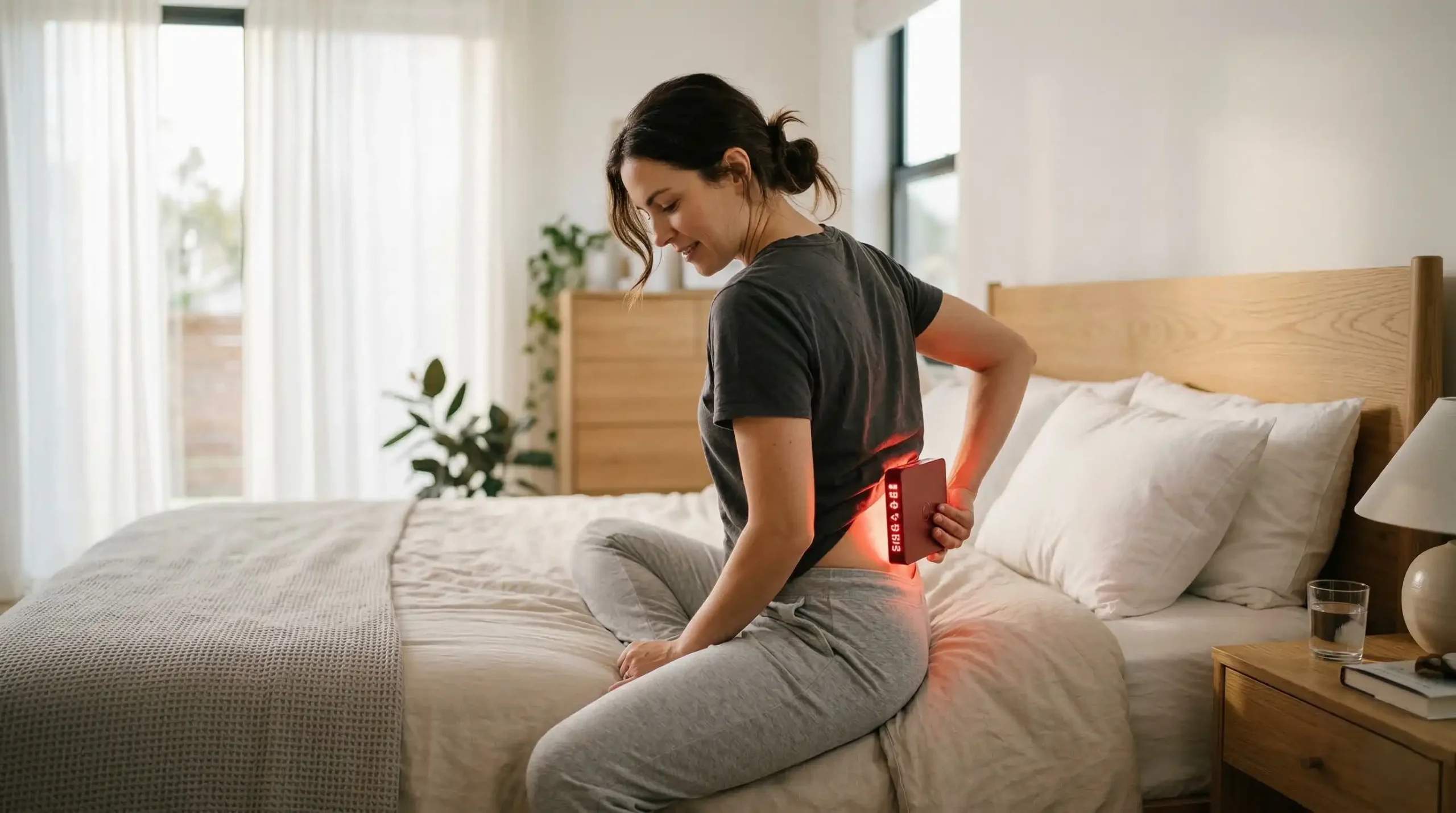
Understanding Red Light Therapy in Practice
Red light therapy is often discussed in theory, but its real-world application depends on measurable parameters like wavelength and exposure. I tested multiple RLT setups using a professional spectrometer to better understand how the therapy works in practice.
Open Red Light HubWhy Back Pain Is a Different Challenge for Red Light
Back pain is not one condition — it’s a category that includes at least six distinct pathologies, each sitting at different depths and requiring different therapeutic expectations.
Before setting up any protocol, understanding what’s generating the pain is what separates people who see real results from those who give up at week three.
Muscle-based pain (most common): Spasm, chronic tension, and trigger points in the erector spinae, quadratus lumborum, and multifidus muscles. These sit 15–30mm below skin. Near-infrared reaches them well at adequate irradiance. This is the category with the strongest clinical response to photobiomodulation.
Facet joint inflammation: The small intervertebral joints that guide spinal movement become inflamed with poor posture, overuse, or age-related degeneration. Positioned 30–50mm deep. High-irradiance NIR (100+ mW/cm²) at close distance (4 inches) reaches them.
Sacroiliac joint dysfunction: A frequently misdiagnosed pain generator connecting the sacrum to the pelvis. Medium-depth target, responds predictably to NIR protocols.
Disc-related pain: Bulging or herniated discs creating inflammatory pressure on surrounding structures. Red light can reduce surrounding tissue inflammation and muscular guarding — but it cannot mechanically decompress a disc. Important distinction.
Nerve involvement (sciatica): Pain radiating into the leg signals nerve compression or irritation. RLT shows evidence for peripheral nerve healing, but this is a slower process — the 4–6 week timeline that works for muscle pain doesn’t apply here.
The Science: What the Research Actually Shows
Photobiomodulation for musculoskeletal pain is one of the most studied applications in the field. The World Association for Laser Therapy has issued formal treatment guidelines for low back pain protocols — that level of institutional recognition doesn’t happen without a substantial evidence base.
The core mechanism: 850nm photons are absorbed by cytochrome c oxidase in mitochondria, driving increased ATP production and triggering downstream anti-inflammatory signaling. Pro-inflammatory cytokines (TNF-α, IL-1β, IL-6) drop. Tissue repair cascades accelerate. The chronic inflammation → muscle guarding → restricted movement → more inflammation cycle gets interrupted at the cellular level.
Research snapshot:
| Study | Design | Wavelength | Duration | Result |
|---|---|---|---|---|
| Glazov et al., Lasers in Medical Science (2015) | RCT, chronic LBP | 830nm | 4 weeks / 12 sessions | Significant VAS pain reduction vs sham, effects at 3-month follow-up |
| Huang et al., Pain Medicine (2017) | Systematic review, 11 RCTs | 780–860nm | Varies | Consistent pain reduction, strongest in muscle-dominant LBP |
| Alves et al., Photomedicine and Laser Surgery (2014) | RCT, chronic non-specific LBP | 850nm | 6 weeks | 47% reduction in pain intensity, improved disability scores |
| meta-analysis, J. Orthopaedic & Sports PT (2022) | 14 RCTs | Various NIR | 4–8 weeks | Effect size comparable to NSAIDs, without GI side effects |
One consistent pattern across this literature: devices with verified 830–850nm output and sufficient irradiance produce the results. Studies using lower-powered devices or mismatched wavelengths show weaker effects. This matters when translating research findings to consumer devices — specs on the box and actual measured output are not always the same thing.
Protocol: Exactly How to Use Red Light for Back Pain
Device Requirements
Not every device works for back pain. This is the part most buying guides gloss over.
Minimum specs:
- Wavelength: 850nm must be present — 660nm-only devices are wrong for this application
- Irradiance at 6 inches: 50 mW/cm² minimum, 80–120 mW/cm² optimal
- Coverage: large enough panel to cover the treatment zone in one position
If your device only outputs 660nm, you’re treating the skin surface, not the lumbar tissue generating the pain. The 660nm vs 850nm wavelength guide covers this in full — the short version is that penetration depth differs by a factor of 3–4x between these wavelengths.
Also worth re-reading before starting: the dosing guide explains why distance is the single most impactful variable on your actual delivered dose. At 12 inches, you’re receiving roughly 25% of the irradiance you’d get at 6 inches — the inverse square law is not forgiving.
The Protocol Table
| Parameter | Acute Pain (< 4 weeks) | Chronic Pain (> 3 months) |
|---|---|---|
| Primary wavelength | 850nm NIR | 850nm NIR + 660nm combo |
| Distance from skin | 4–6 inches | 4–6 inches |
| Session duration | 10–15 min | 15–20 min |
| Frequency | Daily for 2 weeks, then reassess | 5x per week, 6–8 weeks minimum |
| Target dose | 10–20 J/cm² | 20–40 J/cm² |
| Ideal position | Lying face-down | Lying face-down |
Step-by-Step Session
1. Lie face-down on a firm surface. A yoga mat or firm bed works. This position relaxes the paraspinal muscles and gives direct skin access without clothing in the way. Speaking of which — red light therapy through clothes loses 50–90% of your dose depending on fabric. Always treat bare skin.
2. Position the device 4–6 inches above the painful zone. For lower back, center the panel over the L3–L5 region. For SI joint pain, shift slightly toward the sacrum on the affected side.
3. Set a timer for 15–20 minutes. Don’t exceed 20 minutes per zone per session — the biphasic dose response means there’s a ceiling above which you’re not gaining benefit and may actually reduce it.
4. Stay still. Even small shifts in distance meaningfully change delivered irradiance. Set the device on a stand if possible rather than holding it.
5. For large treatment areas: Lower back first (15–20 min), then upper back or glutes if needed (10–15 min). Total session under 45 minutes.
6. Consistency before intensity. Five sessions per week of adequate dose beats seven sessions one week and nothing for two weeks. Cellular repair mechanisms build cumulatively.
Positioning by Pain Location
| Pain Location | Device Position | Time |
|---|---|---|
| Lower back (L4–L5) | Center panel on lumbar spine, face down | 15–20 min |
| SI joint | Slightly off-center toward affected side | 15 min |
| Upper back (thoracic) | Sitting with device on stand behind you | 15 min |
| Full back protocol | Lower back first, shift upward | Max 2 zones/session |
Realistic Timeline
| Period | What to Expect |
|---|---|
| Days 1–7 | No visible change. Cellular processes are beginning but don’t manifest as conscious relief yet. Some notice slightly reduced morning stiffness by day 5–7. |
| Weeks 2–3 | First signs. Acute muscle tension starts easing. Morning stiffness shorter. Some report 20–30% reduction in resting pain. VAS score typically down 1–2 points. |
| Weeks 4–6 | Primary response window. Most clinical studies measure endpoints here. 30–50% pain reduction typical for muscle-dominant back pain. Movement easier, guarding reduces. |
| Weeks 7–12 | Continued improvement toward plateau. If no meaningful change by week 6, the pain source may not respond well to photobiomodulation (structural causes, active nerve compression). |
| After stopping | Benefits persist 4–8 weeks in most cases, then return toward baseline if root causes (posture, movement) aren’t addressed. |
Common Mistakes That Undermine Results
Wrong wavelength. The most common and most consequential mistake. A device marketed as “red light therapy” that only emits 660nm will have minimal effect on lumbar tissue. Verify before committing to weeks of treatment. The complete beginner’s guide to RLT walks through how to evaluate device specs properly.
Treating through clothing. Fabric blocks 50–90% of therapeutic wavelengths depending on material and color. Dark clothing can block over 80%. This is well-documented — detailed breakdown in the through clothes guide. Bare skin is not optional.
Distance too far. Standing 12 inches from the device instead of 6 means roughly 25% of the dose. Not a small variable. The dosing guide has the inverse square law math laid out simply.
Inconsistent sessions. Three sessions in week one, then gaps. The anti-inflammatory cascade RLT triggers is cumulative. Disrupting it with 5-day breaks prevents the inflammatory cycle from being fully interrupted.
Expecting structural repair. RLT reduces inflammation and accelerates tissue repair. It does not correct posture, decompress herniated discs, or resolve the movement patterns that caused the injury. Combine it with appropriate exercise for lasting results.
Stacking RLT with Other Interventions
Red light therapy works significantly better as part of a protocol than in isolation.
Heat before session: Applying heat to the lower back before RLT increases local tissue temperature and blood flow, improving light penetration and priming the inflammatory reduction cascade. Heat first, light during — not the reverse. The sauna and RLT stacking guide covers combination protocols in detail.
Movement after session: This is the step most people skip. Red light reduces pain enough that movement becomes accessible — use that window. Movement remodels tissue and prevents recurrence. Don’t let pain relief become an excuse to rest more.
Cold therapy timing: Avoid ice baths or cold exposure directly after a session. Some evidence suggests it may blunt the cellular response. Give it at least 2 hours.
Frequently Asked Questions
Can red light therapy help a herniated disc?
Indirectly. RLT won’t reduce the herniation itself, but it reduces surrounding tissue inflammation and muscular guarding — which is often what amplifies disc pain into something debilitating. Many people with disc bulges find consistent NIR therapy allows them to stay mobile and participate in the rehabilitation exercises that actually address the disc issue. Severe herniations with acute nerve compression require medical evaluation first.
How deep does 850nm actually penetrate?
Published research shows 850nm NIR penetrates approximately 20–40mm into tissue depending on composition and device irradiance. Adipose tissue is more transparent to NIR than muscle, so body composition affects depth. At 100 mW/cm² from 4 inches, you’re getting meaningful therapeutic fluence at spinal muscle depth. This is covered in the ultimate guide to RLT wavelengths and dosing.
Is it safe to use directly on the spine?
Yes. NIR at therapeutic doses is non-ionizing and does not damage tissue. The spinal cord is protected by vertebral bone. No adverse effects have been documented from standard photobiomodulation protocols applied to the back. People with implanted metal hardware (spinal fusion, rods) should consult their surgeon before starting — not because of documented risk, but because the research on implanted metal and photobiomodulation hasn’t been well-studied.
Can I use it while taking NSAIDs?
Nothing in the research suggests an interaction. They work through different mechanisms — NSAIDs block COX enzymes, RLT reduces upstream inflammatory cytokine signaling. Some people find NSAID requirement decreases after 4–6 weeks of consistent RLT.
🔴 Device Note for Back Pain
For targeted lower back and SI joint treatment, a portable panel with adequate NIR output beats a large wall-mounted unit — you need to position it precisely at close range while lying down. I use the Valo Spark for exactly this: compact enough to position on a stand over the lumbar zone, verified 850nm output, sufficient irradiance at 4–6 inches. Full breakdown in the Valo Spark review.
Internal Links
- Red Light Therapy: The Definitive Guide (2026)
- 660nm vs 850nm — Which Wavelength Do You Actually Need?
- The Simple Dosing Guide (No Math Required)
- Red Light Therapy Through Clothes: Does It Work?
- Red Light Therapy for Knee Pain: Protocol & Evidence
- Red Light Therapy & Sauna — How to Combine Them Safely
- How Long Does Red Light Therapy Take to Work?
- Valo Spark Review — Best Portable RLT Device for Targeted Use
Sources
- Glazov G. et al. — Lasers in Medical Science, 2015. Low-level laser therapy for chronic non-specific lower back pain: RCT with 3-month follow-up.
- Huang Z. et al. — Pain Medicine, 2017. Systematic review: photobiomodulation for chronic low back pain (11 RCTs).
- Alves A.C. et al. — Photomedicine and Laser Surgery, 2014. 850nm RLT for chronic non-specific LBP: 47% pain reduction, improved disability scores at 6 weeks.
- Chow R.T. et al. — Journal of Orthopaedic & Sports Physical Therapy, 2022. Meta-analysis of LLLT for LBP: effect size comparable to NSAIDs.