Before workout: Red light pre-activation primes mitochondria, increases ATP availability, may improve performance by 5-10% and reduce perceived exertion.
After workout: Red light accelerates recovery, reduces inflammation and muscle soreness (DOMS), speeds tissue repair.
Best of both: Using red light both before and after training provides complementary benefits—energy boost pre-workout, recovery boost post-workout.
If choosing one: Post-workout red light therapy is more critical for most athletes and fitness enthusiasts.
The key insight: Red light therapy affects your body differently depending on when you use it relative to exercise. Before training, it’s like giving your mitochondria a head start—they’re already producing extra ATP when you begin working out, which can enhance performance and delay fatigue. After training, it helps manage the inflammatory response and accelerates the repair processes that make you stronger. Many serious athletes do both: a brief 5-10 minute pre-workout session for performance, and a longer 15-20 minute post-workout session for recovery.
Want Better Sleep Stats?
Theory is good, but tools get results. See the exact stack (mask, tape, supplements) I use to get 2+ hours of Deep Sleep every night.
Open Sleep HubWhy Heat Destroys Sleep: The Temperature Regulation Mechanism
Sleep isn’t just about being tired—it’s about your body hitting specific physiological states, one of which is a lowered core body temperature. Understanding this mechanism explains why heat causes such severe sleep disruption.
Your Body’s Internal Thermostat
Your circadian rhythm controls body temperature in a predictable 24-hour pattern. Core temperature peaks in late afternoon (around 5-7 PM) when you’re at around 99°F (37.2°C), then gradually declines through the evening. By the time you’re ready for sleep, your core temperature should have dropped to around 97.5-98°F (36.4-36.7°C)—roughly 1-2°F below your daytime peak.
This temperature decline isn’t just correlated with sleep—it’s causally linked. The drop in core temperature triggers the release of melatonin and signals to your suprachiasmatic nucleus (the brain’s master clock) that it’s time to shift into rest mode. When ambient heat prevents this temperature drop, your brain doesn’t get the signal, and you struggle to fall asleep.
Once you’re asleep, maintaining that lower core temperature is critical for staying in deep sleep stages. Your body naturally has its lowest core temperature around 4-5 AM, and if external heat pushes your temperature back up during the night, you’ll likely wake up—often around 3-4 AM—and have difficulty returning to deep sleep.
This is explained in much more detail in our article on ideal temperature for deep sleep, where we break down the exact physics of body cooling and why that 2°F drop is so critical.
How Your Body Dissipates Heat (and Why It Fails in Summer)
Your body has several mechanisms to shed excess heat, all of which become less effective in hot environments:
Radiation: Your body emits heat as infrared radiation from your skin. This works well when the ambient air is cooler than your skin temperature. But when room temperature approaches your skin temperature (around 88-92°F), radiation becomes ineffective—you can’t radiate heat into air that’s almost as warm as you are.
Convection: Air moving over your skin carries heat away through convection. This is why fans help—they keep fresh, cooler air moving across your skin. But if the air itself is hot (above 85°F), convection provides minimal cooling.
Conduction: Direct contact with cooler surfaces allows heat transfer through conduction. This is why cool sheets feel good, and why cooling mattress pads are effective. But if your sheets warm up quickly (common with synthetic materials), this mechanism stops working after a few minutes.
Evaporation: Sweating and evaporative cooling is your body’s most powerful heat dissipation method in hot environments. However, high humidity interferes with evaporation—if the air is already saturated with moisture, your sweat can’t evaporate efficiently. This is why 80°F with 80% humidity feels worse for sleep than 85°F with 30% humidity.
When all four mechanisms are compromised by heat and humidity, your core temperature stays elevated, melatonin release is delayed, and sleep quality suffers dramatically.
The 8 Most Effective Summer Sleep Solutions (Ranked by Impact)
We’ve tested and researched numerous heat-management strategies. Here’s what actually works, ranked by effectiveness:
#1: Cooling Mattress Pad/Topper (Highest Impact)
Why it works: Direct conductive cooling from your mattress is the most effective way to lower your body temperature throughout the night. Unlike air conditioning (which cools the air), a cooling mattress pad or active cooling system (like ChiliSleep or Ooler) directly pulls heat from your body through continuous contact.
How to implement: Cooling mattress pads come in two types: passive (gel-infused memory foam or phase-change materials that stay cooler to the touch) and active (systems that circulate cool water through a pad underneath you). For summer heat, active systems are significantly more effective—they maintain consistent cooling all night instead of warming up after 1-2 hours like passive options.
Cost: Passive cooling toppers: $100-300. Active cooling systems: $400-900.
Effectiveness rating: 9/10. This is the single most impactful change you can make for sleeping in heat.
#2: Strategic Cold Shower Timing (60-90 Minutes Before Bed)
Why it works: This seems counterintuitive, but a cold shower 60-90 minutes before bed triggers a rebound warming effect that then facilitates a deeper temperature drop when you actually lie down. Here’s the mechanism: Cold water on your skin causes vasoconstriction (blood vessels constrict to conserve heat). When you get out, your body overcompensates by vasodilating (opening blood vessels) to warm back up. This increased blood flow to your extremities (hands and feet) is your body’s primary mechanism for dissipating core heat. By pre-triggering this response, you’re priming your body to shed heat more effectively once you’re in bed.
How to implement: Take a 5-10 minute shower at comfortable-but-cool temperature (not ice-cold—that’s unnecessarily unpleasant). The water should feel refreshing but not shock-inducing. Do this 60-90 minutes before bed, not immediately before. The timing matters: too close to bedtime and you haven’t allowed enough time for the rebound vasodilation and cooling effect.
Cost: Free (just water and time).
Effectiveness rating: 8/10. This is remarkably effective and costs nothing.
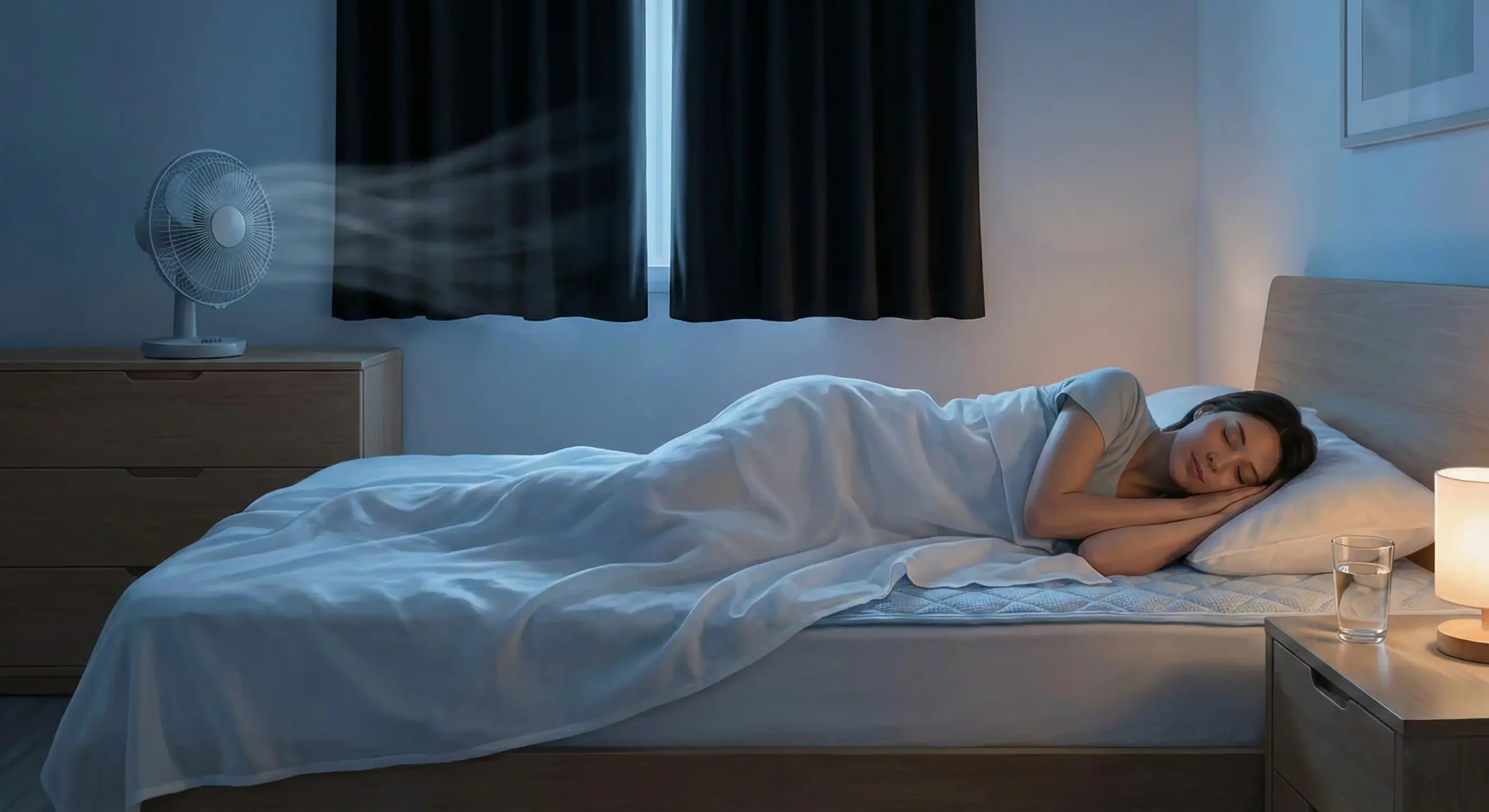
#3: Cross-Ventilation Fan Strategy
Why it works: Creating airflow across your body enhances convective and evaporative cooling. But fan placement matters enormously—a poorly placed fan can actually make things worse by circulating hot air.
How to implement: The optimal setup uses cross-ventilation: one fan positioned to pull hot air out (pointing out an open window on one side of the room) and another fan positioned to push cooler air in (near an open window or door on the opposite side). This creates a continuous flow of air through the room, preventing hot air from stagnating. If you can’t do cross-ventilation, position a fan so it’s not blowing directly on you all night (which can dry out airways and cause discomfort) but rather creating general air circulation in the room.
Alternative: A ceiling fan running counterclockwise (summer mode) creates a gentle downdraft that doesn’t dry you out but keeps air moving.
Cost: $30-80 for a good quality fan.
Effectiveness rating: 7/10. Very helpful, especially when combined with other strategies.
#4: Cotton or Bamboo Sheets (Not Synthetic)
Why it works: Fabric choice dramatically affects heat retention. Synthetic materials (polyester, microfiber) trap heat and don’t absorb moisture well, creating a sticky, uncomfortable sleeping environment. Natural fibers like cotton and bamboo wick moisture away from your skin, allow better airflow, and don’t trap heat the way synthetics do.
How to implement: Look for 100% cotton sheets with a thread count between 200-400. (Higher thread counts actually trap more heat because the weave is too tight for airflow.) Percale weave (crisp feel) is cooler than sateen (smooth feel). Bamboo sheets are another excellent option—they’re naturally moisture-wicking and typically feel 2-3°F cooler to the touch than standard cotton.
What to avoid: Jersey sheets (t-shirt material), flannel, satin, microfiber, and high thread-count (600+) luxury sheets. These are all designed to trap warmth, which is exactly what you don’t want in summer.
Cost: $40-100 for a quality cotton or bamboo sheet set.
Effectiveness rating: 6/10. It won’t solve extreme heat, but it prevents sheets from actively making things worse.
#5: Blackout Curtains (Prevent Daytime Heat Buildup)
Why it works: Sunlight streaming into your bedroom during the day heats up the room, and that heat is retained by walls, furniture, and bedding well into the evening. Blackout curtains block solar heat gain during the day, keeping your bedroom 5-10°F cooler by evening.
How to implement: Install blackout curtains or thermal curtains on all windows that receive direct sunlight. Keep them closed during the hottest part of the day (roughly 12 PM – 6 PM). Open windows at night to let in cooler air, then close curtains again in the morning before the sun hits. This creates a thermal management cycle that keeps your room cooler overall.
Bonus benefit: Blackout curtains also eliminate early morning light, which helps you sleep later (or at least prevents premature waking from sunrise).
Cost: $30-80 per window.
Effectiveness rating: 6/10. Preventive rather than immediate cooling, but meaningful over days and weeks.
#6: Sleep Position Strategy (Alone and Spread Out)
Why it works: Sharing a bed with a partner increases heat generation and heat retention. Each person generates roughly 75-100 watts of body heat—essentially like having a 75-watt light bulb in bed with you. Additionally, sleeping in close contact (cuddling, touching) prevents heat dissipation from the contact areas.
How to implement: If possible, sleep with more space between you and your partner. Some couples resort to separate beds or even separate rooms during extreme summer heat. If that’s not possible, use individual sheets/blankets instead of sharing, which creates an insulating layer between you. Also, consider who naturally runs hotter and position them on the side of the bed with better airflow (near the fan or window).
Solo sleepers: Spread out rather than curling into a ball. The more surface area you expose to the air, the more heat you can dissipate. Sleeping on your back or loosely on your side is better than tight fetal position for heat dissipation.
Cost: Free (just spatial arrangement).
Effectiveness rating: 5/10. Meaningful if you share a bed; less relevant for solo sleepers.
#7: Elevated Legs/Head (Improved Blood Flow for Heat Dissipation)
Why it works: Slightly elevating your legs improves venous return (blood flow back toward your heart) and helps your body move warm blood from your extremities toward your core where it can be cooled more easily through breathing and other mechanisms. Similarly, elevating your head slightly promotes better airflow and keeps cool air circulating near your face and neck—areas with high blood flow near the surface.
How to implement: Use a thin pillow under your knees to elevate legs slightly (don’t overdo it—just 2-3 inches). For your head, use a pillow that keeps your neck supported but not so high that it restricts airflow around your face.
Cost: Free if you already have pillows; $20-40 for a knee pillow if you want something specific.
Effectiveness rating: 4/10. Subtle benefit, but every bit helps in extreme heat.
#8: Cold Foot Bath Before Bed
Why it works: Your feet are one of the primary sites for heat dissipation. They contain specialized blood vessels called arteriovenous anastomoses (AVAs) that can rapidly shunt warm blood from your core to your extremities where heat is released. Cooling your feet before bed accelerates this heat dissipation process.
How to implement: Fill a basin with cool (not ice-cold) water and soak your feet for 5-10 minutes before bed. The water should feel refreshing but not painful—around 60-70°F is ideal. Pat dry and go straight to bed while your feet are still cool.
Alternative: Wet a thin towel, wring it out, and wrap your feet for 5-10 minutes. Re-wet the towel halfway through as it warms up.
Cost: Free (water and a basin or towel).
Effectiveness rating: 5/10. Simple, quick, and surprisingly effective for initiating the sleep-onset temperature drop.
What Doesn’t Work (Stop Wasting Time on These)
Ice packs directly on skin: Seems logical, but ice is too cold—it causes vasoconstriction (blood vessels close to protect you from cold), which actually prevents heat dissipation. You end up colder on the surface but your core temperature stays elevated. Worse, ice packs become uncomfortable and disrupt sleep.
Sleeping naked: Many people assume this helps, but it can backfire. Clothing actually wicks moisture away from your skin, facilitating evaporative cooling. Without any fabric, sweat just pools on your skin rather than evaporating. The exception: very light, loose-fitting cotton sleepwear can be better than nothing.
Alcohol before bed: Alcohol might make you feel relaxed and sleepy initially, but it disrupts thermoregulation. It causes vasodilation (blood vessels expand), which can initially make you feel warm and flushed, then later causes nighttime sweating and temperature fluctuations that fragment sleep. If sleep quality in heat is already poor, alcohol makes it worse.
Leaving the refrigerator open near your bed: People try this surprisingly often. It’s ineffective (refrigerators heat the room overall through their exhaust) and potentially dangerous (risk of food spoilage, wasted electricity).
Heavy meals before bed: Digestion generates heat (thermogenesis). Eating a large meal within 2-3 hours of bedtime raises your core temperature just when you need it to drop. Save big meals for earlier in the day if you’re struggling with heat-related sleep issues.
Combined Protocol: The Complete Summer Sleep Strategy
For maximum effectiveness, combine multiple strategies rather than relying on just one:
Daytime (Prep Phase)
- Keep blackout curtains closed during peak sun (12 PM – 6 PM)
- Open windows early morning and late evening to let in cooler air, close windows during hot afternoon
- Avoid heavy meals within 3 hours of bedtime
- Stay hydrated (dehydration impairs thermoregulation)
90 Minutes Before Bed
- Take a cool shower (5-10 minutes at refreshing temperature)
- Put on light cotton or bamboo sleepwear
- Turn on fans to start circulating cooler evening air
30 Minutes Before Bed
- Dim lights (support melatonin production)
- Optional: cold foot bath (5-10 minutes)
- Ensure cooling mattress pad is running (if using active system)
Bedtime
- Room temperature as cool as possible (ideally 65-68°F if AC available, but realistic goal is “coolest achievable”)
- Fan(s) providing cross-ventilation
- Light, breathable cotton/bamboo sheets (minimal blanket, if any)
- Sleep position that maximizes surface area for heat dissipation
If You Wake Up Hot at Night
- Avoid turning on bright lights (disrupts circadian rhythm and melatonin)
- Use a damp washcloth on neck/forehead for quick cooling
- Flip pillow to cool side
- If necessary, get up, wet hands/wrists with cool water, return to bed
This comprehensive approach addresses heat through multiple mechanisms simultaneously, which is far more effective than any single intervention.
Temperature and Sleep Architecture: What the Data Shows
Beyond subjective discomfort, heat has measurable effects on sleep stages. Research using polysomnography (sleep studies) shows that when bedroom temperature exceeds 75°F:
Deep sleep (Stage N3) decreases by 15-25%: Deep sleep is the most temperature-sensitive sleep stage. When core temperature can’t drop sufficiently, your body spends less time in deep sleep cycles and more time in lighter sleep stages. Since deep sleep is critical for physical recovery, immune function, and hormonal regulation, this reduction has real health consequences.
REM sleep becomes fragmented: REM sleep involves near-total loss of thermoregulation—your body temporarily stops sweating and shivering to maintain temperature. In hot conditions, this makes REM sleep more vulnerable to disruption. You may still get REM sleep, but it’s broken into shorter, less restorative episodes.
Sleep efficiency drops: Sleep efficiency (percentage of time in bed actually spent asleep) drops from a healthy 85-90% to 70-80% or worse when sleeping in heat. You spend more time awake in bed, tossing and turning.
Night awakenings increase: Heat causes more frequent brief awakenings (microarousals) throughout the night, even if you don’t consciously remember them. These fragment sleep continuity and reduce morning alertness.
The cumulative effect: even if you spend 8 hours in bed, you might only get 6-6.5 hours of actual sleep, with reduced quality. This is why people often feel exhausted during heat waves despite “sleeping” their normal amount of time.
Long-Term Strategies If You Live in Hot Climate
If you live somewhere with prolonged summer heat (Arizona, Texas, Southern states, tropical climates), seasonal band-aids aren’t enough. Consider these longer-term solutions:
Mini-split AC for bedroom: If whole-home AC isn’t possible, a mini-split system for just the bedroom (cost: $1200-2500 installed) provides targeted cooling where it matters most. Many people find they can tolerate heat during the day but need cool sleep at night for health and functioning.
Active cooling mattress system: An investment ($400-900), but if heat disrupts your sleep more than 60-90 days per year, the ROI is high. Better sleep = better health, productivity, and quality of life.
Window tinting/reflective film: Reduces solar heat gain through windows by 40-60%, keeping your room cooler without needing blackout curtains during the day. Cost: $200-500 for bedroom windows.
Insulation upgrade: If your bedroom is poorly insulated, consider upgrading attic insulation (reduces heat transfer from hot roof) and weather-sealing around windows. This pays dividends in both summer (keeping heat out) and winter (keeping heat in).
Strategic room choice: If you’re renting or have multiple bedroom options, choose the coolest room for sleeping. Typically, ground-floor rooms facing north or east stay cooler than upper-floor rooms facing south or west. Sometimes just moving to a different bedroom in summer makes a huge difference.
Common Questions About Sleeping in Summer Heat
Is it safe to sleep with a fan on all night?
Yes, for most people, sleeping with a fan on all night is safe and beneficial. Some concerns that occasionally come up: Air circulation drying out airways: Can happen if air blows directly on your face all night, but this is easily solved by positioning the fan to create general room circulation rather than direct airflow. “Fan death” myth: This is a Korean urban legend with no scientific basis. Fans do not cause suffocation or hypothermia. Dust circulation: Fans can stir up dust, which may bother people with allergies. Solution: clean fan blades regularly and use an air purifier if needed. Overall, the benefits of improved air circulation far outweigh any minimal risks.
Will sleeping in heat damage my health?
Short-term heat exposure (a few weeks of poor sleep during a summer heat wave) is uncomfortable but not dangerous for healthy adults. However, chronic sleep disruption from heat over months or years can contribute to health issues: increased inflammation, weakened immune function, metabolic disruption, cardiovascular strain, and mood disorders. If you consistently sleep poorly due to heat for more than 6-8 weeks, invest in better cooling solutions—this isn’t just about comfort, it’s about protecting your long-term health.
Should I sleep with windows open or closed in summer?
It depends on outside vs. inside temperature. If outside temperature is cooler than inside (typically true at night in many climates), open windows to let cooler air in. If outside temperature is hotter than inside (common in desert climates or during extreme heat), keep windows closed and rely on internal cooling methods. Many people get the best results with a combination: windows closed with blackout curtains during hot afternoon, windows open late evening through early morning for cool-down, windows closed again once sun starts heating things up.
Does humidity make heat worse for sleep, or is temperature more important?
Both matter, but humidity is often underestimated. At 80°F with 30% humidity, you can still sleep reasonably well with a fan and appropriate strategies. At 80°F with 80% humidity, sleep becomes nearly impossible without active cooling, because your body can’t evaporate sweat effectively. If you live in a humid climate, a dehumidifier in your bedroom can make a dramatic difference—bringing humidity down from 70-80% to 45-50% makes the same temperature feel significantly cooler. Ideal sleeping conditions: 60-67°F at 40-50% humidity.
INTERNAL LINKS
To optimize your sleep environment beyond just temperature:
- Understand the core temperature mechanism in ideal temperature for deep sleep
- Fix your overall sleep environment in how to improve sleep quality
- Learn about circadian rhythm and light timing in circadian rhythm guide
- See the complete 24-hour protocol in ultimate sleep optimization protocol
- If waking at night is your main issue, read why you wake up at 3-4 AM
SOURCES
- Thermoregulation and sleep architecture: Kräuchi, K. “The thermophysiological cascade leading to sleep initiation in relation to phase of entrainment.” Sleep Medicine Reviews, 2007. https://pubmed.ncbi.nlm.nih.gov/17442590/
- Ambient temperature effects on sleep stages: Okamoto-Mizuno, K., & Mizuno, K. “Effects of thermal environment on sleep and circadian rhythm.” Journal of Physiological Anthropology, 2012. https://pubmed.ncbi.nlm.nih.gov/22738673/
- Body cooling mechanisms and sleep onset: Raymann, R.J., et al. “Skin deep: enhanced sleep depth by cutaneous temperature manipulation.” Brain, 2008. https://pubmed.ncbi.nlm.nih.gov/18567924/
- Passive cooling and sleep quality: Lan, L., et al. “Neurobehavioral approach for evaluation of office workers’ productivity: The effects of room temperature.” Building and Environment, 2011. https://www.sciencedirect.com/science/article/abs/pii/S0360132311000898
- Mattress surface temperature and sleep: Okamoto-Mizuno, K., et al. “Effects of humid heat exposure on human sleep stages and body temperature.” Sleep, 1999. https://pubmed.ncbi.nlm.nih.gov/10408361/