What it is: L-Theanine is an amino acid found naturally in tea leaves that promotes relaxation without sedation.
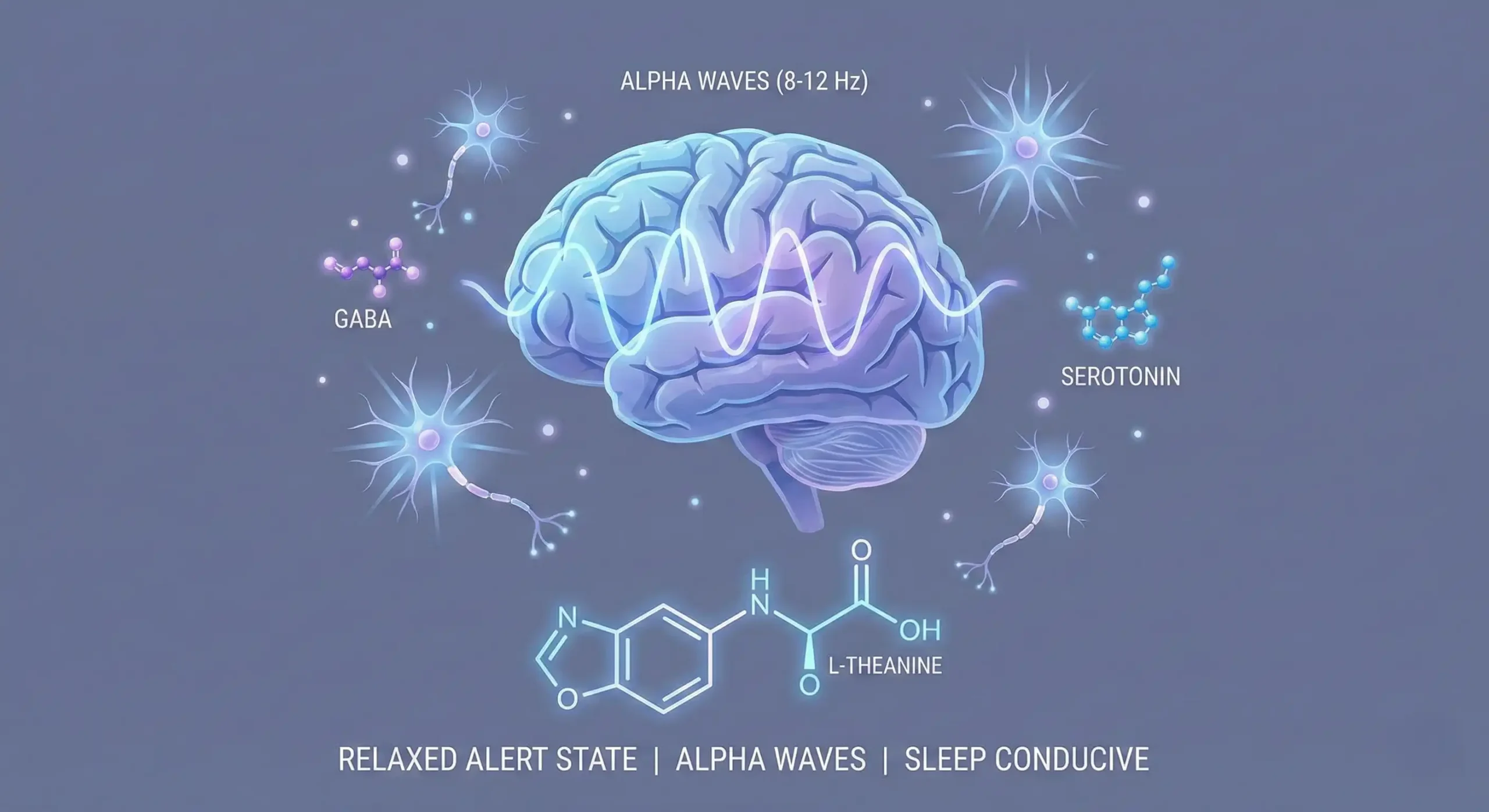
How it works: Increases GABA, serotonin, and dopamine; promotes alpha brain waves (calm alertness); reduces cortisol and stress response.
Dosing for sleep: 100-200mg taken 30-60 minutes before bed (not a sleep aid itself, but reduces anxiety/racing thoughts that prevent sleep).
Timeline: Works within 30-40 minutes, effects last 3-4 hours. Not habit-forming, can be used nightly long-term.
The key distinction: L-Theanine isn’t a sedative like melatonin or sleeping pills—it doesn’t “knock you out.” Instead, it quiets the mental chatter and anxiety that often prevent sleep onset. If your sleep problem is “tired but wired”—body exhausted but mind racing—L-Theanine directly addresses that issue. If your sleep problem is circadian misalignment or you’re genuinely not tired, L-Theanine alone won’t solve it (though it can still be part of the solution). Think of it as removing obstacles to sleep rather than forcing sleep.
Want Better Sleep Stats?
Theory is good, but tools get results. See the exact stack (mask, tape, supplements) I use to get 2+ hours of Deep Sleep every night.
Open Sleep HubWhat Is L-Theanine and How Does It Affect Sleep?
L-Theanine is a unique amino acid found almost exclusively in tea plants (Camellia sinensis)—particularly abundant in green tea, but also present in black tea, white tea, and oolong. It’s responsible for the calming yet focused mental state that tea drinkers often experience, distinct from the jittery energy of coffee.
Unlike typical amino acids that are used to build proteins, L-Theanine is psychoactive—it crosses the blood-brain barrier and directly influences neurotransmitter systems in your brain. This makes it particularly effective for sleep-related issues rooted in stress, anxiety, or an overactive mind.
How L-Theanine Works in Your Brain
L-Theanine influences multiple neurotransmitter systems simultaneously, creating a unique “relaxed alertness” state:
GABA (gamma-aminobutyric acid) modulation: L-Theanine increases GABA activity in your brain. GABA is your primary inhibitory neurotransmitter—it acts like a brake pedal for your nervous system, reducing neuronal excitability and promoting calm. Low GABA is associated with anxiety, racing thoughts, and difficulty “turning off” your mind. By supporting GABA function, L-Theanine makes it easier to transition from the active, alert state of daytime into the quiet, restful state needed for sleep.
Serotonin and dopamine boost: L-Theanine modestly increases serotonin and dopamine levels in certain brain regions. Serotonin promotes feelings of well-being and is a precursor to melatonin (your sleep hormone). Dopamine supports motivation and reward processing. The combination creates a calm, content mental state that’s conducive to winding down for sleep.
Alpha brain wave promotion: EEG studies show that L-Theanine increases alpha wave activity (8-12 Hz) in the brain, particularly in the frontal cortex. Alpha waves are associated with relaxed alertness—the state you’re in during meditation, gentle focus, or just before falling asleep. Beta waves (13-30 Hz), by contrast, are associated with active thinking, stress, and alertness. By shifting your brain from beta-dominant to alpha-dominant, L-Theanine creates the neural environment where sleep can naturally occur.
Cortisol reduction: L-Theanine blunts the stress response by reducing cortisol release during stressful situations. Cortisol is your “wake-up” hormone—elevated cortisol at night prevents sleep onset and disrupts sleep architecture. If your sleep issues are stress-related (work worries, life stress keeping you awake), L-Theanine’s cortisol-dampening effect is particularly relevant.
What L-Theanine Doesn’t Do
It’s equally important to understand what L-Theanine isn’t:
Not a sedative: L-Theanine doesn’t cause drowsiness or force sleep. You won’t feel groggy or “drugged.” Some people report feeling more mentally clear after taking L-Theanine because anxiety fog is reduced.
Not a circadian regulator: L-Theanine doesn’t reset your body clock or shift your circadian rhythm like light exposure or melatonin do. If your sleep problem is circadian misalignment (like in circadian rhythm disruption), L-Theanine addresses symptoms but not the root cause.
Not a cure for sleep apnea or movement disorders: L-Theanine works on the mental/neurological side of sleep—anxiety, racing thoughts, stress. It won’t help with physical sleep disorders like sleep apnea, restless leg syndrome, or chronic pain keeping you awake.
Not a replacement for sleep hygiene: If your bedroom is hot, bright, and noisy, or you’re drinking coffee at 8 PM, L-Theanine can’t override terrible sleep habits. It’s a tool that works best within the context of good sleep optimization practices.
The Research: Does L-Theanine Actually Improve Sleep?
The research on L-Theanine for sleep is moderately robust, with most studies showing positive but modest effects. Here’s what the science says:
Sleep Quality Studies
A 2019 study in Nutrients examined L-Theanine supplementation (200mg daily for 4 weeks) in adults with stress-related sleep difficulties. Results:
- Significant improvement in sleep quality scores (Pittsburgh Sleep Quality Index)
- Reduced sleep latency (time to fall asleep) by an average of 15 minutes
- Improved subjective sleep satisfaction
- No side effects or next-day grogginess reported
A double-blind RCT from Journal of Clinical Psychiatry (2011) studied 60 boys diagnosed with ADHD who had sleep difficulties. Those receiving 200mg L-Theanine twice daily (morning and evening) showed:
- Higher sleep efficiency (more time asleep vs. time in bed)
- Fewer nighttime awakenings
- Parents reported the children seemed more refreshed in the morning
A 2020 study in Pharmacological Research investigated L-Theanine’s effects on sleep after acute stress. Participants given 200mg L-Theanine before a stressful task showed:
- Reduced subjective anxiety
- Better sleep quality that night (measured via actigraphy)
- Maintained REM sleep despite the stressor (stress typically reduces REM)
EEG and Brain Wave Studies
Research using EEG monitoring consistently shows that L-Theanine increases alpha wave activity within 30-45 minutes of ingestion. A landmark study in Asia Pacific Journal of Clinical Nutrition (2008) found:
- 200mg L-Theanine significantly increased alpha waves in the occipital and parietal regions
- Effects peaked around 60 minutes post-ingestion
- Participants reported feeling more relaxed but not sleepy
This alpha wave promotion is why L-Theanine is sometimes marketed as a focus supplement (for calm, sustained concentration during the day) as well as a sleep aid (for calm transition into sleep at night). The dose and timing determine which benefit you get.
Limitations of the Research
Modest effect sizes: L-Theanine typically reduces sleep latency by 10-20 minutes and improves subjective sleep quality. These are meaningful improvements, but not dramatic transformations—don’t expect to go from 2 hours of tossing and turning to instant sleep.
Best for anxiety-related sleep issues: The studies show strongest effects in people whose sleep problems are driven by stress, anxiety, or racing thoughts. If your insomnia is from chronic pain, sleep apnea, or severe circadian dysfunction, L-Theanine alone won’t be sufficient.
Individual variability: As with most supplements, some people respond very well (“this changed my sleep completely!”) while others notice minimal effects. Genetics, baseline stress levels, and other factors influence response.
How to Use L-Theanine for Sleep: Practical Protocol
Based on the research and clinical use, here’s the evidence-based protocol for using L-Theanine to improve sleep:
| Parameter | Recommendation | Notes |
|---|---|---|
| Dose | 100-200mg | Start with 100mg; increase to 200mg if needed |
| Timing | 30-60 min before bed | Allows time for absorption and brain effects |
| Frequency | Nightly is fine | Non-habit-forming; safe for long-term use |
| Form | Capsules or powder | Powder can be mixed into herbal tea |
| Duration | Use consistently for 1-2 weeks minimum | Benefits increase with regular use |
| Empty or full stomach | Either works | Some prefer empty stomach for faster absorption |
Step-by-Step Implementation
Week 1 (Testing Phase):
- Start with 100mg taken 45 minutes before your target bedtime
- Observe how you feel: more relaxed? Easier to stop ruminating? No effect?
- Track sleep onset time and subjective sleep quality
Week 2 (Optimization):
- If 100mg showed modest benefit, try 200mg
- If timing felt off (effects wore off too soon or peaked too late), adjust timing by 15 minutes
- Note any patterns: does it work better on high-stress days?
Week 3+ (Consistency):
- Settle into your optimal dose and timing
- Continue nightly or use situationally (high-stress nights only)
- Can be used indefinitely without tolerance buildup
Combining L-Theanine With Other Sleep Aids
L-Theanine + Magnesium Glycinate: This is one of the most popular and effective combinations. L-Theanine calms the mind, magnesium glycinate relaxes muscles and supports GABA receptors. Take both 30-60 min before bed. Non-interacting, complementary mechanisms.
L-Theanine + Melatonin: Can be combined. L-Theanine addresses anxiety/racing thoughts, melatonin addresses circadian timing. Take L-Theanine 30-60 min before bed, melatonin 60-90 min before bed (melatonin needs longer lead time).
L-Theanine + Ashwagandha: Another adaptogen that reduces cortisol and anxiety. They work synergistically. Some people find this combination very sedating, so start with lower doses of each.
L-Theanine + Caffeine (Daytime Use): Interestingly, L-Theanine + caffeine is a popular combination for daytime focus (calm alertness without jitters). The ratio is typically 2:1 L-Theanine to caffeine (e.g., 200mg L-Theanine + 100mg caffeine). This is for daytime productivity, not sleep—don’t take caffeine anywhere near bedtime.
L-Theanine vs. Other Sleep Supplements: How Does It Compare?
Understanding where L-Theanine fits in the landscape of sleep supplements helps you choose the right tool for your specific sleep issue.
L-Theanine vs. Melatonin
Melatonin:
- Hormone that regulates circadian timing
- Best for: Jet lag, shift work, circadian misalignment
- Mechanism: Signals “biological night” to your body
- Timing: Take 60-90 min before desired sleep time
- Side effects: Possible next-day grogginess, vivid dreams
L-Theanine:
- Amino acid that promotes relaxation
- Best for: Anxiety-driven insomnia, racing thoughts
- Mechanism: Calms nervous system via GABA, alpha waves
- Timing: Take 30-60 min before bed
- Side effects: Minimal to none
Which to choose: If your problem is “I’m tired but my mind won’t shut off,” try L-Theanine first. If your problem is “I’m not sleepy at the right time” (circadian issue), melatonin is more appropriate. Many people use both.
L-Theanine vs. Magnesium
Magnesium (specifically glycinate or threonate):
- Mineral that supports GABA receptors and muscle relaxation
- Best for: Muscle tension, restless legs, anxiety
- Mechanism: Nervous system calming + physical relaxation
- Dose: 200-400mg before bed
- Side effects: Digestive issues with some forms (not glycinate)
L-Theanine:
- Primarily mental/cognitive calming
- Less physical muscle relaxation effect
- Works faster (30-40 min vs. 60-90 min for magnesium)
Which to choose: If your issue is physical tension or muscle cramps at night, magnesium. If it’s mental anxiety or racing thoughts, L-Theanine. Again, combining both is very common and effective.
L-Theanine vs. Prescription Sleep Medications
Prescription medications (Ambien, benzos, Z-drugs):
- Force sleep through sedation
- Fast-acting, powerful
- Risk of dependence, tolerance, next-day impairment
- Should be short-term use only
L-Theanine:
- Supports natural sleep onset (doesn’t force it)
- Gentle, subtle effects
- No dependence, no tolerance, no withdrawal
- Safe for long-term use
Which to choose: L-Theanine is appropriate for mild-to-moderate sleep onset issues. Severe, chronic insomnia that’s impacting function often requires medical treatment (which might include prescription meds short-term while addressing root causes). L-Theanine can be part of the plan but usually isn’t sufficient alone for severe insomnia.
Who Benefits Most From L-Theanine for Sleep?
L-Theanine works particularly well for specific sleep problem profiles:
Ideal Candidates for L-Theanine
The “tired but wired” person: Physically exhausted, mentally alert. Lies in bed with racing thoughts about work, relationships, tomorrow’s to-do list. This is L-Theanine’s sweet spot.
Stress-driven poor sleep: If your sleep quality tanks during high-stress periods (work deadlines, life transitions, financial stress), L-Theanine can buffer the impact of that stress on sleep.
The ruminator: Tendency to replay conversations, analyze problems, or plan obsessively when trying to fall asleep. L-Theanine quiets this mental loop.
Anxiety-prone individuals: Generalized anxiety, social anxiety, or performance anxiety that carries over into nighttime. L-Theanine’s anxiolytic effects help.
Students or knowledge workers: People whose work involves intense mental effort often struggle to “turn off” their minds. L-Theanine creates a cognitive off-ramp.
Who Might Not Benefit as Much
People with sleep apnea: L-Theanine won’t address airway obstruction or breathing disruptions. You need CPAP or surgical intervention for sleep apnea.
Chronic pain sufferers: If pain is what’s keeping you awake, L-Theanine’s mental calming won’t be sufficient. You need pain management strategies.
Severe circadian misalignment: If your sleep schedule is shifted by 3-4+ hours (extreme night owl trying to sleep at 10 PM), L-Theanine helps with anxiety about not sleeping but doesn’t fix the circadian root cause.
Already-calm individuals with pure circadian issues: If you’re relaxed and calm but simply not sleepy at bedtime because your body clock is off, addressing light exposure and circadian timing is more important than adding L-Theanine.
Potential Side Effects and Safety Considerations
L-Theanine has an excellent safety profile with minimal side effects, but here’s what to know:
Common Non-Issues
Tolerance: Unlike many sleep aids, L-Theanine doesn’t lose effectiveness over time. You don’t need to keep increasing the dose.
Dependence: Not habit-forming. You can stop taking it anytime without withdrawal symptoms.
Next-day grogginess: Rare. Most people wake up feeling normal or refreshed because their sleep quality was better, not worse.
Drug interactions: Minimal. L-Theanine doesn’t interact significantly with most medications.
Rare or Mild Side Effects
Headaches: A small percentage of people (~5%) report mild headaches, particularly at higher doses (400mg+). Solution: reduce dose.
Dizziness: Rare, usually only at very high doses. Start with 100mg to assess tolerance.
Vivid dreams: Some people report more vivid or memorable dreams when taking L-Theanine. Not necessarily unpleasant, just noticeable.
Gastrointestinal discomfort: Very rare. Taking with food can help if this occurs.
Who Should Avoid or Use Caution
Pregnant or breastfeeding women: Limited research on safety during pregnancy/lactation. Best to avoid or consult with a healthcare provider.
People on blood pressure medications: L-Theanine can lower blood pressure slightly. If you’re on antihypertensive meds, monitor your blood pressure and consult your doctor.
Before surgery: Discontinue 2 weeks before scheduled surgery (theoretical concern about blood pressure interactions with anesthesia).
Children: While some research has been done in children (particularly ADHD studies), give children supplements only under medical guidance.
Common Questions About L-Theanine for Sleep
Can I drink green tea before bed instead of taking L-Theanine supplements?
Green tea contains L-Theanine, but also contains caffeine—typically 20-45mg per cup. Even though the L-Theanine partially offsets caffeine’s stimulating effects, the caffeine can still disrupt sleep for sensitive individuals. If you want to try tea, choose decaf green tea or white tea (lower caffeine). However, you’d need to drink 3-4 cups of tea to get the 100-200mg L-Theanine dose used in sleep studies, so supplements are more practical. One exception: if you’re using L-Theanine for daytime calm focus, regular green tea is perfect (the L-Theanine + caffeine combo is actually synergistic for alert focus).
How quickly does L-Theanine work, and how long do the effects last?
L-Theanine is absorbed relatively quickly. Effects typically begin 30-40 minutes after ingestion and peak around 60-90 minutes. The half-life is approximately 3-4 hours, meaning effects gradually diminish over the next few hours. For sleep, this timeline works well—you take it 30-60 min before bed, effects peak as you’re falling asleep and last through early-to-mid sleep cycles. If you wake up 5-6 hours later, L-Theanine is no longer active, which is fine (you don’t need it for staying asleep, primarily for falling asleep).
Is it better to take L-Theanine every night or only when I’m stressed?
Both approaches work. Daily use: Builds consistent baseline calmness, may improve sleep quality cumulatively. Good for people with chronic anxiety or persistent sleep onset issues. As-needed use: Take on high-stress days or when you anticipate sleep difficulty. Good for people with occasional stress-related insomnia. There’s no tolerance buildup, so you won’t lose effectiveness with daily use, but you also don’t need to take it daily if you don’t need it every night. Experiment with both approaches and see which fits your pattern.
Can L-Theanine help with middle-of-the-night awakenings, or just falling asleep initially?
L-Theanine is most effective for sleep onset (falling asleep initially) because that’s when anxiety and racing thoughts are most problematic. For middle-of-the-night awakenings, the L-Theanine you took before bed is likely metabolized by then (remember, 3-4 hour half-life). Some people keep a low dose (50-100mg) on their nightstand and take it if they wake at 2-3 AM and can’t return to sleep—this can help calm the “oh no, I’m awake and tomorrow will be terrible” anxiety spiral. However, if you’re waking due to other causes (need to urinate, sleep apnea, hot room temperature), L-Theanine won’t fix those issues. See our guide on why you wake up at 3-4 AM for more on nighttime awakenings.
INTERNAL LINKS
To build a complete sleep optimization strategy beyond L-Theanine:
- Address circadian timing issues in circadian rhythm reset protocol
- Fix multiple sleep factors in ultimate sleep protocol
- Understand why you can’t fall asleep in tired but wired guide
- Improve overall sleep quality in how to improve sleep quality
- Learn about red light for evening calm in red light therapy for sleep
SOURCES
- L-Theanine and sleep quality in stress: Williams, J.L., et al. “The effects of green tea amino acid L-theanine consumption on the ability to manage stress and anxiety levels.” Nutrients, 2019. https://pubmed.ncbi.nlm.nih.gov/31623400/
- Alpha brain wave promotion: Nobre, A.C., et al. “L-theanine, a natural constituent in tea, and its effect on mental state.” Asia Pacific Journal of Clinical Nutrition, 2008. https://pubmed.ncbi.nlm.nih.gov/18296328/
- GABA and neurotransmitter effects: Kakuda, T. “Neuroprotective effects of theanine and its preventive effects on cognitive dysfunction.” Pharmacological Research, 2011. https://pubmed.ncbi.nlm.nih.gov/21349332/
- Sleep quality in ADHD children: Lyon, M.R., et al. “The effects of L-theanine on objective sleep quality in boys with ADHD.” Alternative Medicine Review, 2011. https://pubmed.ncbi.nlm.nih.gov/22214254/
- Stress response and cortisol: Kimura, K., et al. “L-Theanine reduces psychological and physiological stress responses.” Biological Psychology, 2007. https://pubmed.ncbi.nlm.nih.gov/16930802/