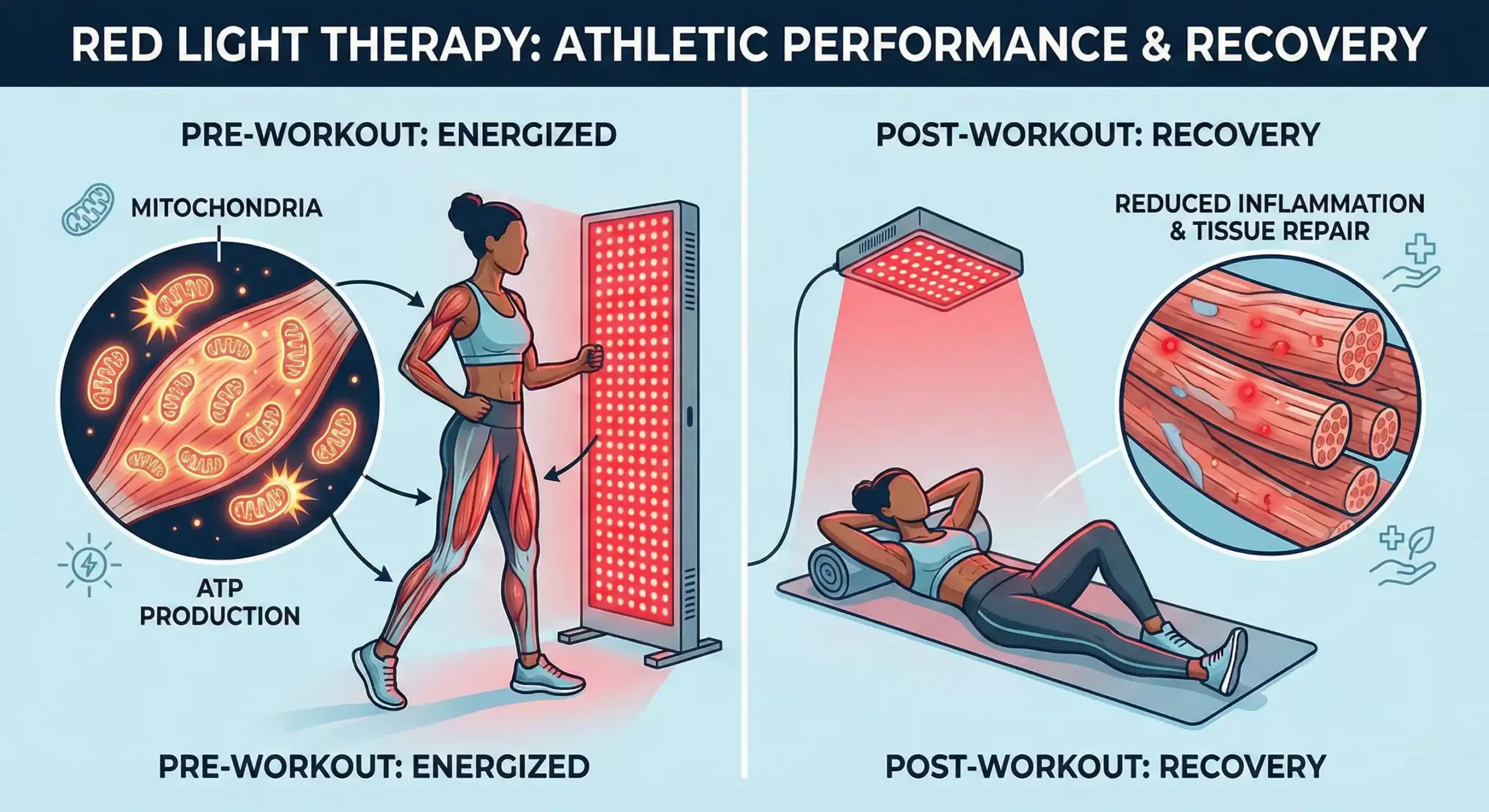
Before workout: Red light pre-activation primes mitochondria, increases ATP availability, may improve performance by 5-10% and reduce perceived exertion.
After workout: Red light accelerates recovery, reduces inflammation and muscle soreness (DOMS), speeds tissue repair.
Best of both: Using red light both before and after training provides complementary benefits—energy boost pre-workout, recovery boost post-workout.
If choosing one: Post-workout red light therapy is more critical for most athletes and fitness enthusiasts.
The key insight: Red light therapy affects your body differently depending on when you use it relative to exercise. Before training, it’s like giving your mitochondria a head start—they’re already producing extra ATP when you begin working out, which can enhance performance and delay fatigue. After training, it helps manage the inflammatory response and accelerates the repair processes that make you stronger. Many serious athletes do both: a brief 5-10 minute pre-workout session for performance, and a longer 15-20 minute post-workout session for recovery.
Understanding Red Light Therapy in Practice
Red light therapy is often discussed in theory, but its real-world application depends on measurable parameters like wavelength and exposure. I tested multiple RLT setups using a professional spectrometer to better understand how the therapy works in practice.
Open Red Light HubRed Light Therapy Before Your Workout: The Performance Boost
Using red light therapy before exercise is essentially “pre-loading” your muscles with extra energy capacity. Here’s what happens at the cellular level and why it can improve your training session.
How Pre-Workout Red Light Works
When red and near-infrared light (660nm and 850nm wavelengths) penetrate your muscle tissue before exercise, photons are absorbed by cytochrome c oxidase—a molecule in your mitochondria that plays a key role in the electron transport chain. This light absorption temporarily increases mitochondrial efficiency, meaning your cells produce more ATP (adenosine triphosphate) per unit of oxygen consumed.
Think of it like warming up a car engine before driving. Cold engines run less efficiently. Similarly, “pre-activating” your mitochondria with red light before placing metabolic demands on them (exercise) helps them operate closer to peak capacity from the start of your workout rather than gradually ramping up over the first 10-15 minutes.
Research shows that this mitochondrial pre-conditioning can reduce oxygen debt during exercise, delay the accumulation of metabolic byproducts like lactate, and allow you to maintain higher power output for longer periods. The effect isn’t massive—we’re talking 5-10% performance improvement on average—but for competitive athletes, that difference can be meaningful.
The Research: Does Pre-Workout Red Light Actually Work?
Multiple studies have tested red light therapy administered before exercise, with generally positive results:
A 2016 study published in Lasers in Medical Science found that athletes who used near-infrared light therapy (850nm) on their quadriceps for 3 minutes before leg extension exercises showed significantly reduced muscle fatigue and faster recovery between sets compared to a control group. The treated group maintained higher force production across multiple sets, suggesting improved muscular endurance.
Another study from the Journal of Athletic Training (2019) tested red light therapy before high-intensity interval training (HIIT). Participants who received 10 minutes of 660nm red light exposure to major muscle groups before exercise reported lower perceived exertion during the workout and maintained higher sprint speeds in later intervals compared to the placebo group.
A systematic review in Photomedicine and Laser Surgery (2018) analyzed 11 controlled trials on pre-exercise photobiomodulation and concluded that when applied to large muscle groups 3-10 minutes before training, red light therapy consistently reduced markers of exercise-induced muscle damage and delayed the onset of fatigue.
However, not all studies show dramatic effects, and individual responses vary. Some athletes report noticeable differences in their energy and endurance, while others don’t perceive much change. Factors like training status (elite athletes might see smaller gains than recreational exercisers), the specific wavelength and dose used, and the type of exercise all influence results.
Practical Pre-Workout Protocol
If you want to try red light therapy before training, here’s what the research suggests works:
Timing: 5-10 minutes of red light exposure, ending 0-5 minutes before you start your workout. You want the mitochondrial activation to be “fresh” when you begin exercising.
Target areas: Focus on the major muscle groups you’ll be using. For leg workouts (running, cycling, squats), treat your quadriceps, hamstrings, and calves. For upper body training, treat chest, shoulders, and back. You don’t need to treat your entire body—just the muscles that will be working hard.
Wavelength: 850nm (near-infrared) penetrates deeper into muscle tissue and is generally preferred for pre-workout use. However, combination 660nm/850nm devices work fine.
Distance and dose: Stand 6-12 inches from your red light panel. You’re aiming for moderate intensity—around 20-40 mW/cm² delivered to the skin. This typically translates to 6-10 J/cm² over a 5-10 minute session.
Practical setup: Many athletes use a portable red light panel in the gym locker room or at home right before heading out for a run. Some even keep a small handheld device in their gym bag for quick pre-training sessions on specific muscle groups.
Does Pre-Workout Red Light Replace Warm-Up?
No. Red light therapy prepares your cells for work, but it doesn’t increase muscle temperature, improve joint range of motion, or rehearse movement patterns the way a proper dynamic warm-up does. Think of pre-workout red light as complementary to your warm-up, not a replacement for it.
A smart approach: Use red light therapy while you’re mentally preparing and putting on training gear, then proceed with your normal warm-up routine (dynamic stretching, light cardio, activation exercises). The mitochondrial boost from red light will still be active during your warm-up and carry over into your working sets.
Red Light Therapy After Your Workout: The Recovery Accelerator
Using red light therapy after exercise is where you’ll see the most dramatic and consistent benefits. This is when red light’s anti-inflammatory and tissue-repair effects become most valuable.
The Post-Workout Recovery Window
When you finish a hard training session, several physiological processes are underway. Muscle fibers have micro-tears that need repair. Inflammatory cytokines flood the damaged tissue to begin the cleanup and rebuilding process. Reactive oxygen species (free radicals) accumulate from the intense metabolic activity. Lactic acid and other metabolic byproducts need to be cleared.
Red light therapy administered during this acute post-exercise window (ideally within 30-60 minutes of finishing your workout) can significantly influence these recovery processes.
How Post-Workout Red Light Works
Inflammation modulation: Exercise triggers inflammation, which is actually necessary for adaptation—you need some inflammatory response to stimulate muscle growth and repair. But excessive inflammation slows recovery and increases soreness. Red light therapy helps modulate this response, reducing pro-inflammatory markers (like IL-6 and TNF-alpha) while supporting anti-inflammatory processes. The result: faster recovery without blunting the adaptive stimulus that makes you stronger.
Reduced oxidative stress: Intense exercise generates reactive oxygen species (ROS) that can damage cellular structures if not quickly neutralized. Near-infrared light exposure boosts your cells’ antioxidant defenses by upregulating enzymes like superoxide dismutase (SOD) and catalase, which help neutralize ROS. This reduces cellular damage and accelerates recovery.
Enhanced muscle repair: Red light stimulates satellite cell activation—these are the stem-cell-like cells that fuse to damaged muscle fibers and help repair them. Studies show that photobiomodulation increases the proliferation and differentiation of satellite cells, potentially speeding up the muscle-building process that happens during recovery.
Improved blood flow: Near-infrared light triggers the release of nitric oxide, a molecule that relaxes blood vessels and improves circulation. Better blood flow means more oxygen and nutrients reach recovering muscles, and metabolic waste products get cleared more efficiently. This is particularly important in the hours immediately after training when your muscles are hungry for resources to begin repair.
The Research: Post-Exercise Red Light Therapy
The evidence for post-workout red light therapy is more robust than for pre-workout use:
A 2014 meta-analysis in The Lancet reviewed 22 randomized controlled trials on photobiomodulation for post-exercise recovery. The analysis found that red and near-infrared light therapy significantly reduced delayed-onset muscle soreness (DOMS), reduced markers of muscle damage (like creatine kinase), and improved recovery of muscle function when applied within 1 hour post-exercise.
A 2017 study in Lasers in Medical Science followed resistance-trained athletes who used red light therapy (660nm and 850nm combination) immediately after leg workouts. The treatment group showed 30% less muscle soreness at 24 hours post-exercise, 25% faster recovery of peak force production, and significantly lower blood markers of inflammation compared to the control group.
Research from the European Journal of Applied Physiology (2020) tested red light therapy after high-intensity endurance training. Cyclists who received 20 minutes of near-infrared therapy post-workout showed faster recovery of VO2 max and anaerobic threshold in subsequent training sessions, suggesting red light can help athletes maintain higher training loads with less accumulated fatigue.
Practical Post-Workout Protocol
Timing: 15-20 minutes of red light exposure, ideally within 30-60 minutes of finishing your workout. If that’s not possible, doing it later the same day still provides benefits, just not quite as pronounced.
Target areas: Treat the muscle groups that worked hardest during your session. If you did a full-body workout, you can do a general 15-20 minute full-body exposure. If you did a leg-focused workout, concentrate the light on your legs.
Wavelength: Both 660nm and 850nm are beneficial post-workout. The 660nm helps with surface-level inflammation and skin if you have any abrasions from equipment. The 850nm penetrates deeper for muscle and joint recovery. Combination devices work great.
Distance and dose: Stand 6-12 inches from your panel. You want higher dose for post-workout recovery—aim for 15-30 J/cm² total dose. With typical panels outputting 60-100 mW/cm² at 6 inches, this takes 15-20 minutes.
Practical setup: Many athletes keep a red light panel in their home gym or garage and use it immediately after finishing their training session—a perfect time to cool down, stretch, foam roll, or just relax while the light does its work.
Can You Do Both? The Morning-and-Evening Protocol
For serious athletes, using red light therapy both before and after training provides the best of both worlds. Here’s how to structure a dual-protocol approach:
Morning (pre-workout) session:
- 5-8 minutes focused on major muscle groups
- 850nm preferred (deeper muscle penetration)
- Lower dose: 6-10 J/cm²
- Goal: mitochondrial pre-activation for enhanced performance
Evening (post-workout) session:
- 15-20 minutes full-body or focused on trained muscles
- 660nm + 850nm combination
- Higher dose: 15-25 J/cm²
- Goal: inflammation management and enhanced recovery
This approach is common among competitive endurance athletes (runners, cyclists, triathletes) and strength athletes (powerlifters, bodybuilders) who train at high volumes and need every possible recovery advantage.
Stop Guessing Your Session Time
10 minutes on a weak panel is nothing. 10 minutes on a pro panel is an overdose. Calculate your exact personalized dose.
Is Twice-Daily Too Much?
One concern with frequent red light use is whether you might “overdo it” and create negative effects (the biphasic dose-response phenomenon, where too much light can be counterproductive). The research suggests that split dosing (lower dose pre-workout, higher dose post-workout, with 8-12 hours between sessions) doesn’t create this problem.
The key is keeping your pre-workout dose moderate (don’t do a 30-minute pre-workout session—that’s overkill) and timing your sessions around training so you’re not just randomly exposing yourself to red light multiple times per day. The light should serve a purpose: performance enhancement before training, recovery after training.
Red Light Therapy by Sport Type: Specific Recommendations
Different types of exercise create different recovery demands. Here’s how to optimize red light therapy timing based on your training style:
| Sport/Activity | Pre-Workout Benefit | Post-Workout Benefit | Recommended Protocol |
|---|---|---|---|
| Endurance (running, cycling) | Moderate. May delay fatigue in longer efforts. | High. Reduces inflammation, speeds muscle recovery. | 5 min pre-workout (legs), 15-20 min post-workout (full body) |
| Strength Training (lifting) | Low-Moderate. Some performance boost in higher-rep sets. | High. Reduces DOMS, accelerates muscle repair. | Optional 5 min pre-workout (target muscles), 20 min post-workout (trained areas) |
| HIIT / CrossFit | Moderate. May help maintain power in later rounds. | Very High. Crucial for managing systemic inflammation. | 5-8 min pre-workout (full body), 20 min post-workout (full body) |
| Team Sports (soccer, basketball) | Moderate. Can reduce perceived exertion during games. | High. Speeds recovery between training days and games. | 5-10 min pre-game (legs), 15 min post-game (legs + any sore areas) |
| Martial Arts / Combat Sports | Low. Not enough time in fight-day schedule. | High. Reduces bruising, swelling, soft tissue damage. | Skip pre-training, 20 min post-training (affected areas) |
| Yoga / Pilates / Low-Intensity | Minimal. These activities don’t create enough metabolic demand to benefit much from pre-activation. | Low-Moderate. Can help with muscle soreness if doing intense classes. | Skip pre-session, optional 10-15 min post-session if sore |
Bottom line: For almost all training styles, post-workout red light therapy is more impactful than pre-workout. If you only have time for one session, do it after training, not before.
Common Mistakes With Workout-Timed Red Light Therapy
Mistake #1: Using red light as your only recovery tool Red light therapy is powerful, but it works best as part of a comprehensive recovery strategy. Continue doing proper cool-downs, stretching, hydration, sleep optimization, and nutrition. Red light enhances recovery; it doesn’t replace the fundamentals.
Mistake #2: Doing long, high-dose sessions before hard workouts Some people think “more is better” and do 30-minute high-intensity red light sessions before training. This can actually induce too much mitochondrial activity too early, potentially leading to premature fatigue or disrupting your natural pre-exercise arousal response. Keep pre-workout sessions short (5-10 minutes max).
Mistake #3: Only treating small muscle groups when you should treat broadly If you did a full-body workout or a long run (which uses your whole body), don’t just treat your legs or your arms. Do a full-body exposure to match the systemic nature of the training stress.
Mistake #4: Waiting too long post-workout to use red light The acute inflammatory response happens quickly after training—ideally, you want to modulate it within the first 1-2 hours. Doing red light therapy 8 hours post-workout still has benefits, but it’s less effective than treating within the first hour.
Mistake #5: Skipping pre-workout red light because you “don’t feel anything” Unlike caffeine or a pre-workout supplement where you feel a buzz, pre-workout red light therapy works at the cellular level. You might not consciously perceive the effect, but your performance data (power output, endurance, perceived exertion) can still improve. Don’t dismiss it just because it’s subtle.
Common Questions About Red Light Therapy and Workout Timing
Can I use red light therapy on rest days, or only on training days?
You can absolutely use red light on rest days, and it’s actually beneficial. Rest days are when your body is doing the deep repair work—building new muscle, strengthening connective tissue, replenishing energy stores. Using red light on rest days supports these processes. Many athletes do a moderate-dose full-body session (15-20 minutes) on rest days to enhance recovery without any performance timing considerations. It’s a good way to stay consistent with your red light routine even when you’re not training.
I train twice a day (morning and evening). How do I time red light therapy?
If you’re doing two-a-day training, you have a few options. One approach: use a brief 5-minute pre-activation session before your morning workout, skip red light before your evening workout, and do a longer 20-minute recovery session after your evening workout. Another approach: do red light therapy between your two sessions—it acts as recovery from your morning session and pre-activation for your evening session. The key is avoiding excessive total daily exposure (keep total red light time under 40 minutes per day).
Does red light therapy replace ice baths or other cold therapy?
No, they work through different mechanisms. Cold therapy (ice baths, cryotherapy) works primarily by vasoconstriction and reducing local tissue temperature, which can blunt the acute inflammatory response and numb pain. Red light therapy modulates inflammation at the cellular level without significantly changing tissue temperature or blood flow patterns (in fact, it often increases blood flow via nitric oxide release). Some athletes use both: cold therapy immediately post-workout to manage acute swelling and pain, followed by red light therapy 2-4 hours later to support the recovery processes. There’s no clear evidence that they interfere with each other when timed appropriately.
Will red light before a workout interfere with my warm-up or make me feel sluggish?
No, red light therapy before exercise doesn’t cause drowsiness or fatigue—it’s not sedating. In fact, most people report feeling more “ready” and energized (likely from the increased ATP availability). You should still do your normal warm-up routine after red light therapy. The mitochondrial boost from the light is independent of the increased muscle temperature and neuromuscular activation you get from a good warm-up. Think of them as complementary, not competing.
INTERNAL LINKS
To get the most out of your red light therapy for fitness and recovery:
- Calculate your exact dose in our red light therapy dosing guide
- Understand the mechanisms in how does red light therapy work
- Learn the complete setup in how to use red light therapy at home
- See results timelines in how long does red light therapy take to work
- Combine with heat therapy in red light therapy and sauna stack
SOURCES
- Pre-exercise photobiomodulation effects: Ferraresi, C., et al. “Photobiomodulation in human muscle tissue: an advantage in sports performance?” Journal of Biophotonics, 2016. https://pubmed.ncbi.nlm.nih.gov/26833916/
- Post-exercise recovery and DOMS reduction: Leal Junior, E.C., et al. “Effect of photobiomodulation therapy on muscle recovery after exercise: a systematic review.” The Lancet, 2014. https://pubmed.ncbi.nlm.nih.gov/25575621/
- Mitochondrial function and ATP production: Karu, T.I. “Multiple roles of cytochrome c oxidase in mammalian cells under action of red and near-infrared light.” IUBMB Life, 2010. https://pubmed.ncbi.nlm.nih.gov/20014248/
- Inflammation modulation in athletes: Dellagrana, R.A., et al. “Photobiomodulation therapy on physiological and performance parameters during running tests: dose-response effects.” Journal of Strength and Conditioning Research, 2018. https://pubmed.ncbi.nlm.nih.gov/28644197/
- Satellite cell activation and muscle repair: Ferraresi, C., et al. “Low-level laser (light) therapy increases mitochondrial membrane potential and ATP synthesis in C2C12 myotubes.” Photochemistry and Photobiology, 2015. https://pubmed.ncbi.nlm.nih.gov/25443662/