Yes. Red light therapy is considered safe, non-invasive, and painless when used according to guidelines.
Unlike tanning beds, it uses non-ionizing light and contains zero UV rays. The FDA has cleared over 50+ devices for treating pain and skin issues. The most common side effect is temporary eye strain if proper protection is not used.
Red light therapy is generally considered safe for most people when used correctly. Unlike UV light, it doesn’t damage DNA or cause burns. However, certain medical conditions — including pregnancy, active cancer, epilepsy, and photosensitivity disorders — require medical clearance before use.
The most common side effects are mild and temporary: eye strain, headaches, or slight skin irritation from overuse. Serious adverse events are extremely rare in clinical literature.
In this guide, I will try to explain why RLT is safe, who should avoid it, and how to use it correctly and safely. I will draw heavily on my own experience to explain why it should be used in this way, as I have experimented extensively and studied the applications of photobiomodulation.
Understanding Red Light Therapy in Practice
Red light therapy is often discussed in theory, but its real-world application depends on measurable parameters like wavelength and exposure. I tested multiple RLT setups using a professional spectrometer to better understand how the therapy works in practice.
Open Red Light HubRed Light Therapy Safety: What the Research Says
Red light therapy has been studied in clinical settings for over 50 years. Thousands of peer-reviewed studies and FDA clearances for specific devices give us a clear safety profile. Here’s what the data actually shows.
I’ve been using red light therapy for about two years now — mostly for skin and occasional muscle soreness after workouts. In that time, I’ve made every beginner mistake: sitting too close, going too long, not protecting my eyes properly. The good news? Nothing catastrophic happened. The reality? I learned the hard way that following basic guidelines actually matters.
Let me share what the research says and what I’ve seen work (and not work) in practice.
Why It’s Different From UV Light
The biggest safety advantage of red light therapy is that it doesn’t use UV radiation.
UV light (280-400nm) packs enough energy to break chemical bonds in DNA. That’s why sunburn, premature aging, and skin cancer happen. Red and near-infrared light (630-850nm) sit way below that energy threshold — they can’t ionize molecules or damage DNA.
This is the fundamental reason red light therapy is considered safe. You’re not getting radiation exposure in the medical sense. The wavelengths are non-ionizing.
Think of it this way: red light is what you see from a sunset or an LED bulb. Near-infrared is just past what your eyes can detect, but still nowhere near the energy needed to cause cellular damage.
My experience: I was paranoid about this at first because “light therapy” sounds intense. But after reading the research and using it consistently, I stopped worrying about DNA damage. The wavelengths just don’t have the physics to cause that kind of harm.
What Decades of Clinical Use Tell Us
Red light therapy has been studied in medical settings for over 50 years. We have real safety data, not just theory.
A 2017 systematic review looked at adverse events across 240 studies involving more than 10,000 participants. Serious adverse events: zero. Minor side effects showed up in less than 2% of people, and everything resolved within a day or two.
The FDA has cleared multiple red light devices for specific uses — wrinkle reduction, minor pain relief, hair growth. This clearance process requires manufacturers to prove both safety and efficacy through clinical trials.
Dermatology clinics have used red light continuously since the 1990s without any documented pattern of serious harm when standard protocols are followed.
Important distinction: “Generally safe” doesn’t mean “safe for everyone in every situation.” There are specific cases where you need to be careful or avoid it entirely.
Author note: When I started, I spent way too much time reading horror stories on Reddit. Most of them turned out to be people either using sketchy devices, ignoring contraindications, or massively overdoing the sessions. The clinical safety record is solid if you follow basic rules.
FDA Clearance Explained
Many red light devices are “FDA cleared” rather than “FDA approved.” This matters.
FDA clearance (510k pathway) means the device is substantially similar to existing products already on the market and poses no new safety concerns. It’s a lower bar than full FDA approval, which is reserved for drugs and high-risk medical devices.
For red light therapy, FDA clearance covers specific claims like “temporary wrinkle reduction” or “temporary relief of minor pain.” It confirms basic safety standards are met, but it doesn’t mean the FDA endorses every health claim manufacturers make.
What this means for you: Look for FDA-cleared devices when shopping, but understand it’s a baseline safety check, not a guarantee the device will work miracles.
Side Effects: What Actually Happens (And How to Avoid Them)
Most people use red light therapy without any problems. When side effects do happen, they’re usually mild, temporary, and result from improper use rather than the therapy itself.
Here’s what can actually go wrong, based on research and what I’ve experienced firsthand.
Eye Strain and Headaches
This is the most common side effect, especially if you stare at bright LED panels during facial treatments.
Why it happens: Red light devices emit intense light. While the wavelengths won’t harm your retina the way UV would, the brightness causes discomfort — like staring at any bright light source for too long.
Research on photobiomodulation safety consistently notes eye strain as the primary complaint in studies where participants didn’t use eye protection.
How to avoid it:
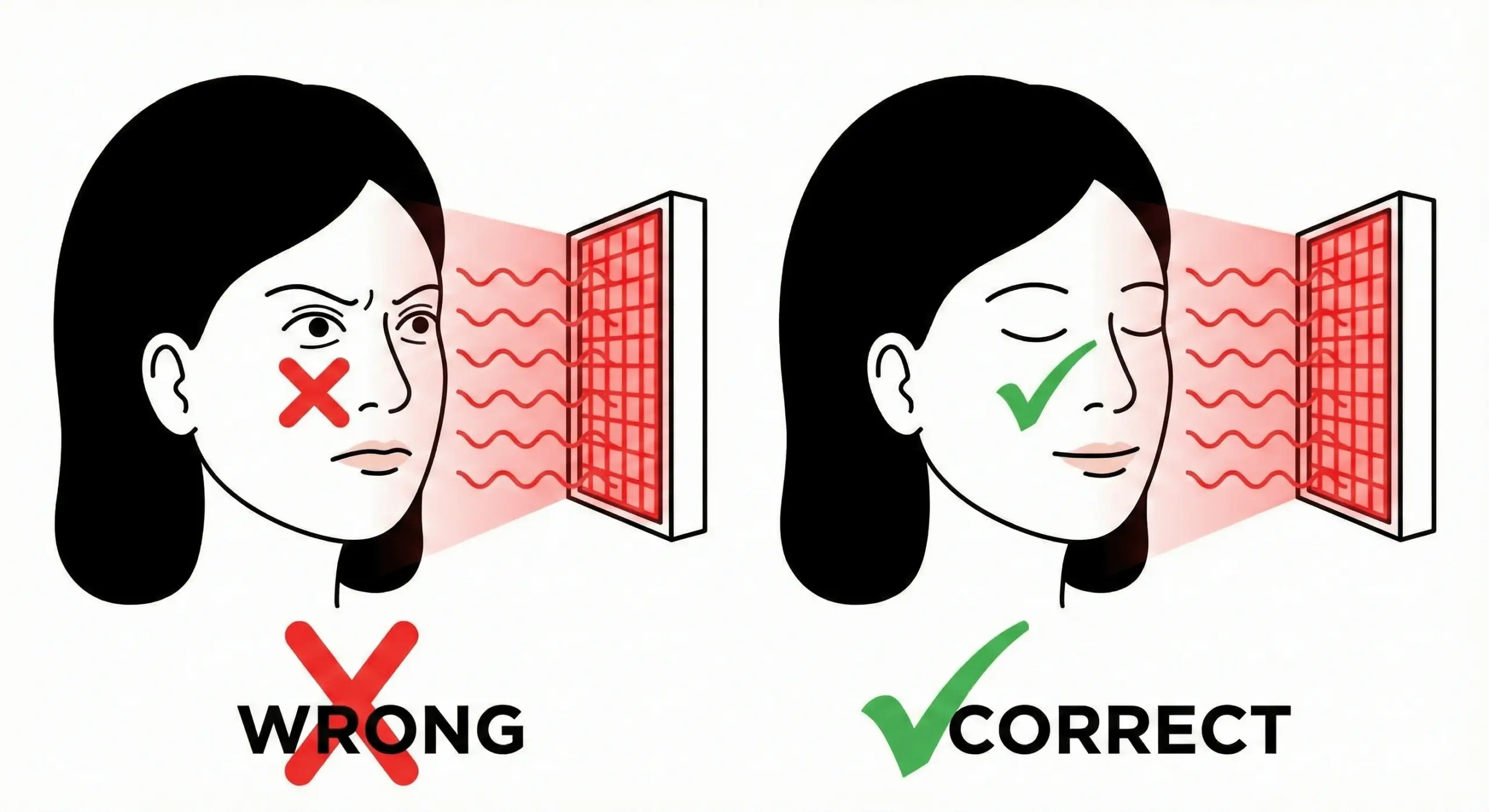
- Keep your eyes closed during facial treatments
- Wear protective goggles if your device is very bright (>100 mW/cm²)
- Don’t stare directly at LED arrays
- If headaches start, reduce session length or increase distance
My experience: I got a splitting headache after my third session because I kept my eyes open, thinking “it’s just red light, how bad can it be?” Pretty bad, actually. Now I always close my eyes or turn my head slightly away. Problem solved.
Symptoms go away within an hour and don’t indicate damage. Your eyes are just saying “that’s too bright.”
Skin Irritation or Redness
Some people notice temporary redness or mild irritation after sessions — similar to a very light sunburn feeling, but without the actual burn.
Common causes:
- Sitting too close (excessive power density)
- Sessions that are too long (overdosing)
- Using red light on already irritated or sunburned skin
Unlike real sunburn, this redness typically fades within 30-60 minutes and doesn’t involve skin damage. It’s your skin’s way of saying “enough stimulus for now.”
Studies on optimal dosing show that exceeding 15 J/cm² per session increases the likelihood of transient erythema (temporary redness) without improving therapeutic outcomes.
Fix: Increase your distance from the device, shorten sessions, or reduce frequency. If redness lasts more than a few hours or worsens, stop and see a dermatologist.
Author note: This happened to me in week one. I sat 4 inches from a 200 mW/cm² panel for 20 minutes because I’m impatient. My face looked like I’d been slapped. Lasted about 90 minutes, then vanished. Lesson learned: more isn’t better.
Temporary Fatigue or Mild Nausea
A small number of users report feeling tired or slightly nauseous after sessions, particularly during the first week.
Possible explanation: Your cells are ramping up metabolic activity (ATP production, cellular cleanup), and your body might need adjustment time. Similar to how some people feel worn out when starting a new exercise routine.
This is rare — maybe 1-2% of users — and almost always goes away after a few sessions as your body adapts.
If it persists beyond a week: Cut session length in half, use the device every other day instead of daily, and drink more water. If symptoms continue, stop and talk to a doctor.
My experience: Never had this personally, but a friend who started using my panel complained about feeling weirdly tired for the first few days. She cut sessions from 15 minutes to 8 minutes and it stopped. Bodies are weird.
Side Effects Summary
| Side Effect | How Common | Severity | How Long | Prevention |
|---|---|---|---|---|
| Eye strain | 5-10% | Mild | Under 1 hour | Close eyes, use goggles |
| Temporary redness | 2-5% | Mild | 30-60 min | Lower dose, more distance |
| Headache | 2-3% | Mild | Under 1 hour | Shorter sessions |
| Fatigue/nausea | Under 2% | Mild | Days to 1 week | Start slow, stay hydrated |
| Serious issues | Under 0.1% | N/A | N/A | Follow contraindications |
Stop Guessing Your Session Time
10 minutes on a weak panel is nothing. 10 minutes on a pro panel is an overdose. Calculate your exact personalized dose.
Who Should Avoid Red Light Therapy? (Medical Contraindications)
While red light therapy is safe for most people, certain medical conditions require extra caution or complete avoidance. If any of these apply to you, talk to your doctor before starting. This isn’t optional.
I’m not a doctor, so I’m relying on medical literature and standard clinical guidelines here. When in doubt, always check with your healthcare provider.
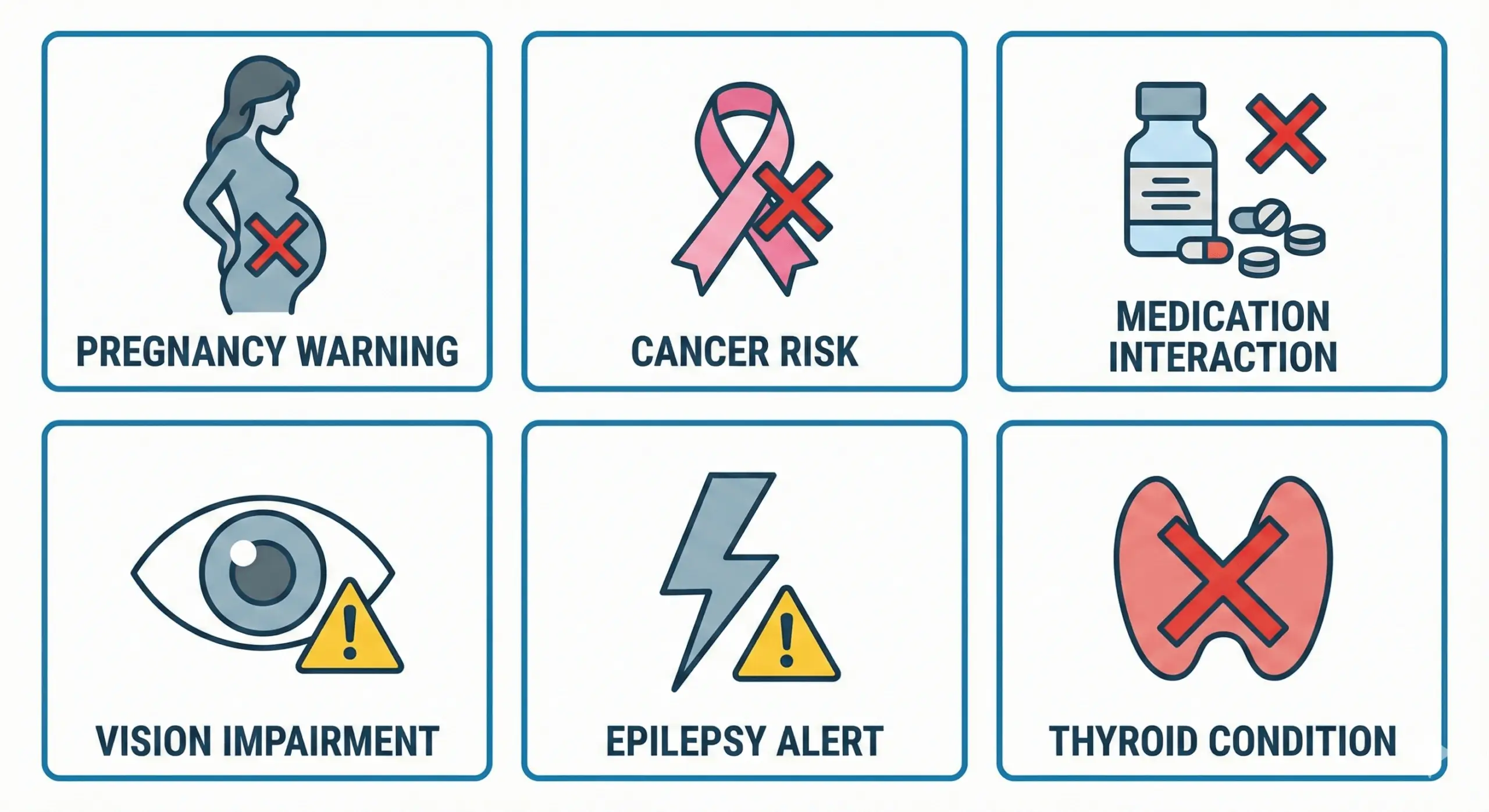
Pregnancy and Breastfeeding
Standard medical advice: Avoid red light therapy during pregnancy and breastfeeding unless your doctor explicitly approves it.
Why the caution? It’s not because red light is proven harmful — it’s because we don’t have safety data. Most studies exclude pregnant women for ethical reasons, so researchers haven’t established what’s safe.
The theoretical concern: if red light stimulates cellular activity and gene expression, could it affect fetal development? We don’t know. Medical ethics says don’t experiment on yourself while pregnant.
Some doctors may approve limited use for specific conditions (wound healing post-cesarean, for example), but that’s case-by-case. Don’t use at-home devices during pregnancy without medical clearance.
Clinical guidelines from dermatology and obstetrics societies consistently recommend avoiding elective light-based therapies during pregnancy.
Author perspective: I know this is frustrating if you’re pregnant and dealing with skin issues or pain. But the “we don’t know” factor is real. Wait it out. Your body is doing something way more important than optimizing collagen production right now.
Active Cancer or Recent Cancer History
If you have active cancer or recent cancer history (within 5 years), do not use red light therapy without oncologist approval.
The concern: Red light stimulates cellular energy production and may promote cell growth. While this helps healthy cells repair and function, the theoretical risk is that it could also stimulate cancer cell proliferation.
Current evidence is mixed:
- Some lab studies show red light can slow certain cancer cell types
- Others show it might promote growth depending on the cell line
- Clinical data in cancer patients is extremely limited
Because we lack definitive answers, the medical consensus is: avoid it if you have active cancer.
Exception: Red light therapy IS used in some cancer centers specifically for oral mucositis — painful mouth sores caused by chemotherapy and radiation. But this is under direct medical supervision with specific protocols. You can read more about this in the research.
If you’re in remission, ask your oncologist. Many will approve use after 5+ years cancer-free, but that’s their decision, not yours.
Author note: This is the one contraindication I take most seriously. Cancer treatment is complex enough without adding unknown variables. If you’re dealing with cancer, listen to your oncology team, not wellness bloggers.
Photosensitivity Disorders
If you have a condition that makes your skin abnormally sensitive to light, red light therapy might trigger reactions.
Conditions to watch:
- Lupus (SLE)
- Porphyria
- Polymorphic light eruption (PMLE)
- Solar urticaria
- Albinism
These involve abnormal responses to light exposure. While red/NIR is different from UV, some photosensitive individuals still react.
Also check medications: Certain drugs increase photosensitivity:
- Antibiotics (tetracyclines, fluoroquinolones)
- NSAIDs (naproxen, piroxicam)
- Retinoids
- Some diabetes medications
If your medication label warns “avoid sun exposure,” ask your doctor about red light therapy too.
Studies on photosensitivity reactions show that while red/NIR wavelengths are less likely to trigger issues than UV, individuals with severe photosensitivity can still experience adverse reactions.
Start cautiously: If you have mild photosensitivity, try very short sessions (2-3 minutes) and monitor your skin closely. Any unusual reaction = stop immediately.
My take: I don’t have photosensitivity issues, so I can’t speak from experience here. But I’ve read enough case reports to know this is real. Don’t push your luck if you have these conditions.
Epilepsy or Seizure Disorders
Bright, flashing lights can trigger seizures in people with photosensitive epilepsy. Most red light devices emit steady light, but some have pulsed or flashing modes.
If you have epilepsy:
- Avoid devices with flashing/pulsed modes entirely
- Use only continuous (steady) light settings
- Consult your neurologist before starting
- Never look directly at the light source
The risk with steady red light is relatively low, but it’s not zero. Your neurologist can advise based on your specific triggers.
Author perspective: If you have any seizure history, this is non-negotiable. Get medical clearance first. Brain health isn’t worth experimenting with.
Thyroid Conditions
Some people with hyperthyroidism (overactive thyroid) report symptoms worsening after using red light on their neck area.
The theory: Red light might stimulate thyroid hormone production. For hypothyroidism (underactive thyroid), some preliminary research suggests potential benefits, but data is very limited.
Recommendation:
- Hyperthyroidism: avoid red light on your neck/throat
- Hypothyroidism: consult your endocrinologist before use
- On thyroid medication: monitor symptoms and labs closely if you start RLT
Research on red light therapy and thyroid function is in early stages, with small pilot studies showing mixed results. More definitive data is needed.
My experience: I avoid treating my neck area because I don’t need to complicate things with my thyroid (which is fine, but why risk it?). Focus on areas where you actually need treatment.
Eye Conditions
If you have certain eye conditions, direct bright light exposure might cause problems:
- Macular degeneration
- Retinopathy
- Recent eye surgery (LASIK, cataract removal)
- Severe dry eye
The wavelengths themselves won’t damage your retina like UV would at typical home device intensities, but brightness can worsen existing issues.
Solution: Always keep eyes closed during facial treatments, or use protective goggles rated for red/NIR wavelengths. Position devices so they’re not directly in your line of sight.
How to Use Red Light Therapy Safely (Practical Rules)
Following basic safety guidelines dramatically reduces your already-low risk of side effects. Here’s how to use red light therapy responsibly, based on research and real-world experience.
Eye Protection (Non-Negotiable)
Your eyes don’t need red or near-infrared exposure, and the brightness can be uncomfortable or potentially problematic with prolonged viewing.
Rules:
- Always close your eyes during facial treatments
- Wear protective goggles if your device is very bright or you have eye conditions
- Never stare directly at LED arrays, especially close-up
- Position panels so you’re not in direct line of sight when possible
The retina can handle brief red light exposure, but chronic, repeated bright light isn’t ideal for long-term eye health. This is about prevention, not immediate danger.
If you experience vision changes, eye pain, or persistent floaters after red light use, see an eye doctor immediately.
Author experience: I ignored this advice for the first month. Got frequent eye strain and mild headaches. Started closing my eyes consistently, and problems disappeared. Learn from my mistakes — just close your eyes.
Dosing: More Isn’t Better
One of the most common mistakes: thinking longer sessions equal better results.
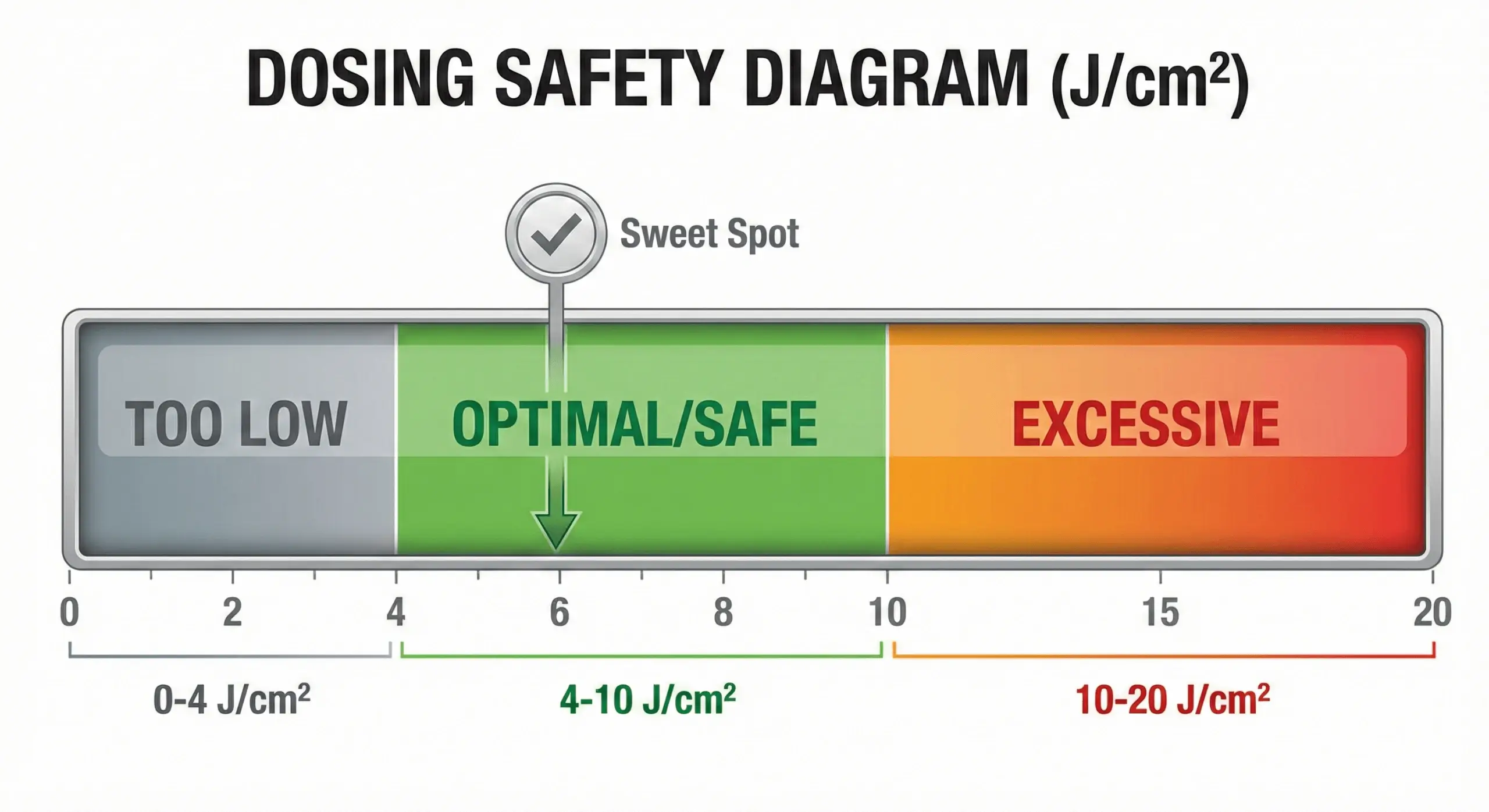
Reality: Red light follows a dose-response curve where too much actually reduces effectiveness and increases side effect risk.
Safe dosing guidelines:
- Start with 5-10 minutes per treatment area
- Stay within 4-10 J/cm² per session (check your device specs)
- Position device 6-12 inches from skin (follow manufacturer recommendations)
- Don’t exceed 20 minutes per area even if you feel nothing
Calculate your dose:
Dose (J/cm²) = Power (mW/cm²) × Time (seconds) ÷ 1000
Example: 100 mW/cm² device for 6 minutes = 6 J/cm²
Research consistently shows that exceeding 15 J/cm² per session rarely improves outcomes and may trigger the mild side effects discussed earlier [3].
My approach: I use a 100 mW/cm² panel at 8 inches for 10 minutes. That gives me about 6 J/cm². Simple, effective, no issues. When I tried doubling the time “to speed things up,” I just got redness. Stick to the science.
Frequency and Rest Days
Your cells need time to respond to red light stimulus. Daily use is generally safe, but some people benefit from rest days.
Recommended schedule:
- Beginners: 3-4 times per week for first 2 weeks
- Regular use: 5-7 times per week is safe for most people
- If experiencing fatigue or irritation: Take 1-2 days off per week
Listen to your body. If you feel worse after sessions, you might be overdoing it. More frequency doesn’t speed results — consistency over weeks matters more than daily intensity.
Author note: I do 5 days per week, take weekends off. Gives my skin a break and honestly, I don’t want to deal with setup every single day. Find a rhythm that’s sustainable for you.
Device Quality and Safety
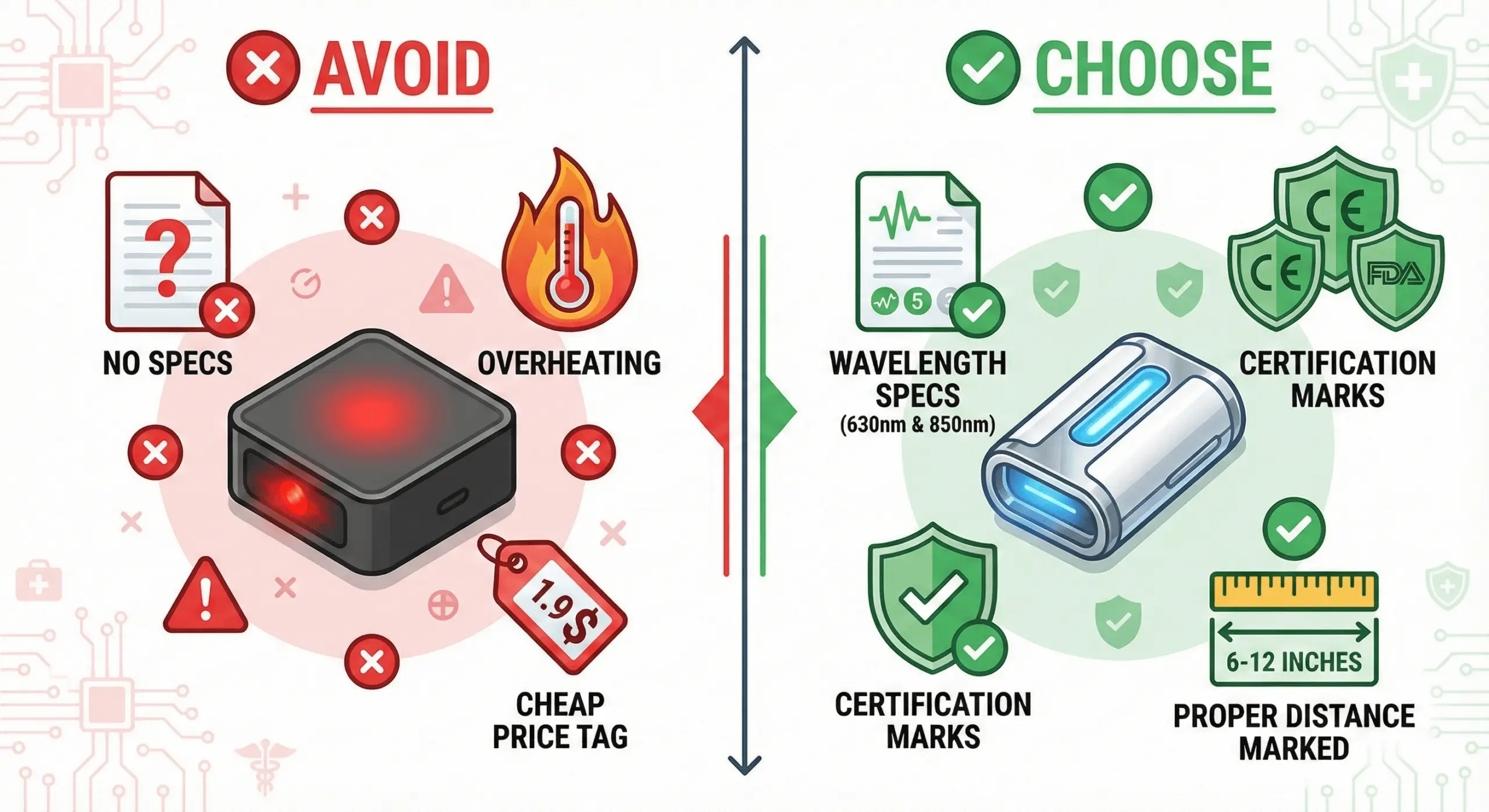
Not all red light devices are equal, and poor quality devices pose higher risks.
Red flags (unsafe devices):
- No wavelength specifications listed
- Claims of “full spectrum” without details
- Suspiciously cheap ($30-50 for large panels)
- No certifications (FCC, ETL, CE marks)
- Overheating during use
- Flickering or inconsistent light output
What to look for:
- Specific wavelengths listed (660nm, 850nm, etc.)
- Third-party tested power output
- Proper electrical certifications
- Reputable manufacturer with support
- Realistic health claims
A quality device costs more upfront but is safer and more effective. Cheap devices might emit wrong wavelengths, overheat, or have inconsistent output — all increase risk.
My experience: I bought a cheap Amazon panel first ($60). It got weirdly hot, the LEDs were uneven, and I have no idea what wavelengths it actually emitted. Returned it, spent $300 on a reputable brand. Night and day difference in both safety feel and results. If you want to learn more about choosing your panel and find out everything you need to know when buying, go to this article.
When to Stop Using Red Light Therapy
Stop immediately and consult a doctor if you experience:
- Unusual or persistent redness (>2 hours post-session)
- Blistering or burns
- Severe headaches or vision changes
- Worsening of existing medical conditions
- New rashes or skin reactions
- Persistent nausea or fatigue beyond first week
Also stop if:
- You become pregnant
- You’re diagnosed with cancer
- You start medications causing photosensitivity
- You develop unexplained symptoms during treatment
When in doubt, pause and get medical advice. Better to be overly cautious.
Author perspective: I’m cautious by nature, so I track everything in a journal. If something feels off, I stop for a few days and reassess. No wellness trend is worth ignoring your body’s warning signs.
Frequently Asked Questions
Can Red Light Therapy cause cancer?
No. Red and near-infrared light are forms of non-ionizing radiation. Unlike UV (ultraviolet) light from the sun or tanning beds, they do not carry enough energy to break DNA bonds or cause cell mutations. In fact, some research suggests RLT can help reduce the side effects of cancer treatments, though active tumors should not be stimulated without doctor supervision.
Do I absolutely need to wear goggles?
It depends on your device. For high-power LED panels, looking directly at the light can cause temporary eye strain or “dazzling.” We recommend blocking glasses or simple tanning goggles for comfort. However, the light itself is not toxic to the eye; in fact, specific protocols are used by ophthalmologists to treat declining vision, but these use much lower intensities.
Is it safe to use on tattoos?
Yes. Unlike laser hair removal (IPL), which targets pigment and can burn tattooed skin, Red Light Therapy uses different wavelengths that do not heat up pigment excessively. It will not fade your tattoos or cause burns on inked skin.
Can I use Red Light Therapy while pregnant?
While there is no evidence suggesting it is harmful, there are also no major clinical trials on pregnant women for ethical reasons. Because of this, most manufacturers advise against using it on the abdomen during pregnancy as a precaution. Using it on the face or limbs is generally considered lower risk, but always consult your OB-GYN first.
Is it safe for children?
Generally, yes. Red light therapy is used in hospitals for wound healing and even in NICUs (neonatal intensive care) for jaundice (though blue light is more common there). However, children have more sensitive eyes and skin. If you use it on a child, reduce the dose (time) by 50% and ensure they wear eye protection.
Reference
This article is based on peer-reviewed research and FDA regulatory data. Below is the list of primary sources used:
- Avci P, Gupta A, Sadasivam M, et al. Low-level laser (light) therapy (LLLT) in skin: stimulating, healing, restoring. Semin Cutan Med Surg.
View Study (PubMed) - Hamblin MR. Mechanisms and applications of the anti-inflammatory effects of photobiomodulation. AIMS Biophys.
View Study (PubMed) - Huang YY, Sharma SK, Carroll J, Hamblin MR. Biphasic dose response in low level light therapy – an update. Dose Response.
View Study (PubMed) - American College of Obstetricians and Gynecologists. Skin conditions during pregnancy.
View Study (ACOG) - Zecha JA, Raber-Durlacher JE, Nair RG, et al. Low level laser therapy/photobiomodulation in the management of side effects of chemoradiation therapy in head and neck cancer: part 1. Support Care Cancer.
View Study (PubMed) - Lehmann P. Diagnostic approach to photosensitivity. J Dtsch Dermatol Ges.
View Study (PubMed) - Hofling DB, Chavantes MC, Juliano AG, et al. Low-level laser in the treatment of patients with hypothyroidism induced by chronic autoimmune thyroiditis: a randomized, placebo-controlled clinical trial. Lasers Med Sci.
View Study (PubMed)