Using red light therapy at home is straightforward, but getting it right makes the difference between seeing results and wasting your time. After two years of daily use — and plenty of trial and error — I’ve figured out what actually works.
This guide covers everything from setting up your device to tracking results, with practical tips based on research and real-world experience. I’ll also share my personal routine and the mistakes I made so you can avoid them.
What you’ll learn:
1.How to set up your device safely
2.Optimal positioning and distance
3.Session timing and frequency
4.What to expect (realistic timeline)
5.Common mistakes to avoid
Let’s start with the basics.
Understanding Red Light Therapy in Practice
Red light therapy is often discussed in theory, but its real-world application depends on measurable parameters like wavelength and exposure. I tested multiple RLT setups using a professional spectrometer to better understand how the therapy works in practice.
Open Red Light Hub🚀 How to Use Red Light Therapy (Quick Start)
6–12 inches for deep tissue (muscles/joints).
12–18 inches for skin (anti-aging).
Start with 10 minutes per area.
Max 20 minutes.
3–5 times per week is the sweet spot.
Daily is okay for acute recovery.
⚠️ Crucial Rule: Use on bare skin only. Clothing blocks the light.
What You Need to Know Before Your First Session
Before you plug in your device and start glowing, there are a few critical safety checks. Red light therapy is generally safe, but doing it wrong can cause side effects or just waste your time.
Check the Contraindications
Do NOT use red light therapy if:
- You’re pregnant or breastfeeding
- You have active cancer or recent cancer history (<5 years)
- You have photosensitivity disorders (lupus, porphyria)
- You have epilepsy (especially photosensitive type)
- You’re taking photosensitizing medications
If any of these apply, stop and consult your doctor first. This isn’t optional.
I’m not a doctor, so I can’t give medical advice. But I can tell you that ignoring contraindications is the fastest way to turn a safe therapy into a problem. When in doubt, ask your healthcare provider.
For a complete list of contraindications and safety information, see our guide on red light therapy safety
Verify Your Device Specs
Before your first session, make sure you know:
- Exact wavelengths (should be 630-670nm and/or 810-850nm)
- Power output (irradiance in mW/cm²)
- Recommended distance (usually 6-12 inches)
- Coverage area (how much skin gets exposed)
If your device doesn’t list this information clearly, that’s a red flag. You need these numbers to calculate proper dosing.
My experience: My first device was a cheap Amazon panel with zero specs. I had no idea if I was getting 2 J/cm² or 20 J/cm². Complete guesswork. When I upgraded to a quality panel with verified specs, I could finally dial in proper protocols. Don’t skip this step.
Prepare Your Space
What you need:
- Stable place to position device (stand, wall mount, or stable surface)
- Timer (most devices have auto-shutoff, but set a backup)
- Measuring tape (to check distance)
- Eye protection (goggles or just close your eyes)
- Clear space with no obstructions
Optional but helpful:
- Mirror (to check positioning for facial treatments)
- Journal or app (to track sessions and results)
- Before photos (if treating skin issues)
I use a simple timer on my phone and keep a notes app log. Nothing fancy, but it helps me stay consistent.
Setting Up Your Red Light Device (First-Time Setup)
Getting the physical setup right is half the battle. Here’s exactly how to do it.
Step 1 — Choose Your Treatment Area
Most people start with one of these:
- Face/neck (skin health, anti-aging)
- Full body (general wellness, recovery)
- Targeted area (knee, shoulder, lower back for pain)
My recommendation: Start with one specific area for the first 2 weeks. Don’t try to treat your whole body on day one. Pick your primary goal and focus there.
My routine: I started with facial treatments because that’s what I cared about most (skin texture, fine lines). After 8 weeks of consistent use, I expanded to full-body sessions 2-3 times per week.
Step 2 — Position Your Device
Distance matters more than you think.
Most devices work best at 6-12 inches from your skin. Closer = more intense but smaller coverage area. Farther = less intense but covers more.
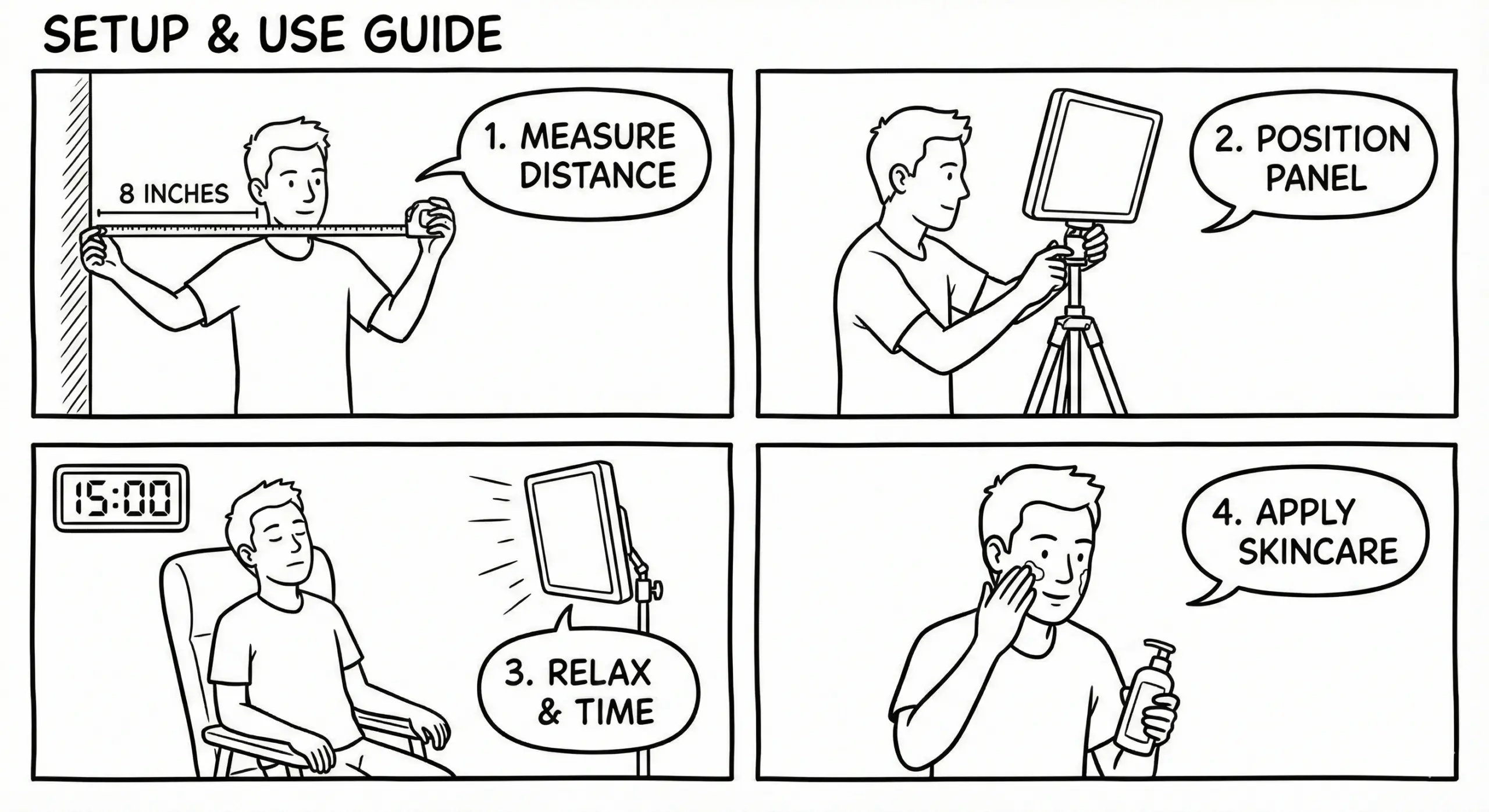
How to find your optimal distance:
- Check manufacturer recommendations (start there)
- Use the inverse square law: Doubling distance = 1/4 the power
- Adjust based on your device’s power output
For example:
- High-power device (150+ mW/cm²): Start at 12 inches
- Medium-power device (80-120 mW/cm²): Start at 8-10 inches
- Lower-power device (<80 mW/cm²): Start at 6 inches
My setup: I have a 100 mW/cm² panel. I position it 8 inches from my face, mounted on a stable stand. For body treatments, I sit about 10 inches away. Measured it once with a tape measure, marked the spot, now it’s automatic.
Pro tip: Don’t eyeball the distance. Actually measure it the first few times until you get a feel for it.
Step 3 — Bare Skin Only
This seems obvious, but I’ll say it anyway: red and near-infrared light don’t penetrate clothing well.
Remove:
- Shirts, pants (for body treatments)
- Makeup, sunscreen, lotions (for facial treatments)
- Jewelry that might reflect light
Even thin cotton reduces light transmission by 30-50%. You’re basically wasting half your session if you’re clothed.
My approach: I do morning sessions right after shower, before applying anything to my skin. Clean skin, no barriers, maximum absorption.
Step 4 — Protect Your Eyes
Non-negotiable rule: Do not stare at the light.
Options:
- Close your eyes (simplest for facial treatments)
- Wear protective goggles (if device is very bright or you have eye conditions)
- Turn your head slightly away (if treating body, not face)
The wavelengths won’t damage your retina like UV would, but the brightness causes eye strain and headaches. I learned this the hard way.
My mistake: First two weeks, I kept my eyes open during facial treatments because I wanted to “see” what was happening. Got persistent headaches. Started closing my eyes, headaches stopped immediately. Learn from my stupidity.
My Honest Take After 2 Years
Red light therapy works, but it’s not magic. It requires consistency, proper dosing, and realistic expectations.
What I’ve learned:
- Results take 8-12 weeks to become obvious
- Consistency matters way more than intensity
- Following research-backed protocols eliminates most problems
- Device quality makes a huge difference
- It’s sustainable as a long-term routine if you keep it simple
Is it worth it? For me, yes. My skin is noticeably better, I have fewer tension headaches (I use it on my neck), and it’s become a relaxing part of my morning routine.
Would I recommend it? If you:
- Have realistic expectations (not expecting miracles)
- Can commit to 5+ sessions per week for at least 12 weeks
- Are willing to invest in a quality device
- Don’t have contraindications
Then yes, try it. If you’re looking for a quick fix or can’t stay consistent, save your money.
My routine going forward: Maintenance mode. 5 mornings per week for face, 2-3 evenings per week for body. It’s now as automatic as brushing my teeth.
How Long and How Often to Use Red Light Therapy
This is where most people either overdo it or don’t do enough. Let me break down what research says and what actually works in practice.
Understanding Dose (The Most Important Concept)
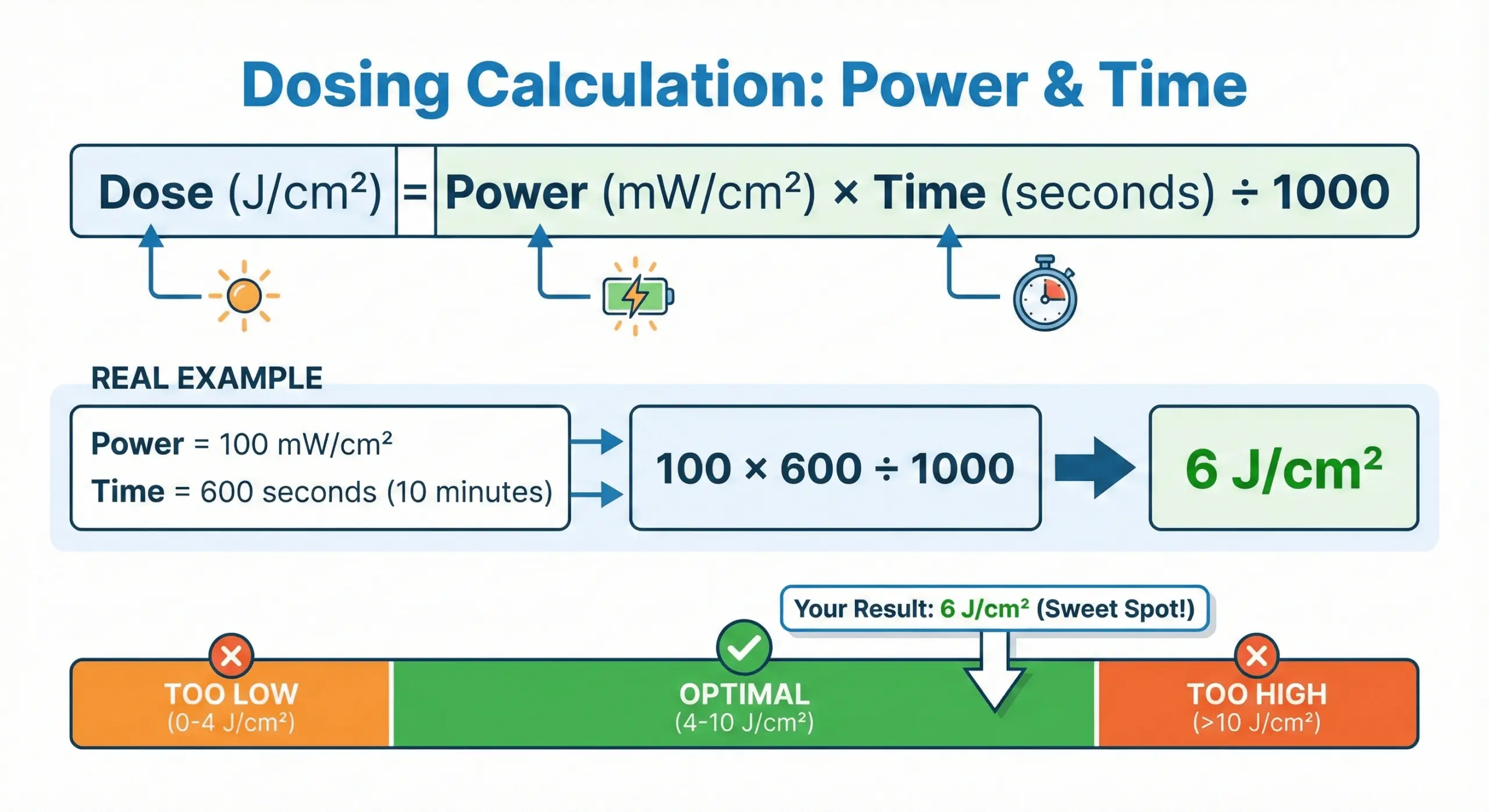
Red light therapy is measured in joules per square centimeter (J/cm²) — the total energy delivered to your skin.
Formula:
Dose (J/cm²) = Power (mW/cm²) × Time (seconds) ÷ 1000
Optimal range based on research: 4-10 J/cm² per session. A comprehensive review published in Dose Response found that exceeding therapeutic doses often reduced effectiveness by 20-40 due to the biphasic response curve.
Cheat Sheet: Settings by Goal
| Goal | Distance | Time | Frequency |
|---|---|---|---|
| Anti-Aging / Skin | 12–18 inches | 5–10 mins | 3–5x / week |
| Pain Relief / Joints | 6 inches | 10–15 mins | Daily or 5x / week |
| Muscle Recovery | 6–12 inches | 10–20 mins | Post-workout |
Example calculation:
- Device: 100 mW/cm² at 8 inches
- Target dose: 6 J/cm²
- Time needed: (6 × 1000) ÷ 100 = 60 seconds = 10 minutes
Why this matters: Too little (under 4 J/cm²) won’t trigger the biological response. Too much (over 15 J/cm²) can actually reduce effectiveness.
My approach: I aim for 6 J/cm² for facial treatments, 8 J/cm² for body. Been using these numbers for over a year with consistent results.
Session Length Guidelines
General recommendations:
- Face/neck: 10-15 minutes
- Targeted area (knee, shoulder): 10-20 minutes
- Full body (front or back): 15-20 minutes
Beginner protocol (First 2 weeks):
- Start with 8-10 minutes per area
- Use 3-4 times per week
- Give your body time to adjust
Regular protocol (After 2 weeks):
- 10-20 minutes per area
- 5-7 times per week is safe for most people
- Listen to your body
My routine:
- Morning (5 days/week): 12 minutes facial treatment (face + neck)
- Evening (3 days/week): 18 minutes full-body (alternating front/back)
- Weekends: Rest days (because I’m lazy and consistency matters more than perfection)
I track this in my phone notes. Nothing fancy, just “Face 12min” or “Body 18min.” Helps me stay honest about actual usage vs what I think I’m doing.
Frequency — Daily vs Every Other Day
What research shows: Consistent, moderate frequency (5x/week) tends to outperform intensive but sporadic use (2x/week at higher doses). A study in Lasers in Surgery and Medicine found that regular dosing maintained elevated cellular responses better than intermittent high-dose protocols.
Safe frequency:
- Daily use: Fine for most people at proper doses
- Every other day: Good if you’re sensitive or just starting
- 3-4x/week: Minimum for seeing results
My experience: I do 5 days per week (Monday-Friday). Weekends off. This works because:
- It’s sustainable (I don’t burn out)
- It’s consistent enough for results
- My skin doesn’t get irritated
- I can actually stick to it long-term
Some people do better with daily use. Some prefer every other day. Find what’s sustainable for you — consistency beats intensity.
Time of Day
Does timing matter? Somewhat, but not as much as consistency.
Morning use:
- May support circadian rhythm (red/NIR light exposure)
- Good for energy/alertness (anecdotal, but I notice it)
- Easier to build into routine
Evening use:
- Fine for body/targeted treatments
- Avoid bright light exposure 1-2 hours before sleep if treating face (can affect melatonin)
My preference: Morning sessions for face, evening for body when needed. Morning works better for my schedule and I feel like it gives me a small energy boost. Could be placebo, but if it helps me stay consistent, I’ll take it.
How I Actually Use Red Light Therapy (Real Routine, Not Instagram Version)
Let me walk you through exactly what I do, including the boring parts nobody posts about.
My Weekday Morning Routine (Face Treatment)
6:45 AM — Setup (2 minutes)
- Shower, clean face (no products)
- Position panel 8 inches from face (already set up, just turn it on)
- Set phone timer for 12 minutes
- Close eyes
6:47-6:59 AM — Session (12 minutes)
- Stand/sit comfortably in front of panel
- Eyes closed the entire time
- Usually I’m half-asleep and just zone out
- Sometimes I listen to a podcast, sometimes I just exist
7:00 AM — Done
- Turn off device
- Apply skincare routine (vitamin C serum, moisturizer, SPF)
- Continue with my day
Total time commitment: 15 minutes including setup and cleanup.
Do I do this every single day? No. I aim for 5 days/week. Some weeks I hit 7, some weeks I hit 3. Life happens. The key is getting back to it, not being perfect.
My Evening Body Sessions (3x/Week)
8:00 PM — Setup
- Remove shirt
- Position panel 10 inches away
- Set timer for 18 minutes
- Sit on a stool in front of the panel (I have a large panel)
Session:
- Treat front torso for 9 minutes
- Rotate, treat back for 9 minutes
- Eyes don’t need protection for body treatment (not facing the light)
- I usually watch YouTube or scroll my phone (not ideal for sleep hygiene, but I’m being honest here)
Why only 3x/week for body? Because I don’t have a specific pain or recovery issue. If I was dealing with chronic back pain or training hard, I’d probably do 5x/week. Right now, 3x feels like general wellness maintenance.
What I Track (Simple System)
I use Apple Notes (nothing fancy):
Oct 2024
Mon 10/7: Face 12min ✓
Tue 10/8: Face 12min ✓
Wed 10/9: Face 12min + Body 18min ✓
Thu 10/10: Face 12min ✓
Fri 10/11: Face 12min ✓
Sat-Sun: Rest

Notes: Skin looking smoother this week. Slight redness after Wed body session (sat too close?), adjusted distance.
Why I track:
- Accountability (easy to think you’re consistent when you’re not)
- Pattern recognition (if I get irritation, I can look back and see what I did differently)
- Results timeline (when did I first notice changes?)
What I don’t track: Detailed dosing calculations every session. I calculated my protocol once, verified it works, now I just execute.
Mistakes I Made (Learn From My Failures)
Month 1 — Overdoing It
- Used 20 minutes daily, sat 4 inches away
- Got persistent redness and headaches
- Lesson: More isn’t better. Followed research-backed dosing, problems disappeared.
Month 2 — Inconsistency
- Used it 7 days one week, then 1 day the next week
- Saw zero results
- Lesson: Consistency > intensity. Sustainable routine beats sporadic heroics.
Month 3 — Wrong Expectations
- Expected dramatic changes after 3 weeks
- Almost quit because “it wasn’t working”
- Looked at before photos at week 8, actually saw significant improvement
- Lesson: Take photos. Your brain forgets what you looked like before.
Month 4 — Ignoring Eye Protection
- Kept eyes open during sessions “to multitask”
- Chronic eye strain
- Lesson: Just close your damn eyes. Not worth it.
Month 6 — Neglecting Device Maintenance
- Never cleaned the panel, dust buildup reduced output
- Results plateaued
- Wiped it down, results improved again
- Lesson: Clean your device monthly with microfiber cloth.
Results Timeline: What Actually Happens (Based on Research + Experience)
Let’s set realistic expectations based on what research shows and what I’ve observed.
Week 1-2: Nothing Visible (Cellular Level Only)
What’s happening:
- ATP production increases in treated cells. Research shows mitochondrial ATP synthesis peaks 3-6 hours after red light exposure
- Gene expression begins to change
- Mitochondrial function improves
What you notice:
- Probably nothing
- Maybe slight redness if you overdose
- Possibly mild fatigue as body adjusts (rare)
My experience: First two weeks, I saw absolutely nothing. I questioned if the device even worked. I stuck with it because I’d already spent the money and read enough research to know changes take time.
Don’t quit in week 2. This is where most people give up.
Week 3-4: Subtle Changes
What’s happening:
- Protein synthesis ramping up
- Inflammation markers decreasing
- Collagen production beginning (for skin applications)
What you might notice:
- Skin feels slightly smoother (texture)
- Minor reduction in redness/inflammation
- Small decrease in pain (if treating pain)
My experience: Around week 3, my skin felt different when I washed my face. Not dramatically, but noticeably smoother. My partner didn’t notice anything visually yet.
Week 6-8: Noticeable Improvements
What’s happening:
- Tissue remodeling in progress
- Cumulative cellular benefits
- Collagen density increasing
What you might notice:
- Visible skin texture improvement
- Fine lines look slightly softer
- Pain reduction becomes more consistent
- Overall skin tone more even
My experience: Week 7 is when my partner said “your skin looks really good, are you doing something different?” That was validation that it wasn’t just placebo. I compared photos from week 1 to week 7 — clear difference in skin smoothness and tone.
Week 12+: Significant Results
What’s happening:
- Structural changes in tissue
- Maximized collagen density (for skin)
- Sustained anti-inflammatory effects
What you might notice:
- Significant wrinkle reduction. A controlled clinical trial showed 20-35% reduction in wrinkle depth and 31% increase in collagen density after 12 weeks of consistent treatment
- Substantial pain relief (if applicable)
- Skin appears more youthful overall
- Results plateau and require maintenance
My experience: At 12 weeks, I looked at my before photo and genuinely didn’t recognize my skin. Not like I suddenly looked 20 years younger, but the texture, tone, and fine lines were noticeably better. This is also when results stabilized — continued improvement happened more slowly after this point.
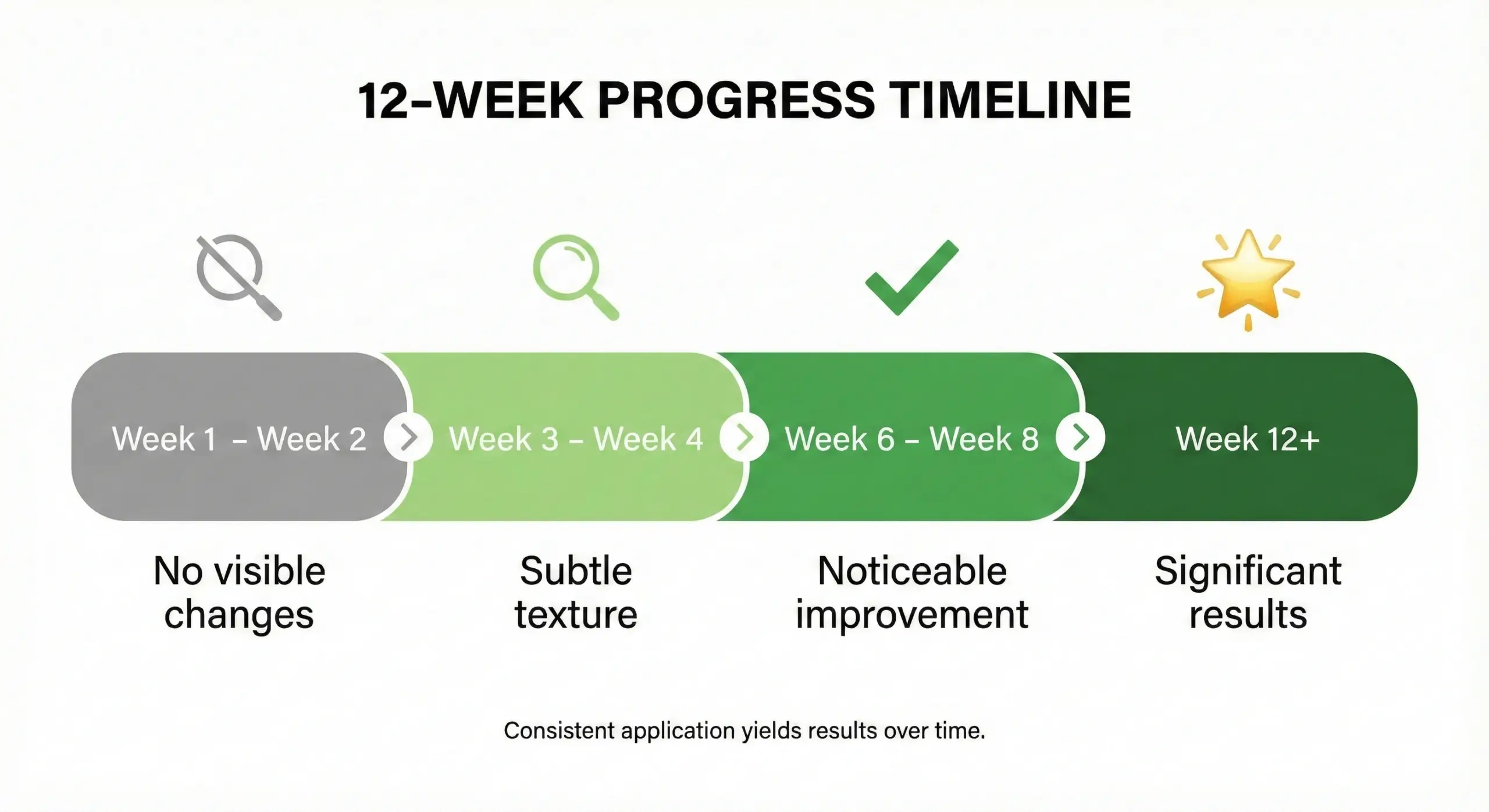
Reality Check Table
| Timeframe | Realistic Expectation | My Experience |
|---|---|---|
| Week 1-2 | Nothing visible | Saw nothing, almost quit |
| Week 3-4 | Subtle texture changes | Skin felt smoother |
| Week 6-8 | Noticeable improvements | Partner noticed difference |
| Week 12+ | Significant results | Clear before/after difference |
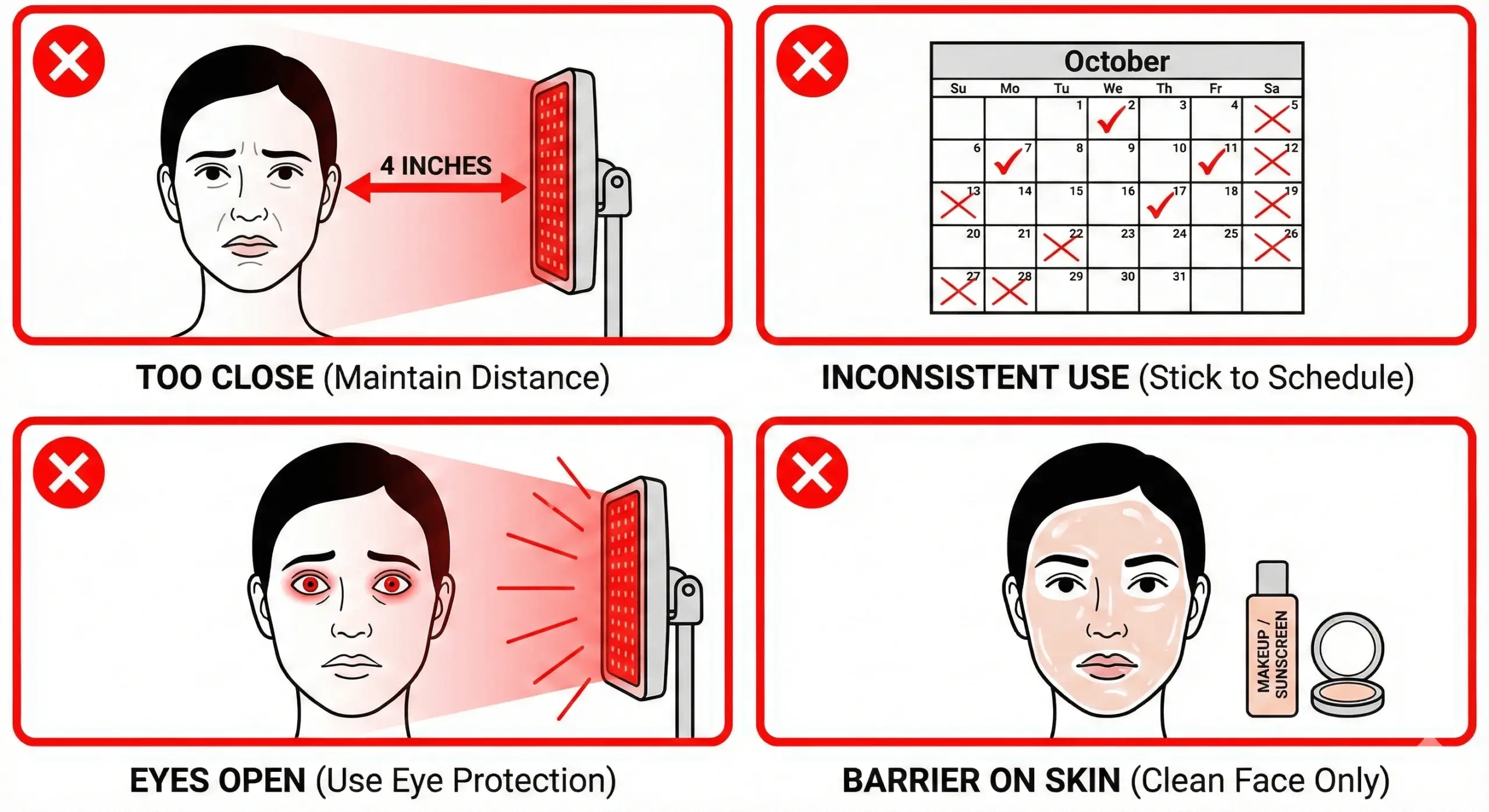
Biggest Mistakes People Make (And How to Avoid Them)
After helping friends set up their devices and reading countless Reddit threads, these are the most common ways people mess this up.
Mistake #1 — Not Calculating Dose Properly
The problem: People just guess session length based on what “feels right.”
Why it’s bad: You might be getting 2 J/cm² (too low) or 20 J/cm² (too high) without knowing it.
The fix:
- Find your device power output (mW/cm² at specific distance)
- Calculate: Dose = Power × Time ÷ 1000
- Aim for 4-10 J/cm²
My take: Yes, math is annoying. Do it once, write it down, then never think about it again. Your device specs don’t change.
Mistake #2 — Quitting Too Early
The problem: People expect Instagram-worthy results in 2 weeks.
Why it’s bad: Cellular changes take time. Collagen synthesis is a weeks-to-months process, not a days process. Research on <a href=”#ref-2″>photobiomodulation in skin shows measurable collagen improvements require 8-12 weeks of consistent treatment</a>.
The fix:
- Commit to 12 weeks minimum before judging
- Take before photos (you will forget what you looked like)
- Track sessions to ensure you’re actually consistent
My take: I almost quit at week 3. The only reason I didn’t was because I’d already told people I was testing it and didn’t want to look stupid. Turns out spite is a powerful motivator. By week 8, I was glad I stuck with it.
Mistake #3 — Sitting Too Close
The problem: People think closer = better results.
Why it’s bad:
- Too much power density = overdosing
- Smaller coverage area (inefficient)
- Higher risk of redness/irritation
The fix:
- Follow manufacturer distance recommendations
- If you don’t have specs, start at 12 inches and adjust
- Measure the distance, don’t eyeball it
My experience: I sat 4 inches away for the first month because I’m impatient. Got redness every session. Moved to 8 inches, redness stopped, results actually improved. Closer isn’t better.
Mistake #4 — Inconsistent Use
The problem: Using it 7 days one week, zero days the next two weeks.
Why it’s bad: You need sustained gene expression changes. Sporadic use doesn’t allow cellular processes to compound.
The fix:
- Choose a sustainable frequency (5x/week beats 7x/week if you can’t maintain 7)
- Build it into existing routine (I do it right after shower)
- Use a tracking system (even just checkmarks on a calendar)
My approach: I aim for 5 days/week. Some weeks I do 7, some weeks I do 3. But I never go more than 3 days without a session. Sustainability > perfection.
Mistake #5 — Ignoring Eye Protection
The problem: Staring at bright LEDs because “it’s just light.”
Why it’s bad:
- Eye strain
- Headaches
- Potential long-term eye health concerns (not proven, but why risk it?)
The fix:
- Close your eyes during facial treatments
- Wear goggles if device is very bright (>150 mW/cm²)
- Turn your head away during body treatments
My mistake: Kept eyes open for the first month. Chronic headaches. Closed my eyes, headaches gone. This is the easiest fix that most people ignore.
Mistake #6 — Using on Dirty Skin
The problem: Applying red light over makeup, sunscreen, or lotions.
Why it’s bad:
- These products can block or scatter light
- Reduces effective dose reaching your skin
- You’re wasting your session
The fix:
- Use on clean, bare skin
- No makeup, no sunscreen, no moisturizer during session
- Apply skincare products AFTER your session
My routine: Shower → Red light → Skincare. In that order. Every time.
Device Care and Problem-Solving
Cleaning Your Device
Red light panels collect dust, which reduces output over time.
How to clean:
- Wipe with dry microfiber cloth monthly
- For stubborn spots: slightly damp cloth, then dry immediately
- Never use cleaning chemicals on LEDs
My experience: I neglected this for 6 months. Results plateaued. Wiped down the panel, noticed visible dust buildup. Results improved again within 2 weeks. Now I clean monthly.
Checking Device Output
Over time, LEDs can degrade. Most quality devices last 50,000+ hours, but it’s worth checking.
Signs of degraded output:
- Results plateau despite consistent use
- LEDs look dimmer
- Uneven light distribution
What to do:
- Contact manufacturer (many offer testing)
- Consider power meter (expensive but accurate)
- If device is >5 years old, might be time to replace
If You’re Not Seeing Results
Checklist:
- Are you actually consistent? (Track it honestly)
- Is your dose in the 4-10 J/cm² range?
- Has it been at least 8 weeks?
- Is your device actually emitting correct wavelengths?
- Are you treating the right area for your goal?
- Have you taken before/after photos to compare?
My advice: Most “it’s not working” cases are inconsistency or wrong expectations. If you’ve genuinely been consistent for 12 weeks at proper doses and see zero change, your device might be faulty or you might need to consult a dermatologist about your specific skin concerns.
My Honest Take After 2 Years
Red light therapy works, but it’s not magic. It requires consistency, proper dosing, and realistic expectations.
What I’ve learned:
- Results take 8-12 weeks to become obvious
- Consistency matters way more than intensity
- Following research-backed protocols eliminates most problems
- Device quality makes a huge difference
- It’s sustainable as a long-term routine if you keep it simple
Is it worth it? For me, yes. My skin is noticeably better, I have fewer tension headaches (I use it on my neck), and it’s become a relaxing part of my morning routine.
Would I recommend it? If you:
- Have realistic expectations (not expecting miracles)
- Can commit to 5+ sessions per week for at least 12 weeks
- Are willing to invest in a quality device
- Don’t have contraindications
Then yes, try it. If you’re looking for a quick fix or can’t stay consistent, save your money.
My routine going forward: Maintenance mode. 5 mornings per week for face, 2-3 evenings per week for body. It’s now as automatic as brushing my teeth.
Frequently Asked Questions
Do I need to wear goggles?
Generally, red light is safe for eyes, but it is extremely bright. I recommend wearing the blackout goggles provided with your panel for comfort, especially if you are sitting close (6 inches) or are sensitive to light. Never stare directly into the LEDs.
Can I wear clothes during red light therapy?
No. Red and near-infrared light cannot penetrate thick fabrics like denim, cotton, or polyester. For the therapy to work, the photons must hit your bare skin directly.
Should I shower before or after?
It is best to use red light therapy on clean skin before applying heavy lotions, sunscreens, or makeup, as these can block the light. Showering beforehand is ideal but not strictly necessary as long as your skin is product-free.
Reference
This article is based on peer-reviewed research and FDA regulatory data. Below is the list of primary sources used:
- Huang YY, Sharma SK, Carroll J, Hamblin MR. Biphasic dose response in low level light therapy – an update. Dose Response.
View Study (PubMed) - Avci P, Gupta A, Sadasivam M, et al. Low-level laser (light) therapy (LLLT) in skin: stimulating, healing, restoring. Semin Cutan Med Surg.
View Study (PubMed) - Lanzafame RJ, Stadler I, Kurtz AF, et al. Reciprocity of exposure time and irradiance on energy density during photoradiation on wound healing in a murine pressure ulcer model. Lasers Surg Med.
View Study (PubMed) - Karu T. Mitochondrial mechanisms of photobiomodulation in context of new data about multiple roles of ATP. Photomed Laser Surg.
View Study (PubMed) - Wunsch A, Matuschka K. A controlled trial to determine the efficacy of red and near-infrared light treatment in patient satisfaction, reduction of fine lines, wrinkles, skin roughness, and intradermal collagen density increase. Photomed Laser Surg.
View Study (PubMed)