Does red light therapy help rosacea? Yes — with important nuances by subtype. Red light at 630–660nm reduces the inflammatory signaling that drives rosacea flares, calms vascular reactivity over time, and supports skin barrier function without triggering the thermal or chemical irritation that worsens most rosacea-prone skin. Multiple clinical studies show meaningful reduction in erythema and inflammatory lesion count after 6–10 weeks of consistent treatment.
Best wavelength: 630–660nm primary — this is the anti-inflammatory and skin-level wavelength. Near-infrared (850nm) at low irradiance is compatible but not the priority for rosacea specifically.
Protocol: 8–12 minutes per session, 6–8 inches from face (more conservative than standard protocols — rosacea skin is reactive), 4–5x per week. Start at the conservative end and increase gradually.
What it won’t do: Eliminate the vascular component of rosacea permanently. Erythematotelangiectatic rosacea (the visible dilated blood vessels) requires laser treatment for structural vascular change. Red light manages the inflammatory and reactive component — it doesn’t ablate vessels.
Why rosacea is different from standard facial protocol: Standard anti-aging facial RLT uses fairly aggressive irradiance at close range to maximize collagen stimulation. Rosacea-prone skin is hyperreactive — to heat, to light, to topicals, to almost everything. The protocol here is deliberately more conservative in irradiance and distance. Lower dose, longer timeline, gentler introduction. This isn’t a limitation — it’s what the skin biology of rosacea requires.
Understanding Red Light Therapy in Practice
Red light therapy is often discussed in theory, but its real-world application depends on measurable parameters like wavelength and exposure. I tested multiple RLT setups using a professional spectrometer to better understand how the therapy works in practice.
Open Red Light HubWhy Rosacea Is an Inflammatory Condition First
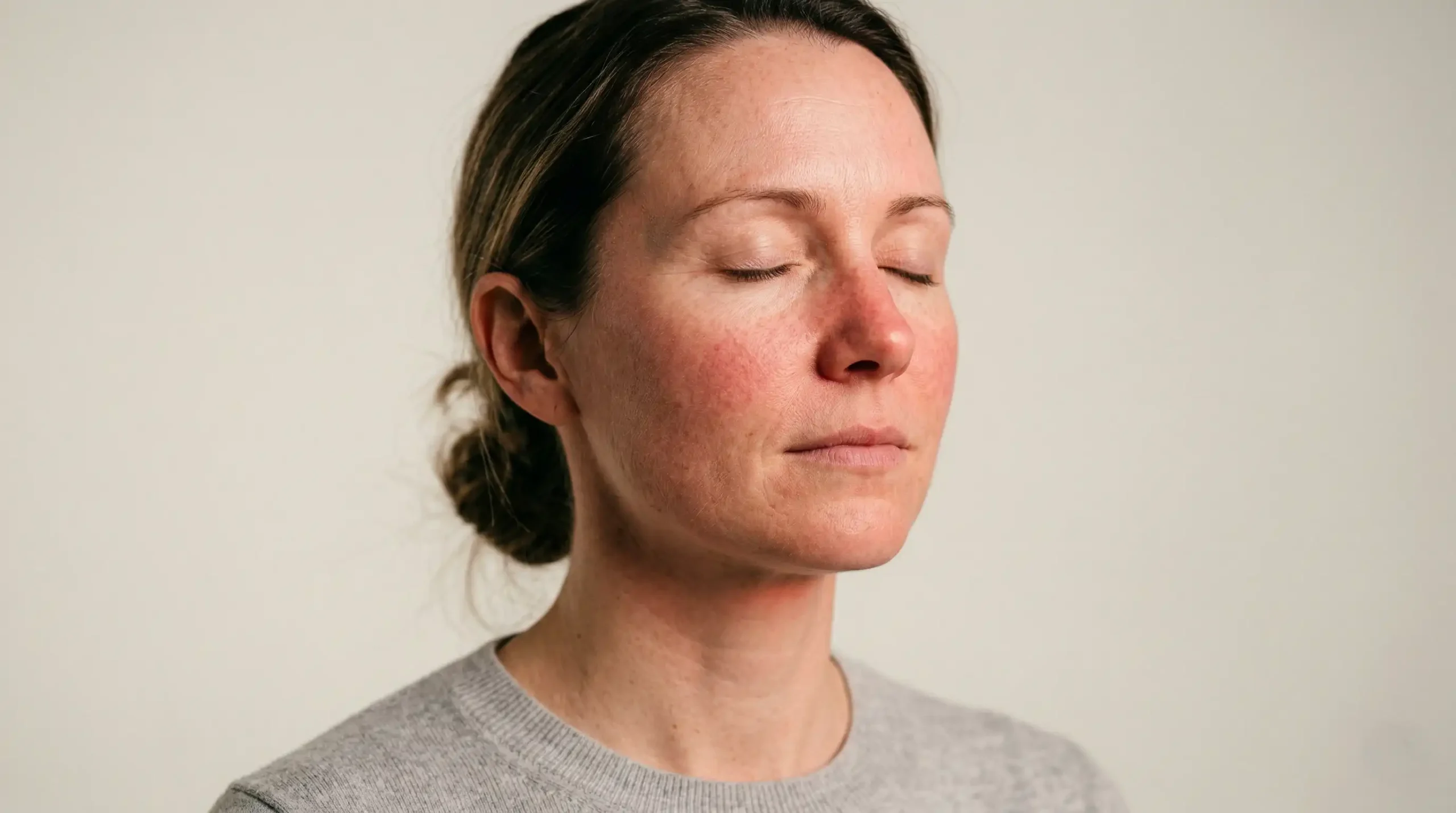
Rosacea is commonly misunderstood as a skin condition defined primarily by redness. It’s more accurately described as a chronic inflammatory condition of facial skin and vasculature — the redness, flushing, and visible vessels are symptoms of the underlying inflammatory and neurovascular dysregulation, not the disease itself.
This framing matters because it explains why red light therapy has a rational mechanism for rosacea and why topical treatments that only address the surface often produce limited results.
The four subtypes — and how RLT applies differently:
Erythematotelangiectatic rosacea (ETR — subtype 1): Persistent central facial redness, flushing, visible dilated blood vessels (telangiectasia). The inflammatory component responds to RLT. The structural vascular component (permanent dilated vessels) requires vascular laser for permanent change. RLT reduces reactivity and flare frequency — it doesn’t remove existing telangiectasia.
Papulopustular rosacea (subtype 2): Inflammatory papules and pustules alongside central redness. Looks similar to acne but different mechanism. This is where RLT has the most direct clinical evidence — the anti-inflammatory mechanism directly targets the cytokine signaling driving papule formation. Responds similarly to inflammatory acne but with the sensitivity considerations below.
Phymatous rosacea (subtype 3): Skin thickening and tissue overgrowth, most commonly rhinophyma (nose thickening). Limited evidence for RLT benefit in this subtype — the fibrotic tissue changes are not primarily inflammatory in the same way. Not a primary target for photobiomodulation.
Ocular rosacea (subtype 4): Eye involvement — redness, dryness, sensitivity. Some emerging evidence for RLT benefit in ocular rosacea specifically, but this requires direct ophthalmological involvement and is outside standard consumer RLT application.
Most people have mixed presentations — subtype 1 and 2 overlap is common. For the purposes of this protocol, the focus is on the inflammatory and vascular reactivity components where the evidence is strongest.
The Mechanism: Why Red Light Reduces Rosacea Inflammation
Rosacea involves a dysregulated innate immune response in facial skin. Several interconnected pathways drive the condition, and photobiomodulation addresses multiple of them simultaneously.
Cathelicidin and TLR2 dysregulation: People with rosacea produce abnormally high levels of cathelicidin antimicrobial peptides, which are processed into forms that trigger excessive inflammation via Toll-like receptor 2 (TLR2) signaling. Red light at 630nm has been shown to modulate TLR2 activity and reduce the inflammatory downstream effects of cathelicidin overproduction.
Pro-inflammatory cytokine reduction: The same cytokine targets relevant to all photobiomodulation applications — TNF-α, IL-1β, IL-6, IL-8 — are overexpressed in rosacea tissue. Red light reduces their expression, interrupting the chronic inflammatory loop that perpetuates symptoms between flares.
Vascular reactivity: Rosacea involves abnormal vascular responses — blood vessels in affected skin dilate too easily and take too long to return to baseline. Nitric oxide regulation from photobiomodulation helps normalize vascular tone over time with consistent treatment. This is a slower effect than the direct anti-inflammatory response — expect 8–12 weeks before vascular reactivity noticeably changes.
Skin barrier support: Rosacea is associated with a compromised skin barrier — increased transepidermal water loss, reduced ceramide levels, heightened sensitivity to environmental triggers. Red light’s support of fibroblast activity and collagen synthesis indirectly strengthens the structural integrity of the skin barrier. A more intact barrier means less reactivity to triggers.
Demodex mite load: Some research suggests rosacea is partly driven by abnormal immune response to Demodex mites — skin mites present in everyone but found at higher densities in rosacea-affected skin. Blue light has antimicrobial properties relevant here. Red light doesn’t directly address Demodex, but by normalizing the inflammatory response, it reduces the tissue environment that enables Demodex overpopulation.
The Research
The clinical literature on photobiomodulation for rosacea is smaller than for acne or general anti-aging, but the available studies are consistent and the mechanistic rationale is strong.
| Study | Design | Wavelength | Duration | Key Result |
|---|---|---|---|---|
| Papageorgiou et al., British Journal of Dermatology (2000) | RCT, inflammatory facial conditions including rosacea | 630nm | 12 weeks | Significant reduction in inflammatory lesion count and erythema severity |
| Goldberg & Russell, Journal of Cosmetic & Laser Therapy (2006) | Case series, rosacea patients | 590nm + 870nm combination | 8 weeks | 70% of patients showed meaningful erythema reduction, improved skin texture |
| Kassir et al., Journal of Drugs in Dermatology (2011) | Clinical review, LED phototherapy for rosacea | 630nm | 8–12 weeks | Reduced inflammatory markers, improved patient-reported flushing frequency |
| Ablon G., Journal of Clinical and Aesthetic Dermatology (2018) | Prospective study, sensitive inflammatory skin | 633nm | 9 weeks | Significant improvement in redness, sensitivity, and overall skin quality scores |
The Goldberg & Russell 2006 study is frequently cited in dermatology for rosacea LED treatment — 70% meaningful response rate over 8 weeks is clinically significant for a condition that most topical treatments manage rather than resolve.
One consistent pattern: the studies that show the strongest results use lower irradiance over longer treatment periods rather than aggressive high-irradiance short protocols. This aligns with what rosacea skin biology requires — gentle consistent stimulation, not intense acute dosing.
Protocol: How to Use Red Light for Rosacea
Why the Rosacea Protocol Is Different From Standard Facial RLT
The face and anti-aging protocol uses relatively aggressive parameters — close distance, high irradiance, daily sessions — to maximize fibroblast activation for collagen synthesis.
Rosacea-prone skin is hyperreactive. Triggers that don’t affect normal skin — mild heat, light pressure, certain topicals, temperature changes — cause significant flare responses. Applying aggressive irradiance at close range to reactive rosacea skin risks triggering a flare rather than calming one.
The rosacea protocol is deliberately more conservative. Lower irradiance effective distance (6–8 inches instead of 4–6), shorter initial sessions (8 minutes instead of 15), slower progression. The therapeutic effect is the same — it just requires more patience and a gentler introduction.
Device Considerations for Rosacea
Face masks vs panels for rosacea: This is one situation where the conventional wisdom about face masks being optimal for facial RLT needs qualification. Many LED face masks press against the skin — the contact pressure and enclosed heat can trigger rosacea flares in sensitive presentations. A panel at 6–8 inches with no contact and good airflow is often better tolerated than a contact mask for rosacea-prone skin.
If using a face mask: choose one with a gap between mask and skin, adequate ventilation, and FDA-cleared safety parameters. The Valo Glow review covers its design in detail — assess whether the contact design works for your specific sensitivity level.
Temperature management: A device that runs hot — warm plastic surface, elevated ambient temperature in the session area — will aggravate rosacea more than a panel at distance. Panel at room temperature, adequate airflow, cool room preferred.
Session Parameters
| Parameter | Introduction Phase (weeks 1–3) | Maintenance Phase (weeks 4+) |
|---|---|---|
| Wavelength | 630–660nm only | 630–660nm primary |
| Distance | 8 inches | 6–8 inches |
| Session time | 8 minutes | 10–12 minutes |
| Frequency | 3x per week | 4–5x per week |
| Target dose | 6–10 J/cm² | 10–15 J/cm² |
| Room temperature | Cool, ventilated | Cool, ventilated |
| Skin prep | Cleansed, nothing applied | Cleansed, nothing applied |
Why start at 3x per week instead of daily: Rosacea skin benefits from adaptation time. Introducing photobiomodulation gradually gives the reactive vasculature and immune cells time to adjust to the new stimulus without triggering a flare. After 2–3 weeks of 3x per week with no adverse reaction, increase to 4–5x per week.
Step-by-Step Session
1. Cool the room. Heat is a primary rosacea trigger. A warm room during treatment adds thermal load that counteracts the anti-inflammatory benefit. Cool room temperature (68–70°F) and a small fan for airflow makes a meaningful difference in how reactive skin tolerates treatment.
2. Cleanse gently. Remove all makeup and skincare products with a non-stripping gentle cleanser. Pat completely dry — don’t rub. Rosacea skin is sensitive enough that friction during drying can trigger redness before the session starts.
3. Nothing on skin before treatment. No serums, no moisturizers, nothing. This is the same principle as all facial RLT — any product creates a partial barrier and potentially increases irritation risk with the enhanced permeability post-session.
4. Position at 6–8 inches. Further than standard anti-aging protocol. The lower irradiance at this distance is appropriate for sensitive skin and still within the therapeutic range for anti-inflammatory effects.
5. Session duration: 8–10 minutes. Don’t exceed 12 minutes in the initial phase. The anti-inflammatory dose-response for rosacea is achieved at lower total energy than the collagen-stimulation dose for anti-aging — you need less than you might think.
6. Cool-down after session. Don’t immediately apply products. Allow 10–15 minutes for the mild vasodilation response to settle before applying anything. Then apply your rosacea-compatible skincare — gentle moisturizer, niacinamide, azelaic acid if prescribed, SPF.
7. Avoid known triggers for 2 hours post-session. Hot beverages, alcohol, intense exercise, steam — post-RLT the skin’s vascular reactivity is temporarily elevated. Standard trigger avoidance is more important in the hour or two after treatment.
Skincare Stack Compatibility
Rosacea management typically involves several topical ingredients. Here’s how they interact with an RLT protocol:
| Ingredient | Before RLT | After RLT | Notes |
|---|---|---|---|
| Azelaic acid | ❌ | ✅ Wait 15 min | Anti-inflammatory, compatible, apply post-session |
| Niacinamide | ❌ | ✅ Immediately after | Reduces MMP activity, strengthens barrier — excellent complement |
| Metronidazole (Rx) | ❌ | ✅ Wait 15 min | No known interaction with RLT |
| Ivermectin cream (Rx) | ❌ | ✅ Wait 15 min | Compatible |
| Retinoids | ❌ | ⚠️ Only if tolerated | Rosacea skin often doesn’t tolerate retinoids well regardless of RLT |
| Vitamin C (L-ascorbic acid) | ❌ | ⚠️ Low concentration only | High-concentration ascorbic acid may irritate rosacea skin post-RLT |
| Hyaluronic acid | ❌ | ✅ Immediately after | Excellent post-session hydration support |
| SPF | ❌ | ✅ Required for AM | UV is a primary rosacea trigger — non-negotiable |
| Mineral sunscreen | ❌ | ✅ Preferred over chemical | Chemical filters can trigger rosacea in sensitive presentations |
The general principle: apply everything after the session, not before. And use the enhanced absorption window that follows photobiomodulation to maximize the efficacy of your anti-rosacea topicals — niacinamide and azelaic acid in particular absorb well and work synergistically with the anti-inflammatory effects of red light.
Realistic Timeline for Rosacea
Rosacea is a chronic condition. Setting timeline expectations accurately determines whether people stick with the protocol long enough to see results.
| Period | What to Expect |
|---|---|
| Week 1–2 | Possible mild initial flare in some people — the vascular reactivity adjustment. Most see nothing in this period. Some notice reduced post-session redness duration compared to week 1. |
| Week 3–4 | First signs. Daily baseline redness may reduce slightly. Flare frequency starts decreasing in some people. Skin feels less reactive to minor triggers. |
| Week 5–7 | Meaningful improvement window. Inflammatory papule count reduces if subtype 2 is present. Central facial redness notably calmer between flares. Post-trigger recovery time shorter. |
| Week 8–10 | Vascular reactivity changes become measurable. Flushing episodes less intense and shorter. Skin barrier feels more resilient. |
| Week 10–14 | Approaching plateau for current protocol. Significant reduction in baseline inflammatory activity typical for consistent users. Flares still occur but less frequently and resolve faster. |
| Ongoing maintenance | 3–4x per week to maintain results. Rosacea is chronic — results require ongoing treatment, not a fixed course. |
What to Do When a Flare Happens During Protocol
Flares happen in rosacea regardless of treatment. The question is what to do with your RLT protocol when one occurs.
Mild flare (increased redness, no papules): Continue protocol but reduce to 3x per week and increase distance to 8–9 inches until the flare subsides. Don’t stop entirely — the anti-inflammatory effect is more valuable during a flare than in calm periods.
Moderate flare (papules, significant redness): Pause treatment for 3–5 days. The compromised skin barrier during a significant flare means the post-session absorption window may amplify irritation rather than benefit. Resume when the acute phase calms, at reduced parameters.
Severe flare: Address the trigger and flare medically first. RLT is a maintenance and management tool — not an acute flare treatment in the same way topical azelaic acid or prescription metronidazole is.
Common Mistakes in RLT for Rosacea
Using anti-aging protocol parameters on rosacea skin. The most common mistake. Standard facial anti-aging protocol — 4–6 inches, 15 minutes, daily, high irradiance — is too aggressive for reactive rosacea skin in most presentations. The protocol needs to be calibrated for reactive skin, not optimized for maximum collagen stimulation.
Applying serums immediately before sessions. Anything on the skin before RLT on reactive skin is a potential irritant when permeability increases post-session. Always cleanse to bare skin before treatment.
Treating in a warm room. Heat is the most universal rosacea trigger. A warm device, warm room, or insufficient airflow during treatment adds thermal load that directly counteracts the calming effect you’re trying to create. Cool environment is not optional for rosacea protocols.
Expecting visible vessel removal. RLT does not ablate telangiectasia. The visible dilated vessels in subtype 1 rosacea are structural — they require pulsed dye laser or IPL for permanent reduction. Red light manages the inflammatory component and reduces reactivity. People who expect their visible vessels to disappear from RLT will be disappointed regardless of how well the inflammatory component responds.
Stopping after improvement. Rosacea is chronic. Improvement from consistent RLT is real but requires ongoing maintenance. Stopping treatment after 8–10 weeks typically results in gradual return toward baseline inflammatory activity over 4–8 weeks.
Frequently Asked Questions
Can red light therapy make rosacea worse?
In some people, particularly in the first 1–2 weeks, the mild vasodilation response from photobiomodulation can temporarily increase redness. This is not a worsening of rosacea — it’s a vascular adaptation response. Using the conservative introduction protocol (3x per week, 8 inches, 8 minutes) minimizes this significantly. True worsening — sustained increase in papules, flushing frequency, or skin sensitivity beyond the adaptation period — is uncommon and would warrant stopping to reassess whether the specific device parameters are appropriate.
Is red light therapy better than IPL for rosacea?
They do different things. IPL (intense pulsed light) targets oxyhemoglobin in dilated vessels — it reduces visible redness and telangiectasia structurally. Red light therapy reduces inflammatory activity and vascular reactivity over time. IPL has faster visible results for the vascular component. RLT has broader anti-inflammatory benefits, no downtime, daily home use, and long-term maintenance capability. Many dermatologists use both — IPL for structural vascular reduction, RLT for ongoing inflammatory management between IPL sessions.
My rosacea gets worse in the sun. Will red light make it worse too?
Different mechanism entirely. Sun-triggered rosacea flares are driven by UV radiation (below 400nm) and heat. Red light therapy (630–660nm) doesn’t include UV and produces minimal heat. The same skin that flares severely with UV sun exposure typically tolerates red light at appropriate parameters. That said — introduce slowly with the conservative protocol outlined above, because rosacea skin is hyperreactive enough that any new stimulus warrants careful introduction.
Can I use red light therapy alongside my prescription rosacea treatment?
Generally yes — the mechanisms don’t conflict. Topical metronidazole, azelaic acid, and ivermectin all work through different pathways than photobiomodulation. Oral antibiotics for rosacea (doxycycline particularly) have photosensitizing properties — this doesn’t contraindicate RLT but warrants more conservative irradiance and monitoring for unusual skin reactions. Discuss with your dermatologist if you’re on systemic treatment.
How is rosacea protocol different from the acne protocol?
Both involve inflammatory facial conditions responding to red light’s anti-inflammatory mechanism. The key differences: acne protocol is more aggressive in parameters because non-rosacea skin tolerates higher irradiance, and blue light addition for bacterial load is a core acne strategy that’s potentially counterproductive for rosacea (blue light can trigger rosacea sensitivity in some presentations). For rosacea, red-only protocol at conservative parameters, no blue light. For acne without rosacea, blue light combination significantly improves bacterial outcomes. Full acne protocol breakdown here.
🔴 Device Note for Rosacea Treatment
Valo Glow — FDA-Cleared, Designed for Sensitive Facial Skin
For rosacea specifically, device quality and safety certification matter more than for most RLT applications. Treating already-reactive skin with an unverified device — unknown LED specs, unknown irradiance, unknown flicker rate — is a different risk calculation than using the same device on non-reactive skin.
The Valo Glow is FDA-cleared, with verified wavelength output and irradiance parameters that match the research protocols — meaning when you follow conservative rosacea-appropriate parameters, you’re working from accurate numbers rather than guessing.
One consideration for rosacea specifically: assess whether the contact design works for your sensitivity level. Some rosacea presentations tolerate contact masks well. Others do better with a panel at distance. The full device breakdown — including design, fit, and wavelength verification — is in the review.
→ Read the Full Valo Glow Face Mask Review
Internal Links
- Red Light Therapy: The Definitive Guide (2026)
- Red Light Therapy for Face: Anti-Aging Protocol & Evidence
- Red Light Therapy for Acne: Protocol, Evidence & Results
- Red Light Therapy for Inflammation: Protocol & Evidence
- Red Light Therapy Side Effects: What’s Real vs Myth
- Red Light Therapy Eye Safety: Risks & Safe Protocol
- 660nm vs 850nm — Which Wavelength Do You Actually Need?
- The Simple Dosing Guide (No Math Required)
- How Long Does Red Light Therapy Take to Work?
- 7 Red Light Therapy Mistakes Killing Your Results
- Valo Glow Face Mask Review: Worth $300?
Sources
- Papageorgiou P. et al. — British Journal of Dermatology, 2000. RCT: 630nm phototherapy for inflammatory facial conditions — significant reduction in lesion count and erythema severity.
- Goldberg D.J., Russell B.A. — Journal of Cosmetic and Laser Therapy, 2006. Case series: 590nm + 870nm combination LED for rosacea — 70% meaningful erythema reduction at 8 weeks.
- Ablon G. — Journal of Clinical and Aesthetic Dermatology, 2018. Prospective study: 633nm for sensitive inflammatory skin — significant improvement in redness, sensitivity, and skin quality scores at 9 weeks.
- Two A.M., Del Rosso J.Q. — Journal of Clinical and Aesthetic Dermatology, 2014. Review: cathelicidin dysregulation and TLR2 signaling in rosacea pathogenesis — mechanistic basis for anti-inflammatory phototherapy.