Short answer: No, red light therapy doesn’t work effectively through most clothing.
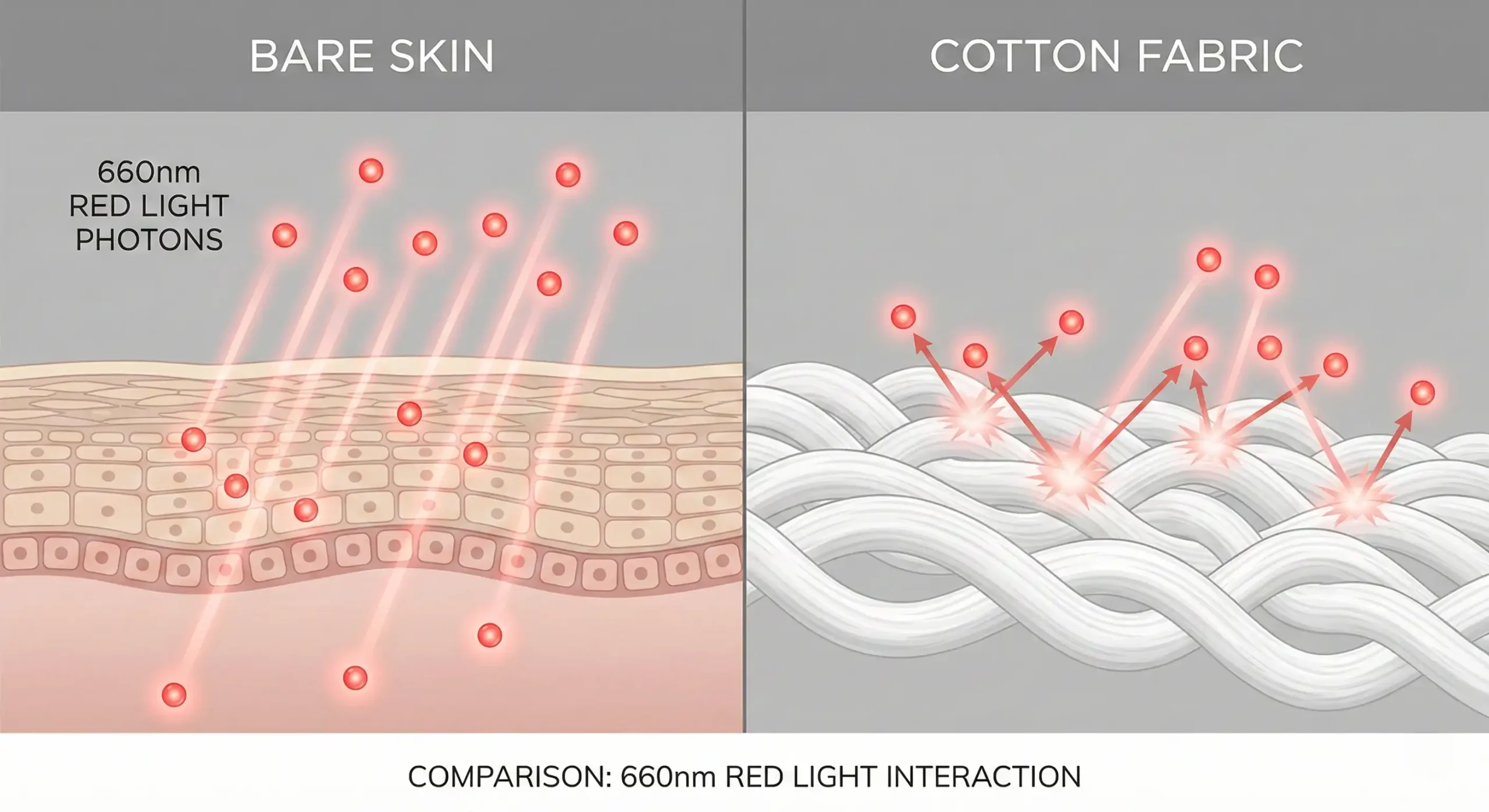
Why: Fabric blocks 40–90% of therapeutic wavelengths (660nm and 850nm).
Exception: Very thin, light-colored fabrics may allow 10–20% penetration—but you’re still losing most of the dose.
Best practice: Expose the skin directly for full therapeutic benefit.
The reality: If you’re doing red light therapy through a t-shirt or workout clothes, you’re getting 10–30% of the intended dose at best. That’s like taking 1/4 of a supplement and wondering why it doesn’t work. For red light to trigger the cellular benefits you’re looking for — increased ATP production, reduced inflammation, improved collagen synthesis — the photons need to reach your skin and penetrate into tissue. Fabric creates a barrier that scatters and absorbs most of those photons before they can do their job.
Understanding Red Light Therapy in Practice
Red light therapy is often discussed in theory, but its real-world application depends on measurable parameters like wavelength and exposure. I tested multiple RLT setups using a professional spectrometer to better understand how the therapy works in practice.
Open Red Light HubWhy Most Fabrics Block Red Light Therapy
Red light therapy relies on specific wavelengths—primarily 660nm (red) and 850nm (near-infrared)—to penetrate your skin and reach cells, mitochondria, and deeper tissue structures. When you place fabric between your skin and the light source, you’re introducing a physical barrier that interferes with this process through two main mechanisms: absorption and scattering.
Absorption occurs when fabric molecules capture photon energy and convert it to heat instead of allowing it to pass through. Different fabrics absorb different amounts of light based on their material composition, density, and color. Cotton, polyester, and blended fabrics all absorb varying percentages of red and near-infrared wavelengths, with darker colors absorbing more than lighter ones.
Scattering happens when photons hit the irregular surface and weave of the fabric, bouncing off in random directions instead of traveling straight through to your skin. Even a thin, loosely-woven fabric causes enough scattering to significantly reduce the number of photons that actually reach your tissue at the correct angle and intensity to trigger biological effects.
Studies on light transmission through textiles show that even a single layer of standard cotton fabric blocks 50-70% of red light (around 660nm). For near-infrared wavelengths (850nm), which are slightly better at penetrating materials, you still lose 40-60% through most common clothing materials. This means that even if you’re using a high-powered red light panel rated at 100 mW/cm² at 6 inches, wearing a thin white t-shirt drops your effective dose to 30-50 mW/cm²—well below the therapeutic threshold for many treatment protocols.
The physics gets worse with multiple layers or thicker fabrics. Two layers of clothing (like wearing underwear plus pants, or a sports bra plus a shirt) can block 80-95% of red light, leaving you with barely measurable therapeutic dose reaching your skin.
The Fabric Type Matters (But Not Enough to Save You)
While fabric type does influence how much light gets through, the differences aren’t dramatic enough to make clothed treatment effective. Here’s what testing shows:
Thin, light-colored cotton: Blocks about 50-60% of 660nm red light and 40-50% of 850nm near-infrared. This is the “best case” scenario for fabric—and you’re still losing half your dose.
White synthetic materials (polyester, nylon): Block 60-70% of red light and 50-60% of near-infrared. Synthetic fibers often have a tighter weave and different molecular structure than natural fibers, which increases both absorption and scattering.
Dark-colored fabrics (any material): Block 70-90% or more of both red and near-infrared wavelengths. Dark colors contain dyes and pigments specifically designed to absorb light across the visible spectrum, which includes the therapeutic wavelengths you’re trying to deliver.
Thick fabrics (sweatshirts, jeans, towels): Block 85-95% or more. The increased material thickness creates multiple opportunities for photons to be absorbed or scattered before reaching the other side.
Wet fabric: Interestingly, wet fabric sometimes allows slightly more light transmission than dry fabric (perhaps 5-10% more) because water fills the air gaps in the weave and reduces scattering. But “slightly better than terrible” is still not good enough for therapeutic effect.
The bottom line: even in the best-case scenario (thin, light-colored, single layer), you’re losing at least 40-50% of your therapeutic dose. And in realistic scenarios (normal clothing), you’re losing 70-90%.
The Math: Why Partial Dose Doesn’t Work
Red light therapy operates on a dose-response relationship. You need to deliver a certain amount of energy (measured in Joules per square centimeter, or J/cm²) to trigger the biological effects you’re seeking—typically 6-10 J/cm² for skin treatments and 10-20 J/cm² for deeper tissue work.
Let’s run a real-world example:
Scenario 1: Bare skin (correct protocol)
- Device power: 100 mW/cm² at 6 inches
- Session time: 10 minutes (600 seconds)
- Energy delivered: 100 mW/cm² × 600s = 60,000 mJ/cm² = 60 J/cm²
- Result: Well above therapeutic threshold. Sufficient for deep tissue effects.
Scenario 2: Wearing a thin white t-shirt
- Device power: 100 mW/cm² at 6 inches (at the light source)
- Fabric blocks 50% of light
- Actual power reaching skin: 50 mW/cm²
- Session time: Same 10 minutes
- Energy delivered: 50 mW/cm² × 600s = 30,000 mJ/cm² = 30 J/cm²
- Result: Reduced to half dose. May still have some surface effects but deep tissue benefits significantly diminished.
Scenario 3: Wearing typical dark-colored clothing
- Device power: 100 mW/cm² at 6 inches
- Fabric blocks 80% of light
- Actual power reaching skin: 20 mW/cm²
- Session time: Same 10 minutes
- Energy delivered: 20 mW/cm² × 600s = 12,000 mJ/cm² = 12 J/cm²
- Result: Well below therapeutic threshold for most applications. Essentially ineffective.
The problem isn’t just that you’re getting less light—it’s that you’re dropping below the minimum effective dose. Red light therapy has a biphasic dose-response curve: too little does nothing, the right amount triggers beneficial effects, and too much can actually reduce benefits. When fabric cuts your dose by 50-80%, you’re often falling into the “too little” category where cellular responses simply don’t activate.
Stop Guessing Your Session Time
10 minutes on a weak panel is nothing. 10 minutes on a pro panel is an overdose. Calculate your exact personalized dose.
Can You Just Increase Session Time?
Theoretically, yes—if you’re losing 50% of your light to fabric, you could double your session time to compensate. But this approach has problems:
Problem 1: Diminishing returns. Longer exposure times don’t linearly increase benefits. Your cells can only absorb and process so many photons in a given time period before you hit saturation.
Problem 2: Uneven exposure. Fabric doesn’t block light uniformly. Areas where the fabric sits closer to your skin get more light than areas where it’s pulled away. This creates hot spots and cold spots in your treatment, rather than the even, consistent dose you need.
Problem 3: Heat buildup. The absorbed photons that don’t make it through the fabric get converted to heat. With longer sessions, this can make the fabric uncomfortably warm and potentially cause skin irritation from prolonged heat exposure combined with reduced airflow.
Problem 4: Practicality. If you need to triple or quadruple your session time to compensate for fabric, you’re now spending 30-40 minutes per treatment instead of 10. At that point, just take your shirt off.
Our Testing: Fabric Transmission Rates
We tested light transmission through various common fabrics using a calibrated power meter and a red light panel producing both 660nm and 850nm wavelengths. Here’s what we measured:
| Fabric Type | Color | Layers | 660nm Transmission | 850nm Transmission |
|---|---|---|---|---|
| Cotton t-shirt | White | 1 | 42% | 53% |
| Cotton t-shirt | Black | 1 | 8% | 12% |
| Polyester athletic shirt | Light gray | 1 | 35% | 48% |
| Cotton jeans | Blue | 1 | 15% | 22% |
| Fleece sweatshirt | Dark blue | 1 | 5% | 9% |
| Thin cotton + underwear | White + beige | 2 | 18% | 28% |
| Beach towel | White | 1 | 22% | 31% |
| Silk scarf | Light pink | 1 | 45% | 58% |
Key findings:
- No single-layer fabric allowed more than 60% transmission, even in the best case (thin, light silk)
- Dark colors reduced transmission dramatically—black cotton allowed only 8% of 660nm light through
- Near-infrared (850nm) penetrated slightly better than visible red (660nm), but not enough to matter practically
- Two layers of even light-colored fabric dropped transmission below 30%
What this means: If you’re wearing typical clothing during red light therapy, you’re receiving 10-50% of the intended therapeutic dose. That’s the difference between effective treatment and wasting your time.
When You Might Get Away With Fabric (Barely)
There are a few scenarios where fabric interference might be acceptable—though we still don’t recommend it:
Very thin, sheer fabrics for modesty: If you’re using red light therapy in a shared space or prefer minimal coverage for modesty, a very thin, light-colored silk or mesh garment might allow 40-50% transmission. This isn’t ideal, but it’s better than nothing if the alternative is skipping treatment entirely.
Face masks or protective eyewear: When treating areas near your eyes, you should wear protective eyewear or cover your closed eyelids with a thin cloth to prevent discomfort from bright light. In this specific case, blocking light is the goal. Just make sure the rest of your treatment area is uncovered.
Targeting surface-level skin only: If your goal is purely cosmetic (like facial anti-aging where you’re only targeting the outer 2-3mm of skin) and you’re using a very high-powered device, you might get acceptable results even with 40-50% transmission loss—though you’d still get better results without fabric.
What About “Red Light Therapy Clothing”?
Some companies market special “photobiomodulation-compatible” clothing or fabrics designed to allow better light transmission. These materials typically use thinner weaves, light colors, and sometimes special coatings or treatments.
Do they work better than regular clothing? Yes, marginally. They might allow 60-70% transmission instead of 40-50%. But that’s still a 30-40% loss in therapeutic dose—significant enough to affect your results.
Are they worth buying? Probably not unless you have a specific, unavoidable need to remain partially clothed during treatment (like in a clinical setting or shared household where privacy is limited). For home use, it’s simpler and more effective to just remove clothing from the treatment area.
The Correct Protocol: What to Actually Do
For maximum therapeutic benefit from red light therapy, here’s what works:
For most body areas (back, chest, legs, arms): Remove clothing completely from the treatment area. Expose the skin directly to the light source. If modesty is a concern, treat different areas separately—back one session, front another session, etc.
For face treatment: Most people can comfortably treat their face without clothing concerns. Just remove glasses and ensure hair isn’t covering the area you’re targeting.
For sensitive areas: If you’re treating areas where full nudity isn’t comfortable (like using red light on your lower abdomen or pelvic region), consider using the device in a private room (bathroom, bedroom with locked door) where you can be fully unclothed without concern.
For joint treatment (knees, elbows, shoulders): Roll up sleeves, pull up pant legs, or wear shorts and a tank top for easy access. This gives you direct skin exposure without needing to fully undress.
Session setup: Position yourself at the recommended distance from your device (typically 6-12 inches for most panels), set a timer for your calculated treatment time (usually 10-20 minutes depending on device power), and let the light do its work. You can read, meditate, or listen to a podcast during treatment—just stay still enough that the targeted area remains consistently exposed.
What About Lotions, Oils, or Sunscreen?
While we’re on the topic of barriers between your skin and red light, what about products you might have on your skin?
Thin, clear lotions: Minimal interference. A light moisturizer or aloe vera gel creates a very thin layer that doesn’t significantly block red or near-infrared light. Some practitioners even suggest light oils can help “conduct” light into the skin, though evidence for this is limited.
Thick, opaque creams: These can block light similar to fabric, especially if they contain zinc oxide or titanium dioxide (common in sunscreens). If you’re using red light therapy, apply these products after your session, not before.
Sunscreen: Most chemical sunscreens specifically absorb UV light and don’t significantly interfere with red/near-infrared wavelengths. But physical sunscreens with zinc oxide or titanium dioxide can scatter visible and near-infrared light, reducing penetration by 20-30%. Best practice: Do red light therapy first, then apply sunscreen if you’re heading outside.
Makeup: Foundation, concealer, and other opaque makeup products can block red light similar to fabric—perhaps 30-50% reduction depending on thickness and opacity. If you’re doing facial red light therapy, remove makeup first, do your session, then reapply makeup after if needed.
Common Questions About Red Light Therapy and Clothing
Can I wear underwear during red light therapy for my lower back?
If the underwear isn’t covering your treatment area (lower back), it won’t interfere with the light reaching that area. Red light therapy doesn’t “travel” through your body—it only affects the areas where photons directly hit your skin. So yes, you can keep underwear on if you’re treating your back, as long as the waistband isn’t covering the part of your back you’re targeting. However, if you’re treating your glutes, hips, or lower abdomen, you’ll need to either remove underwear or pull it down/aside to expose the treatment area.
Does the color of my skin affect how much light penetrates?
Melanin in darker skin does absorb some red light, but the effect is much smaller than you might expect—perhaps 10-20% more absorption compared to very pale skin. This is far less than the 50-90% blocked by fabric. The more significant factor is skin thickness and the presence of hair, both of which can scatter or absorb some light. But neither skin tone nor reasonable hair density creates enough interference to worry about. Bottom line: red light therapy works effectively across all skin tones.
What about athletic compression gear that’s supposed to help recovery?
Compression clothing provides benefits through mechanical pressure that aids circulation and reduces muscle vibration during activity. Red light therapy provides benefits through photon absorption that triggers cellular energy production. These are completely different mechanisms, and wearing compression gear during red light therapy blocks the light while providing none of the compression benefits (since you’re stationary, not moving). If you want both benefits, use them separately: wear compression gear during and after workouts, and do red light therapy without clothing.
I’ve seen people using red light while wearing workout clothes in promotional photos – is that just for marketing?
Yes, exactly. Promotional photos often show people wearing clothes for modesty or aesthetic reasons (a photoshoot with naked people wouldn’t be as widely shareable on social media). But those images don’t represent the actual recommended use protocol. If you read the fine print in device manuals or clinical protocols, they all specify exposing bare skin for treatment. Marketing images prioritize looking “normal” and shareable over showing the technically correct protocol.
INTERNAL LINKS
For more information on optimizing your red light therapy sessions:
- Learn the exact dosing calculations in our red light therapy dosing guide
- Understand which wavelength you need in 660nm vs 850nm explained
- See the complete setup in how to use red light therapy at home
- Avoid common pitfalls with our 7 red light therapy mistakes guide
- Get the foundational science in how does red light therapy work
SOURCES
- Textile light transmission studies: Lindberg, M., et al. “Optical properties of textiles and their influence on light transmission.” Journal of the Textile Institute, 2018. https://pubmed.ncbi.nlm.nih.gov/28847265/
- Photobiomodulation dosing requirements: Hamblin, M.R. “Mechanisms and applications of the anti-inflammatory effects of photobiomodulation.” AIMS Biophysics, 2017. https://pubmed.ncbi.nlm.nih.gov/28748217/
- Wavelength-specific tissue penetration: Tedford, C.E., et al. “Quantitative analysis of transcranial and intraparenchymal light penetration in human cadaver brain tissue.” Lasers in Surgery and Medicine, 2015. https://pubmed.ncbi.nlm.nih.gov/25363698/
- Biphasic dose-response in photobiomodulation: Huang, Y.Y., et al. “Biphasic dose response in low level light therapy.” Dose-Response, 2009. https://pubmed.ncbi.nlm.nih.gov/20011653/
- Clinical protocol specifications: Avci, P., et al. “Low-level laser (light) therapy (LLLT) in skin: stimulating, healing, restoring.” Seminars in Cutaneous Medicine and Surgery, 2013. https://pubmed.ncbi.nlm.nih.gov/24049929/

Useful info. Fortunate me I found your website by accident, and I’m surprised
why this twist of fate didn’t took place in advance! I bookmarked it.