Red light therapy (RLT) uses specific wavelengths of red and near-infrared light to stimulate cellular processes through photobiomodulation. Its effectiveness depends on wavelength, irradiance, distance from the device, and total energy delivered — not simply session length.
Understanding Red Light Therapy in Practice
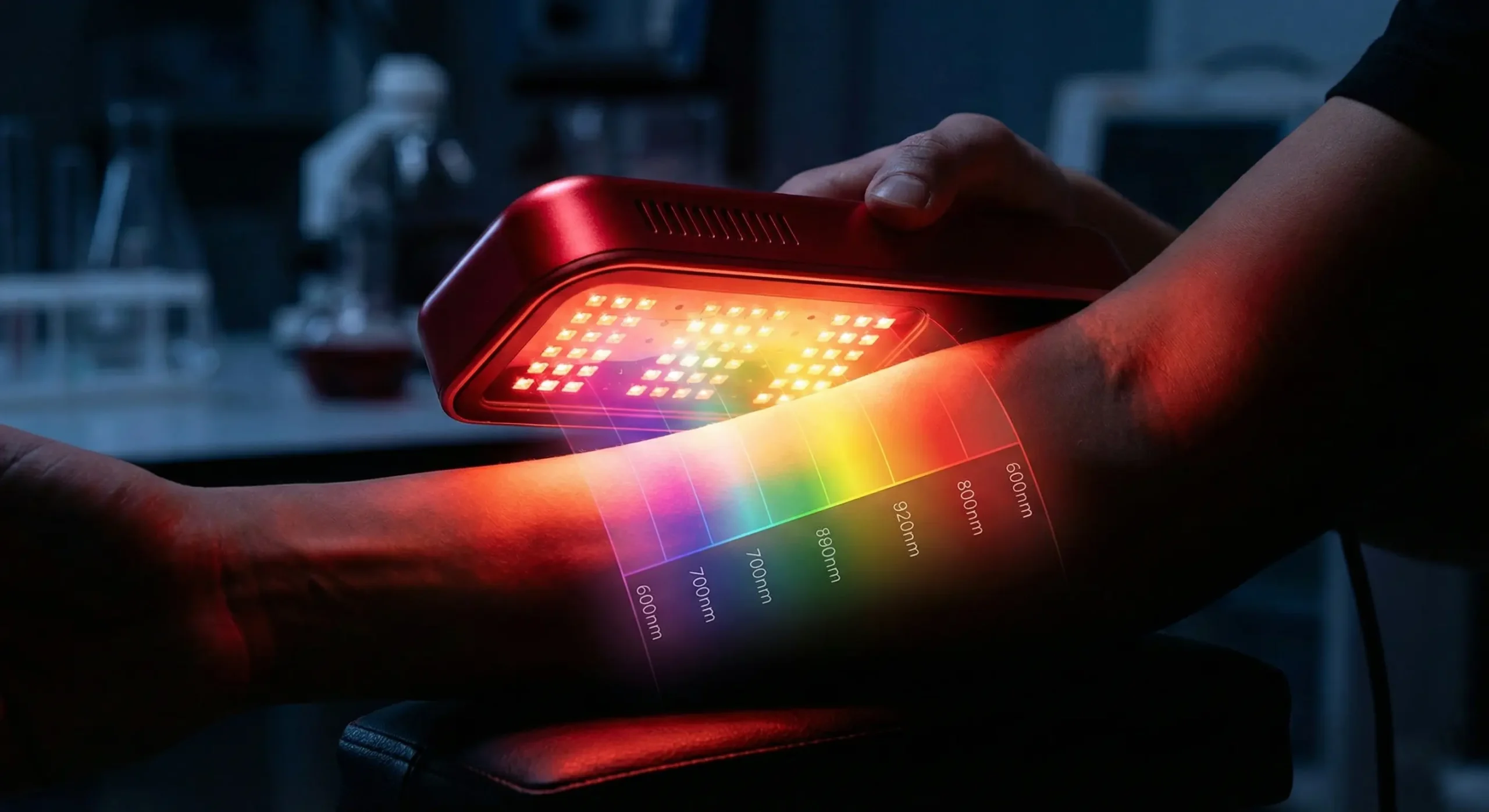
Red light therapy is often discussed in theory, but its real-world application depends on measurable parameters like wavelength and exposure. I tested multiple RLT setups using a professional spectrometer to better understand how the therapy works in practice.
Open Red Light HubIntroduction
Red light therapy isn’t magic.
It isn’t supplements.
And it definitely isn’t “10 minutes for everyone.”
Red light therapy is applied physics interacting with human biology.
Originally studied in aerospace and clinical research, red and near-infrared light is now widely used by biohackers, athletes, and individuals looking to support skin health, recovery, sleep quality, and overall cellular function.
However, most people make the same mistake:
they buy a device and guess the protocol.
This guide explains:
- how red light therapy actually works,
- which wavelengths matter and why,
- what benefits are supported by evidence,
- how dosing really works,
- and how to avoid the most common mistakes.
By the end, you’ll understand exactly why correct dosing matters — and why a calculator is essential.
How Red Light Therapy Works (The 30-Second Science)
Red light therapy works through a process called photobiomodulation (PBM).
In simple terms, specific wavelengths of light are absorbed by cellular structures called mitochondria — the part of the cell responsible for producing ATP (energy).
When mitochondria absorb red or near-infrared photons:
- cellular energy production increases,
- signaling pathways associated with repair and inflammation are modulated,
- and cells function more efficiently.
Key point:
Red light does not heat tissue and does not damage DNA. It is non-ionizing and fundamentally different from UV light.
This is why red light therapy is often described as “charging the battery” rather than stimulating or burning tissue.
Red Light vs Near-Infrared Light: What’s the Difference?
Not all light penetrates tissue equally.
The wavelength determines how deeply photons travel and what tissues are affected.
Red Light (≈ 630–660 nm)
Red wavelengths are absorbed primarily in superficial tissues.
Common use cases:
- Skin health and appearance
- Collagen support
- Scars and stretch marks
- Acne-prone skin
- Surface-level circulation
Red light is ideal when the target tissue is close to the surface.
Near-Infrared Light (≈ 810–850 nm)
Near-infrared wavelengths penetrate much deeper.
Common use cases:
- Muscles and joints
- Tendons and ligaments
- Deeper inflammation
- Recovery and soreness
- Whole-body support
Quick takeaway:
Red light affects skin.
Near-infrared light affects deeper structures.
Most modern panels combine both wavelengths to cover multiple use cases.
Evidence-Based Benefits of Red Light Therapy
Red light therapy is actively researched, and while it is not a medical treatment, studies and applied use suggest it may support several biological processes.
Commonly reported benefits include:
- Improved skin texture and appearance
- Support for collagen production
- Reduced muscle soreness after exercise
- Enhanced recovery signaling
- Improved sleep quality through circadian support
- Modulation of inflammation responses
Important context:
Red light therapy does not “treat diseases.”
Its role is to support normal biological function when used correctly.
Results vary depending on wavelength, dose, consistency, and individual response.
The Most Important Part: Dosing Protocols
Most articles say something like:
“Use red light therapy for 10–20 minutes per session.”
This advice is incomplete and often wrong.
Why Time Alone Is Meaningless
Session time without context ignores three critical variables:
- Irradiance (power output at your distance)
- Distance from the device
- Target energy dose (J/cm²)
Two people using the same panel at different distances can receive dramatically different doses in the same amount of time.
This is why guessing leads to inconsistent or disappointing results.
How Red Light Therapy Dosing Actually Works
Dosing is based on energy delivered over time.
The Core Variables
- Irradiance (mW/cm²):
How much light energy reaches your body at a given distance. - Distance:
Light intensity drops rapidly as distance increases. - Energy dose (J/cm²):
The total energy delivered to the tissue.
The Basic Formula
Time (seconds) = (Target Dose × 1000) ÷ Irradiance
This is why manufacturer marketing numbers are unreliable — they often measure output at unrealistic distances.
Don’t Guess Your Dose
Because real-world irradiance varies between devices and setups, the most reliable way to determine session time is to calculate it.
Stop Guessing Your Session Time
10 minutes on a weak panel is nothing. 10 minutes on a pro panel is an overdose. Calculate your exact personalized dose.
The calculator adjusts for:
- device output,
- distance,
- and your intended target (skin vs deep tissue).
Frequency: How Often Should You Use Red Light Therapy?
Consistency matters more than intensity.
General guidance:
- Skin applications: 3–5 sessions per week
- Recovery or soreness: daily use is common
- Maintenance: 2–3 sessions per week
Biphasic Dose Response
Red light therapy follows a biphasic dose response:
- too little = minimal effect,
- optimal dose = best response,
- too much = reduced benefit.
More is not better.
Rest days allow cellular processes to adapt and respond.
Safety and Contraindications
Red light therapy is generally considered safe when used responsibly.
Basic safety guidelines:
- Avoid direct eye exposure, especially with near-infrared light.
- Use protective eyewear when recommended.
- Be cautious if taking photosensitizing medications.
- Discuss use with a professional if pregnant or managing a serious medical condition.
Red light therapy is not a replacement for medical care.
Why Most Red Light Therapy Guides Get Dosing Wrong
Most guides fail for three reasons:
- They rely on generic time ranges.
- They trust manufacturer marketing specs.
- They ignore distance-based power loss.
As a result, users either underdose (no results) or overdose (reduced effectiveness).
Correct dosing requires understanding physics — not guessing.
Who This Guide Is For
This guide is designed for:
- at-home red light therapy users,
- biohackers and athletes,
- people using panels, masks, or handheld devices.
It is not intended to diagnose or treat medical conditions.
Frequently Asked Questions
Is red light therapy safe?
Red light therapy is generally considered safe and non-invasive when used correctly. It does not emit UV radiation.
How long should a session be?
Session time depends on your device’s real output and distance. Use a calculator instead of fixed time ranges.
What wavelength should I use?
660 nm for skin-level effects; 810–850 nm for deeper tissue support.
Can you overdo red light therapy?
Yes. Excessive dosing can reduce effectiveness due to biphasic dose response.
Does distance really matter?
Yes. Irradiance drops significantly as distance increases, directly affecting dose.
Final Thoughts
Red light therapy works — but only when used correctly.
Understanding wavelengths, distance, and energy delivery transforms red light therapy from guesswork into a predictable, repeatable tool.
If there’s one takeaway from this guide, it’s this:
👉 Don’t guess your dose. Calculate it.
Scientific Sources & Clinical Studies
This guide relies on peer-reviewed research regarding photobiomodulation mechanisms and dosing parameters.
- Mechanism of Action (ATP): de Freitas, L. F., & Hamblin, M. R. (2016). “Proposed Mechanisms of Photobiomodulation or Low-Level Light Therapy.” IEEE Journal of Selected Topics in Quantum Electronics.
- Biphasic Dose Response: Huang, Y. Y., et al. (2009). “Biphasic dose response in low level light therapy.” Dose-Response.
- Skin & Collagen (Red Light): Avci, P., et al. (2013). “Low-level laser (light) therapy (LLLT) in skin: stimulating, healing, restoring.” Seminars in Cutaneous Medicine and Surgery.
- Muscle Recovery (NIR): Ferraresi, C., et al. (2016). “Photobiomodulation in human muscle tissue: an advantage in sports performance and recovery.” Journal of Biophotonics.
- Safety Profile: Hamblin M. R. (2017). “Mechanisms and applications of the anti-inflammatory effects of photobiomodulation.” AIMS Biophysics.
Disclaimer: Content on BioHackingTested is for informational purposes only and does not constitute medical advice.