Disclaimer: This article is an educational review of current research and is not medical advice. Always consult a healthcare provider for treatment decisions. Results vary significantly between individuals.
The Short Answer
Research shows potential, but it’s not magic and it’s not Photoshop.
Red light therapy (RLT) may help with scar appearance—particularly fresh scars—by supporting collagen remodeling and improving skin texture. A 2020 systematic review on photobiomodulation found that RLT “may improve scar appearance and texture,” particularly when started early post-injury.
However, if you’re hoping to completely erase a 10-year-old surgical scar in a month, that’s not happening.
Understanding Red Light Therapy in Practice
Red light therapy is often discussed in theory, but its real-world application depends on measurable parameters like wavelength and exposure. I tested multiple RLT setups using a professional spectrometer to better understand how the therapy works in practice.
Open Red Light HubHow It Works (Simplified Mechanism)
Scars form when your body rushes to close a wound. It lays down collagen fibers quickly—but not neatly. The result is a chaotic, disorganized structure.
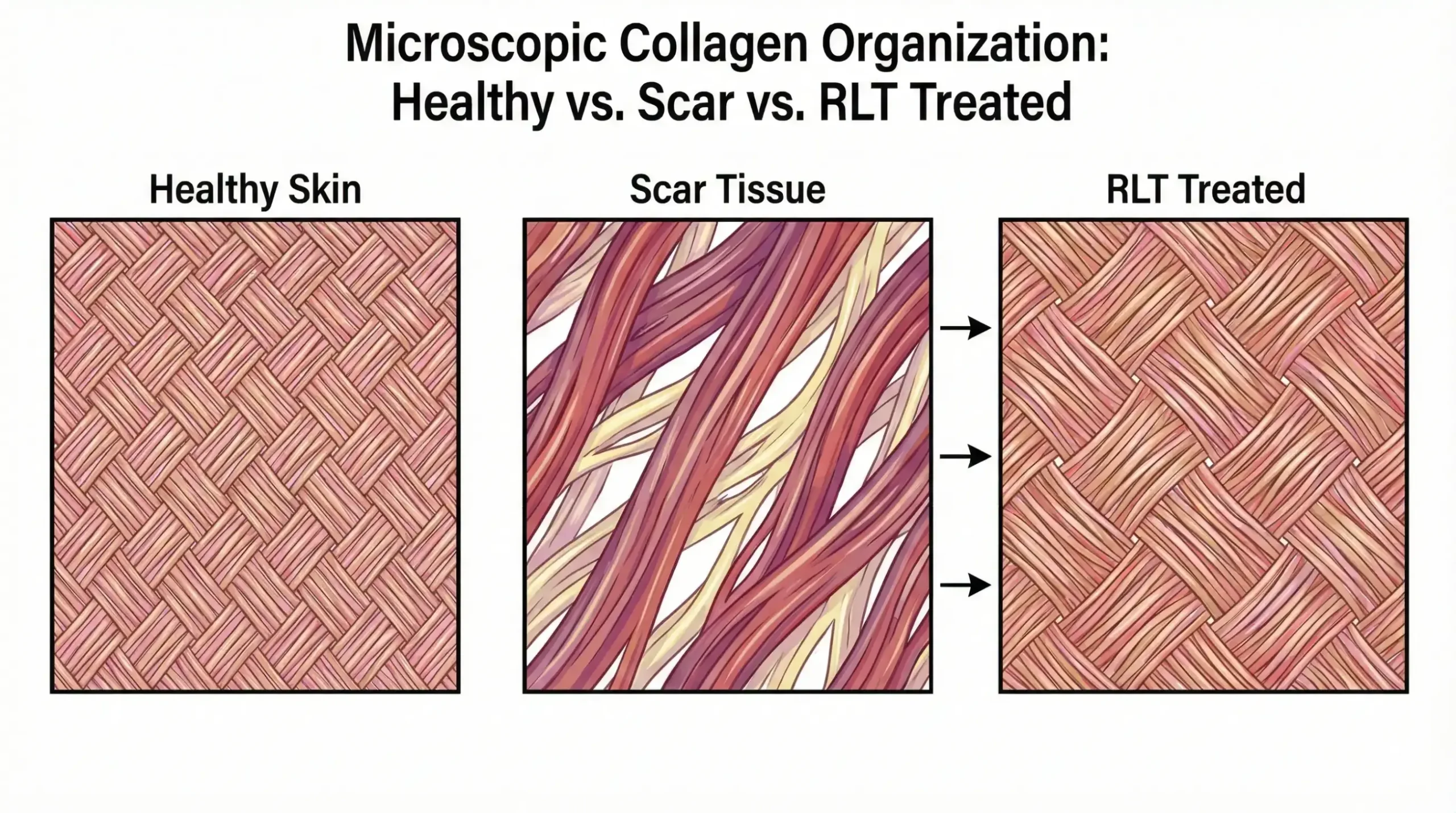
Red light therapy is thought to help through several mechanisms:
- Fibroblast Activation: Red/NIR light energizes mitochondria, helping fibroblasts work more efficiently to increase collagen production.
- Blood Flow: The therapy promotes angiogenesis (formation of new blood vessels), which plays an important role in delivering nutrients to healing tissue.
- Inflammation Modulation: Chronic inflammation keeps scars looking angry and raised. RLT helps calm this response.
Settings Commonly Used in Studies
To understand how red light therapy is typically applied in research settings, studies often report the following ranges:
- Wavelength: 630-660nm (Red light is best for surface skin issues).
- Power Density: 40-80 mW/cm².
- Frequency: Daily or 5x per week.
- Session Length: Usually 10-20 minutes.
These parameters vary widely between studies and are not intended as personal treatment recommendations.
Important: To determine the exact session time for your specific device, use the RLT Calculator on our website. Do not guess with scars.
Realistic Timeline (Managing Expectations)
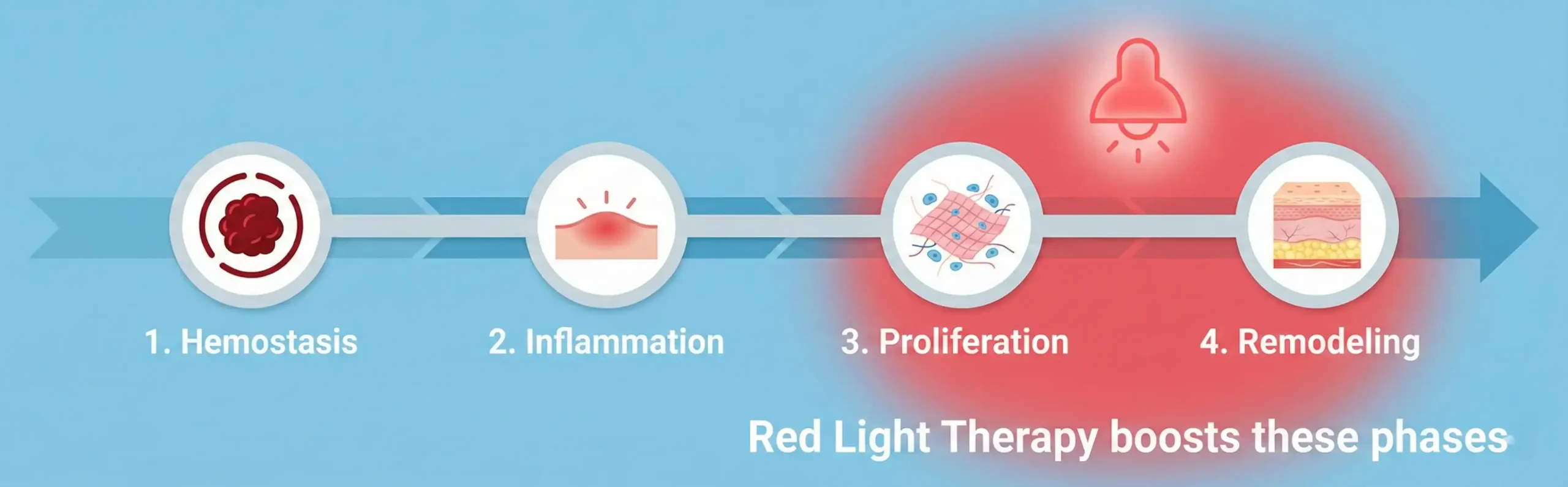
- Weeks 1-4: Likely no visible change. Cellular remodeling is happening under the surface.
- Months 2-3: Possible softening of tissue. Redness may start to fade.
- Month 6+: Potential visible fading of discoloration.
Fred’s Tip: Take photos under the same lighting every week. Change is too slow to notice in the mirror. You need objective comparison shots.
What Won’t Work (Limitations)
Let’s be honest about limitations. Keloid Scars: These are aggressive, overgrown scars. While some studies suggest benefits, keloids are notoriously difficult and may require combination therapies alongside light treatment. Deep Pitted Scars: RLT can improve texture, but it likely won’t fill in deep acne pits completely.
Final Thoughts
Can red light therapy fade scars and stretch marks? The evidence suggests it can help—especially with newer scars and when used consistently over months. Just don’t fall for before-and-after photos on Amazon that show scars vanishing in two weeks. That’s not how biology works.
Common Questions About RLT for Scars
How long does red light therapy take to fade scars?
Old scars (1+ years): 8-12 weeks minimum for noticeable fading, often 4-6 months for significant improvement. New scars (under 6 months): 4-8 weeks with consistent use (3-5x per week). Scars don’t disappear completely, but expect 30-60% improvement in texture, color, and thickness with proper protocol.
Does red light work on stretch marks?
Yes, but set realistic expectations. Red light stimulates collagen in the dermis where stretch marks form. Expect 20-40% improvement in appearance (less redness, smoother texture) after 12-16 weeks of 3-5x weekly sessions. Best results on newer stretch marks (under 1 year old). Silvery old stretch marks improve less but still respond.
What wavelength is best for scars — 660nm or 850nm?
Both, ideally. 660nm (red) penetrates 8-10mm for surface collagen remodeling. 850nm (NIR) penetrates 10-40mm for deeper dermis inflammation reduction. Combination devices work best because scars involve multiple skin layers. If choosing one: 660nm for shallow scars, 850nm for deep or surgical scars.
Can you use red light on surgical scars?
Yes, but wait until incision is fully closed (typically 2-3 weeks post-surgery). Starting RLT during weeks 3-8 post-op can reduce keloid formation and improve long-term scar appearance. Always consult your surgeon first, especially after major procedures. Early intervention works better than treating old surgical scars.
How close should the device be for scar treatment?
6-8 inches for most panels. Closer = higher dose but smaller coverage area. For targeted scar treatment, 6 inches works well. Measure consistently — even 2-3 inches difference can change dose by 50%. Use a ruler or tape measure to maintain exact distance across sessions.
Does RLT work on acne scars?
Yes, especially on atrophic (indented) scars and hyperpigmentation. Red light stimulates collagen production to fill in depressions and reduces melanin for pigmentation fading. Ice pick scars (very deep, narrow) respond less than rolling or boxcar scars. Expect 30-50% improvement over 12-16 weeks. Won’t work on raised/hypertrophic acne scars without professional intervention.