Sleep optimization is the practice of systematically improving both the quantity and quality of your sleep using evidence-based techniques. Unlike simply “getting more sleep,” optimization focuses on maximizing the restorative value of each hour you spend sleeping by addressing factors like sleep environment, circadian rhythm alignment, pre-sleep routines, and lifestyle habits that impact sleep architecture.
The goal isn’t just to sleep longer — it’s to sleep better. Research shows that sleep quality often matters more than duration, with optimized sleep of 7 hours outperforming unoptimized 9-hour sleep in measures of cognitive performance, immune function, and metabolic health.
This guide explains what sleep optimization actually means, why it matters beyond basic sleep hygiene, and which techniques are backed by sleep science rather than wellness marketing. If you’re sleeping 8 hours but still waking up exhausted, this is where to start.
Want Better Sleep Stats?
Theory is good, but tools get results. See the exact stack (mask, tape, supplements) I use to get 2+ hours of Deep Sleep every night.
Open Sleep HubWhy Most People Struggle With Sleep (Despite Knowing It’s Important)
Everyone knows sleep matters. We’ve all read the articles, seen the headlines about needing 7-9 hours, heard about sleep deprivation’s health impacts. Yet according to the CDC, more than one-third of American adults regularly don’t get enough quality sleep.
The disconnect isn’t knowledge — it’s execution. Most sleep advice focuses on duration (“get 8 hours”) without addressing the deeper issues that make quality sleep difficult in modern life. Let me explain why the standard advice fails and what actually needs to change.
The Duration Trap (More Hours ≠ Better Sleep)
I spent years chasing the magic number. Eight hours. That’s what every article said. So I’d force myself into bed at 10 PM, lie there for 45 minutes scrolling my phone because I wasn’t actually tired, finally fall asleep around 11:30, wake up multiple times during the night, and drag myself out of bed at 7 AM having technically “slept 8 hours.”
I was exhausted every single day.
Here’s what I didn’t understand: sleep duration means nothing if the quality is terrible. Eight hours of fragmented, light sleep leaves you more impaired than six hours of deep, consolidated sleep. Research from sleep laboratories shows that sleep architecture — the cycling through different sleep stages — matters as much or more than total time in bed.
Your brain needs specific amounts of deep sleep (slow-wave sleep) for physical restoration and REM sleep for cognitive processing and emotional regulation. If you’re spending 8 hours in bed but only getting 45 minutes of deep sleep and minimal REM, you’re not actually getting restorative rest regardless of what your sleep tracker says.
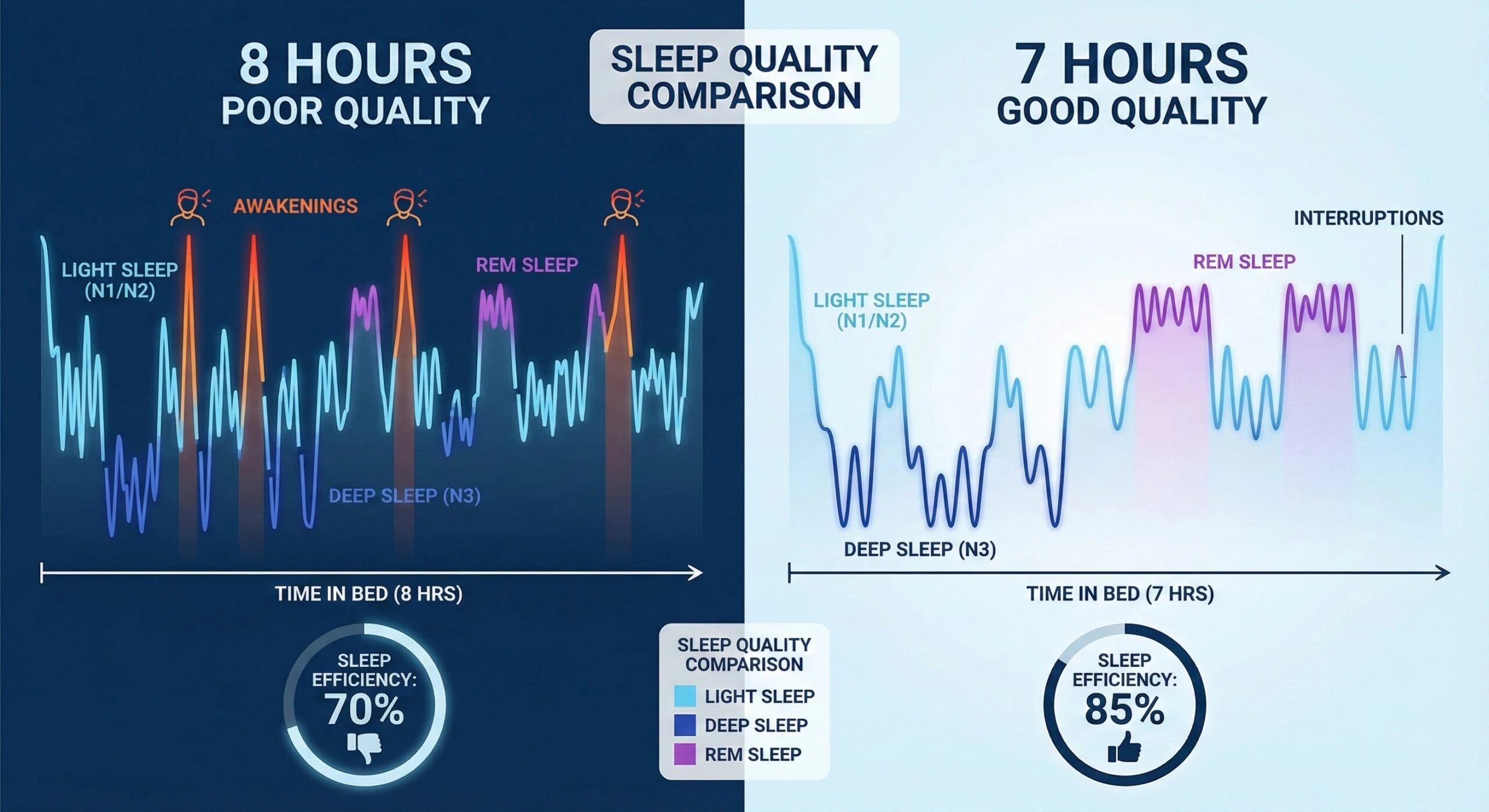
The quality vs quantity breakdown:
- Poor quality 8 hours: Fragmented sleep, multiple awakenings, mostly light sleep stages, poor sleep efficiency
- Good quality 7 hours: Consolidated sleep blocks, sufficient deep and REM sleep, high sleep efficiency (>85% of time in bed actually sleeping)
Studies comparing these scenarios consistently show that the 7-hour good quality sleep produces better outcomes for alertness, mood, cognitive performance, and metabolic markers.
My wake-up call: I started using a sleep tracker that measured sleep stages, not just duration. Turned out my “8 hours” was really 6.5 hours of actual sleep (the rest was lying awake), and of that 6.5 hours, only 12% was deep sleep and 15% was REM. I was spending one-third of my life in bed but getting maybe 90 minutes of truly restorative sleep.
That’s when I realized duration wasn’t my problem. Sleep quality was.
The Modern Sleep Environment Problem
Our biology evolved for 99.9% of human history in environments with specific characteristics: complete darkness after sunset, cool temperatures, minimal noise, natural light exposure during the day, physical activity, and zero artificial stimulation before sleep.
Modern life systematically violates every single one of these conditions.
We’re exposed to bright screens emitting blue light at wavelengths that suppress melatonin production. Our bedrooms are often too warm (research shows optimal sleep temperature is 60-67°F, yet most people keep bedrooms at 68-72°F). We live in cities with ambient light pollution and noise. We sit in offices all day with minimal natural light exposure, dysregulating our circadian rhythms. We consume caffeine late in the day without understanding its 5-6 hour half-life.
The mismatch between biology and environment:
Our circadian system expects strong bright light (ideally 10,000+ lux) in the morning to set our biological clock. Most indoor lighting provides 300-500 lux. We get maybe 1/20th of the light signal our biology expects during the day.
Then at night, our circadian system expects near-total darkness (less than 1 lux). Instead, we’re exposed to 50-200 lux from screens, overhead lights, and devices. We’re getting 50-200x more light than our biology expects at night.
This doesn’t just make it “harder to fall asleep” — it fundamentally dysregulates the master clock in your suprachiasmatic nucleus (SCN), the brain region that coordinates circadian rhythms throughout your entire body.
My apartment’s sleep sabotage: I lived in a city apartment with streetlights shining directly into my bedroom window. My blackout curtains had a 1-inch gap. Light pollution was keeping my bedroom at maybe 10-15 lux throughout the night. I thought it was “dark enough” because I couldn’t see well. But my circadian system could detect it, and it was suppressing melatonin production all night long.
I also had my phone charging on my nightstand, with the screen lighting up for every notification. That’s bursts of 100+ lux every time someone texted me. My sleep tracker showed I was waking up 15-20 times per night in microarousals I didn’t even remember.
Fixing my sleep environment wasn’t about “slightly better” conditions. It was about understanding that my modern apartment was actively hostile to sleep, and I needed to systematically engineer around that.
The Information Overload Paradox
Here’s something ironic: we have more information about sleep than ever before, yet sleep quality has declined over the past few decades. Access to knowledge hasn’t solved the problem.
Why? Because most sleep content focuses on listing tips without explaining the underlying mechanisms or helping you prioritize what actually matters. You end up with a mental checklist of 47 things you “should” do for better sleep, feel overwhelmed, do none of them consistently, and wonder why nothing improves.
I had a note in my phone titled “Sleep Tips” with 30+ bullet points collected from articles, podcasts, and books. Things like:
- Keep room cool
- No caffeine after 2 PM
- Exercise but not too late
- Magnesium supplements
- Meditation before bed
- Weighted blanket
- Blue light blocking glasses
- White noise machine
- Specific pillow height
- Sleep schedule consistency
- No alcohol
- Chamomile tea
- Relaxation exercises
- etc., etc., etc.
The problem: All of these are valid. None of them are wrong. But trying to implement 30 changes simultaneously is impossible. I’d do well for 3 days, miss one night, feel like I’d failed, and give up on all of them.
What I needed wasn’t more tips. I needed a framework to understand which interventions had the biggest impact, which were foundational vs. optional, and how to implement them in a sustainable sequence rather than all at once.
This is what sleep optimization actually means: It’s not about knowing everything about sleep science. It’s about understanding the hierarchy of interventions and systematically addressing the factors that have the largest effect size on your personal sleep quality.
Defining Sleep Optimization (Beyond Basic Sleep Hygiene)
Sleep optimization is a systematic, evidence-based approach to improving sleep quality and efficiency by addressing the physiological, environmental, and behavioral factors that govern sleep architecture and circadian rhythm regulation.
Let me break that down into plain English.
The Three Pillars of Sleep Optimization
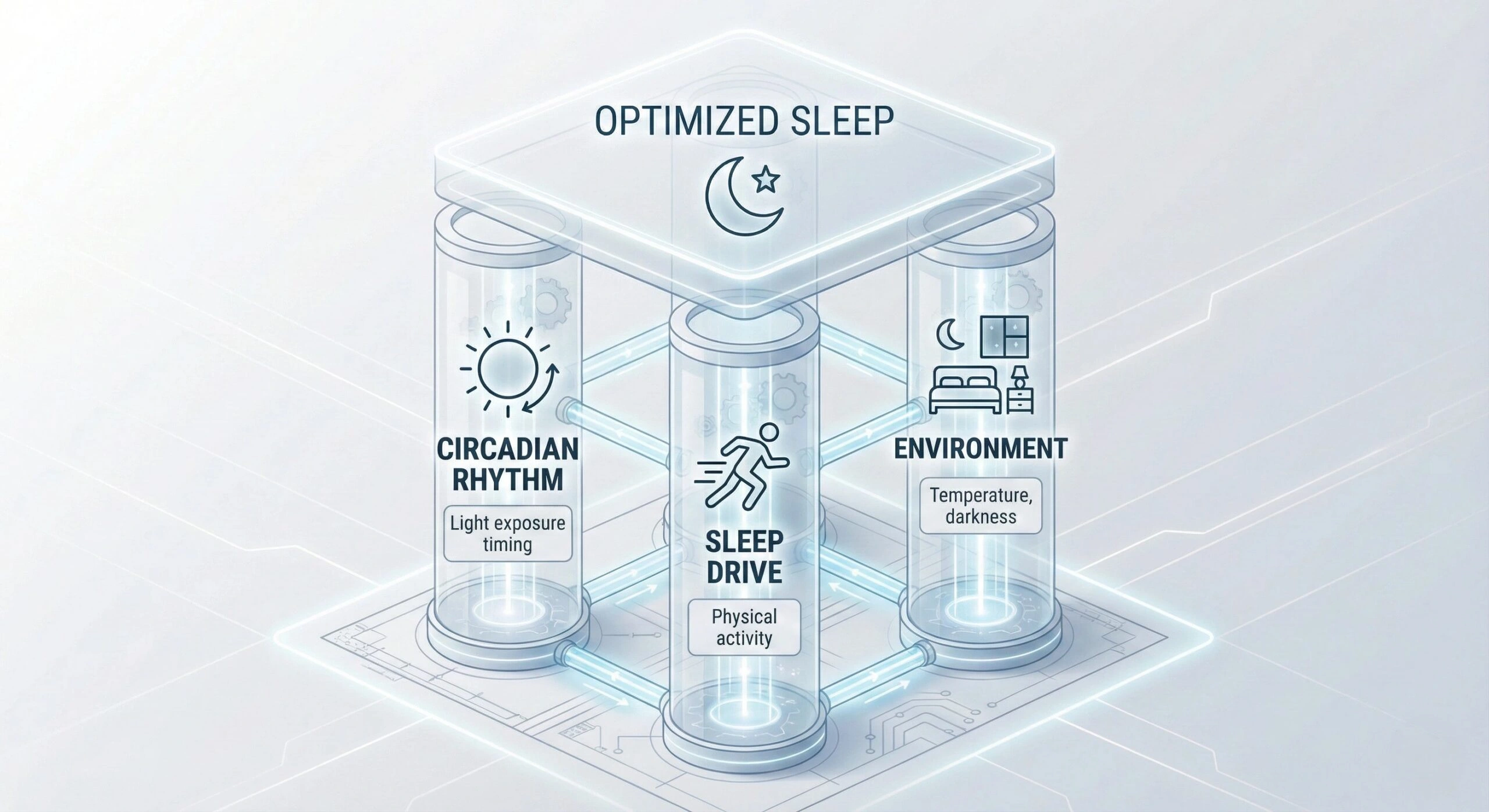
Sleep optimization rests on three foundational pillars. Address these, and you fix 80% of sleep issues. Ignore them, and no amount of supplements or gadgets will help.
Pillar 1: Circadian Rhythm Alignment
Your circadian rhythm is a ~24-hour biological clock controlled by the suprachiasmatic nucleus in your hypothalamus. This master clock coordinates thousands of physiological processes: hormone release (melatonin, cortisol), body temperature regulation, metabolism, immune function, and sleep-wake cycles.
When your circadian rhythm is properly aligned with your sleep schedule, falling asleep is easy, sleep is deep and consolidated, and waking up feels natural. When it’s misaligned, you get insomnia, fragmented sleep, and daytime fatigue regardless of how long you spend in bed.
What drives circadian rhythm:
- Light exposure (strongest zeitgeber/time cue)
- Meal timing
- Exercise timing
- Temperature fluctuations
- Social cues
Research from circadian biology labs shows that <a href=”https://pubmed.ncbi.nlm.nih.gov/30311830/” target=”_blank” rel=”nofollow noopener”>light is the dominant zeitgeber, with morning bright light exposure (>1000 lux) advancing your circadian phase and evening bright light delaying it</a>.
Practical meaning: If you get bright light exposure early in the day and avoid bright light at night, your circadian rhythm naturally aligns with a schedule where you feel tired at an appropriate bedtime and wake feeling refreshed.
If you work in a dim office all day, then stare at screens until midnight, your circadian rhythm has no idea what time of day it is. Your biology thinks it’s perpetual twilight. Melatonin release is confused and delayed. You’re not tired at 10 PM because your circadian system hasn’t received the signals that “night” has started.
My fix: I bought a 10,000 lux light therapy lamp and used it for 20-30 minutes every morning within an hour of waking. I installed f.lux on my computer and enabled night shift on my phone to reduce blue light after 8 PM. I committed to outdoor time during lunch (even cloudy daylight is 10x brighter than indoor lighting).
Within 2 weeks, I started feeling tired at 10:30 PM instead of midnight. Not slightly tired — actually sleepy, eyes heavy, ready for bed. That’s circadian alignment working. Before this, I’d never experienced that natural sleep pressure at a reasonable hour.
Pillar 2: Sleep Drive (Homeostatic Sleep Pressure)
Sleep drive is the biological pressure to sleep that builds up throughout the day based on how long you’ve been awake and what you’ve done during waking hours. It’s regulated by adenosine accumulation in the brain.
The longer you’re awake, the more adenosine accumulates, creating increasing sleep pressure. When you finally sleep, adenosine is cleared, and you wake up with low sleep pressure and high alertness.
What affects sleep drive:
- Time awake (primary factor)
- Physical activity (increases adenosine accumulation)
- Cognitive effort (moderate effect)
- Caffeine (blocks adenosine receptors, masking sleep pressure without clearing it)
Studies on sleep homeostasis demonstrate that physical activity, particularly in the afternoon, significantly increases sleep drive and deepens subsequent sleep, likely through increased adenosine metabolism.
Practical meaning: If you don’t build sufficient sleep drive during the day, you won’t feel tired enough to fall asleep easily at night, even if your circadian rhythm is perfectly aligned.
This explains why sedentary days often lead to poor sleep. If you sit at a desk for 10 hours, have minimal physical activity, and don’t challenge your brain much, adenosine accumulation is relatively low. You don’t have strong sleep pressure by bedtime.
Conversely, if you exercise vigorously, move throughout the day, and engage in cognitively demanding work, adenosine levels are higher by evening. Sleep pressure is strong. Falling asleep is easy.
My experience: On days I worked out intensely in the afternoon, I’d be noticeably sleepier by 10 PM. On days I sat in video calls for 8 hours with minimal movement, I’d still feel wired at 11 PM despite being “tired.” The difference was sleep drive, not circadian rhythm.
I started walking for 30 minutes after lunch and doing resistance training 3-4 afternoons per week. This simple addition increased my sleep drive enough that combined with circadian alignment, I was falling asleep within 10 minutes of getting in bed instead of lying awake for 45+ minutes.
Pillar 3: Sleep Environment Optimization
Even with perfect circadian alignment and strong sleep drive, a suboptimal sleep environment can fragment sleep and reduce sleep quality. Your bedroom conditions directly affect sleep maintenance and sleep architecture.
Critical environmental factors:
- Temperature: 60-67°F optimal (core body temperature needs to drop 2-3°F for sleep initiation)
- Darkness: <1 lux ideal (complete darkness)
- Noise: <30 dB or consistent white noise
- Air quality: CO2 <1000 ppm, adequate ventilation
- Mattress/pillow support: spinal alignment matters
Research on sleep environment factors shows that even small amounts of light exposure during sleep can suppress melatonin and fragment sleep. One study found that room light exposure before bedtime (200 lux for 3 hours) shortened melatonin duration by about 90 minutes.
Practical meaning: You can do everything right with circadian rhythm and sleep drive, but if your bedroom is 72°F, has light leaking in from streetlights, and is noisy from traffic, your sleep will still be fragmented and non-restorative.
My bedroom transformation:
- Installed actual blackout curtains (not “room darkening” — total blackout, tested with light meter showing <0.5 lux)
- Dropped thermostat to 65°F at night (felt cold initially, but sleep quality improved dramatically)
- Added white noise machine to mask intermittent city noise
- Covered or removed all LEDs from devices (even tiny indicator lights emit enough light to affect sleep)
- Upgraded to a mattress that actually supported my spine (previous mattress was 10 years old and causing back pain that woke me up)
These weren’t minor tweaks. Each one measurably improved my sleep metrics. The temperature change alone increased my deep sleep percentage from 12% to 18% according to my sleep tracker.
Sleep Optimization vs Sleep Hygiene (What’s the Difference?)
You’ve probably heard the term “sleep hygiene” — the basic dos and don’ts like keeping a consistent schedule, avoiding caffeine late, and creating a bedtime routine. Sleep hygiene is real and important, but it’s not the same as sleep optimization.
Sleep hygiene is preventive and general. It’s about avoiding behaviors that harm sleep. Don’t consume stimulants before bed. Don’t use screens in the bedroom. Don’t exercise right before sleep. These are important baselines, but they’re reactive — they prevent problems rather than actively improving sleep architecture.
Sleep optimization is active and personalized. It’s about systematically enhancing the physiological processes that govern sleep quality. It requires understanding your personal sleep metrics, identifying your specific limiting factors, and implementing targeted interventions with measurable outcomes.
The distinction:
- Sleep hygiene says “avoid blue light before bed”
- Sleep optimization says “get 10,000 lux of light within 2 hours of waking to phase-advance your circadian rhythm by 1-2 hours, enabling earlier melatonin onset”
- Sleep hygiene says “keep a consistent schedule”
- Sleep optimization says “align your sleep-wake times within your circadian chronotype window, using light exposure timing to shift your natural phase if needed”
- Sleep hygiene says “keep your room cool”
- Sleep optimization says “target 65°F to facilitate the 2-3°F core temperature drop required for sleep onset, and consider warming your extremities to promote distal vasodilation”
Sleep hygiene gives you rules. Sleep optimization gives you mechanisms and tools to manipulate those mechanisms.
Why this matters: If you follow every sleep hygiene rule perfectly but don’t address underlying circadian misalignment, weak sleep drive, or environmental issues, you’ll still have poor sleep. Sleep optimization fixes root causes, not just symptoms.
The Science-Backed Interventions (Prioritized by Effect Size)
Not all sleep interventions are created equal. Some have large, well-documented effects. Others are marginal or context-dependent. Let’s focus on what moves the needle most, based on meta-analyses and systematic reviews.
Light Exposure Timing (Highest Impact Intervention)
If you only optimize one thing about your sleep, make it light exposure. The effect size is enormous and the mechanism is well-understood.
Morning bright light exposure (ideally within 1-2 hours of waking, 10,000 lux for 20-30 minutes, or 30-60 minutes of outdoor sunlight) advances your circadian phase. This means your melatonin onset shifts earlier, you feel tired earlier in the evening, and you wake up earlier feeling more refreshed.
A meta-analysis of light therapy interventions found that morning bright light consistently improved sleep onset latency, total sleep time, and sleep efficiency in people with circadian rhythm sleep disorders.
Evening light avoidance (reducing exposure to bright light, especially blue wavelengths 450-480nm, for 2-3 hours before bed) prevents circadian phase delay. This allows natural melatonin rise to occur on schedule.
Research shows that even relatively modest light exposure (200 lux) in the evening can suppress melatonin by 50% and delay sleep onset.
Practical implementation:
- Morning: Get outside for 15-30 minutes within 2 hours of waking, even on cloudy days (clouds still let through 10,000+ lux). If impossible, use 10,000 lux light therapy lamp at breakfast.
- Daytime: Maximize bright light exposure during working hours (sit near windows, take outdoor breaks)
- Evening: Dim lights after sunset, use warm-toned bulbs (<2700K color temperature), enable device night modes, consider blue-blocking glasses if you must use screens
My protocol: I walk outside for 20 minutes every morning with my coffee, no sunglasses. On winter mornings when it’s still dark when I wake up, I use my light therapy lamp while eating breakfast. After 8 PM, I dim all overhead lights, use only warm table lamps, and wear blue-blocking glasses if I’m using my computer.
This single change — fixing my light exposure timing — had the biggest impact on my sleep of anything I’ve tried. Within 3 weeks, my natural bedtime shifted from 12:30 AM to 10:30 PM without forcing it. I just felt tired earlier because my circadian rhythm had shifted.
Temperature Regulation (Second Highest Impact)
Your core body temperature needs to drop by 2-3°F for sleep initiation and needs to stay relatively cool throughout the night for high-quality sleep. Research demonstrates that thermoregulatory dysfunction during sleep correlates with insomnia and fragmented sleep.
The temperature paradox: Most people keep bedrooms at 68-72°F because that feels comfortable when awake. But this temperature range is too warm for optimal sleep. Your body is trying to cool down, but the environment isn’t helping.
Studies on sleep and thermoregulation show that ambient temperatures of 60-67°F produce the best sleep architecture, with increased deep sleep and reduced awakenings.
Practical implementation:
- Lower bedroom thermostat to 65°F (adjust based on personal comfort, but start here)
- Use breathable bedding (cotton, linen, or bamboo — avoid synthetic materials that trap heat)
- Take a warm bath or shower 90 minutes before bed (the subsequent temperature drop signals sleep onset)
- Keep extremities warm (socks can help if you have cold feet — warming peripheries promotes vasodilation and heat dissipation from core)
My experience: This felt counterintuitive at first. I’d always kept my bedroom at 70°F. When I dropped it to 65°F, I felt cold getting into bed. But once under covers, the cool ambient air helped my body temperature drop, and I fell asleep significantly faster.
My sleep tracker showed a clear difference: at 70°F bedroom temperature, I had 45-55 minutes of deep sleep per night. At 65°F, I consistently got 75-90 minutes. That’s a 50-60% increase in deep sleep from one environmental change.
Exercise Timing and Intensity (Moderate to High Impact)
Physical activity increases sleep drive through multiple mechanisms: adenosine accumulation, energy depletion, and potentially through effects on body temperature regulation and stress hormone clearance.
A meta-analysis of exercise and sleep studies found that regular aerobic exercise significantly improved sleep quality, increased total sleep time, and reduced sleep onset latency compared to no exercise.
Timing matters: Morning or afternoon exercise appears optimal. Late evening intense exercise (within 2-3 hours of bedtime) can interfere with sleep for some people due to elevated core temperature and cortisol, though individual variation exists.
Intensity matters: Both moderate and vigorous exercise improve sleep, with some research suggesting vigorous exercise may produce slightly larger effects on deep sleep.
Practical implementation:
- Aim for at least 150 minutes of moderate aerobic activity or 75 minutes of vigorous activity weekly
- Schedule intense workouts for morning or afternoon
- Light exercise (walking, stretching, yoga) in the evening is fine and may even help
- Consistency matters more than intensity — moderate daily activity beats sporadic intense sessions
My routine: I do resistance training 4x/week in the late afternoon (4-5 PM) and walk 30-45 minutes most days at lunch. On workout days, I’m noticeably more tired by 10 PM. The combination of physical exertion plus the natural post-exercise temperature drop a few hours later aligns perfectly with bedtime.
On days I skip exercise, my sleep is measurably worse — more awakenings, less deep sleep, longer time to fall asleep. The correlation is consistent enough that exercise is now non-negotiable in my routine.
How I Went From 5 Hours of Terrible Sleep to 7.5 Hours of Actually Restorative Sleep
Let me share my actual journey, including the failures and what finally worked. This isn’t a “I fixed my sleep in one week with this weird trick” story. It took 6 months of systematic experimentation to figure out what worked for my biology and lifestyle.
My Sleep Disaster (The Starting Point)
Two years ago, my sleep was catastrophic. I was sleeping maybe 5-6 hours per night on weekdays, crashing for 10-11 hours on weekends to “catch up” (spoiler: sleep debt doesn’t actually work like that). I’d lie awake for 45-90 minutes after getting into bed, wake up 5-7 times per night that I was aware of, and drag myself out of bed feeling like I’d been hit by a truck.
My typical night:
- 11:30 PM: Get in bed, scroll phone for 30 minutes
- 12:00 AM: Try to sleep, lie awake thinking about work
- 12:45 AM: Finally fall asleep
- 2:30 AM: Wake up to use bathroom
- 4:15 AM: Wake up to street noise
- 5:30 AM: Wake up to neighbor’s dog barking
- 6:30 AM: Alarm goes off, snooze 3 times
- 7:00 AM: Actually get up, feel terrible
I was drinking 4-5 cups of coffee daily just to function. I was irritable, foggy-headed, making mistakes at work, and gaining weight despite eating reasonably well. My HRV (heart rate variability) was in the toilet, indicating chronic stress.
What I’d tried before:
- Melatonin supplements (didn’t help onset, made me groggy)
- “Sleepytime” tea (placebo at best)
- Meditation apps (couldn’t focus enough to do them consistently)
- Alcohol to “help me relax” (terrible idea, severely fragmented sleep)
- Random sleep hygiene tips from articles (half-heartedly implemented, no consistency)
Nothing worked because I was treating symptoms, not addressing root causes. I didn’t understand circadian biology, sleep drive, or how my environment was sabotaging me.
The Turning Point (Discovering Sleep Science)
The breakthrough came when I stumbled onto research by sleep scientists like Matthew Walker and Satchin Panda. Not popular books — actual peer-reviewed research on circadian biology and sleep architecture.
I started reading studies on PubMed instead of wellness blogs. I learned about the suprachiasmatic nucleus, melanopsin-containing retinal ganglion cells, adenosine accumulation, and sleep stage cycling. This wasn’t “try this one weird trick” advice. This was mechanistic understanding of what actually governs sleep.
The key insight: My sleep problems weren’t random bad luck or “I’m just a night owl.” They were predictable consequences of circadian misalignment, low sleep drive, and a terrible sleep environment.
My specific issues diagnosed:
- Circadian misalignment: No bright light exposure in morning (walked to windowless office, sat in dim cubicle all day). Heavy screen use until midnight. My circadian rhythm was delayed by 2-3 hours from where it should be.
- Weak sleep drive: Sedentary job, minimal physical activity. Not building enough adenosine pressure.
- Hostile sleep environment: Bedroom at 70°F (too warm), significant light pollution from street, intermittent noise, old mattress.
Once I diagnosed these root causes, I could fix them systematically instead of randomly trying tips.
The Systematic Fix (What I Actually Did, Step by Step)
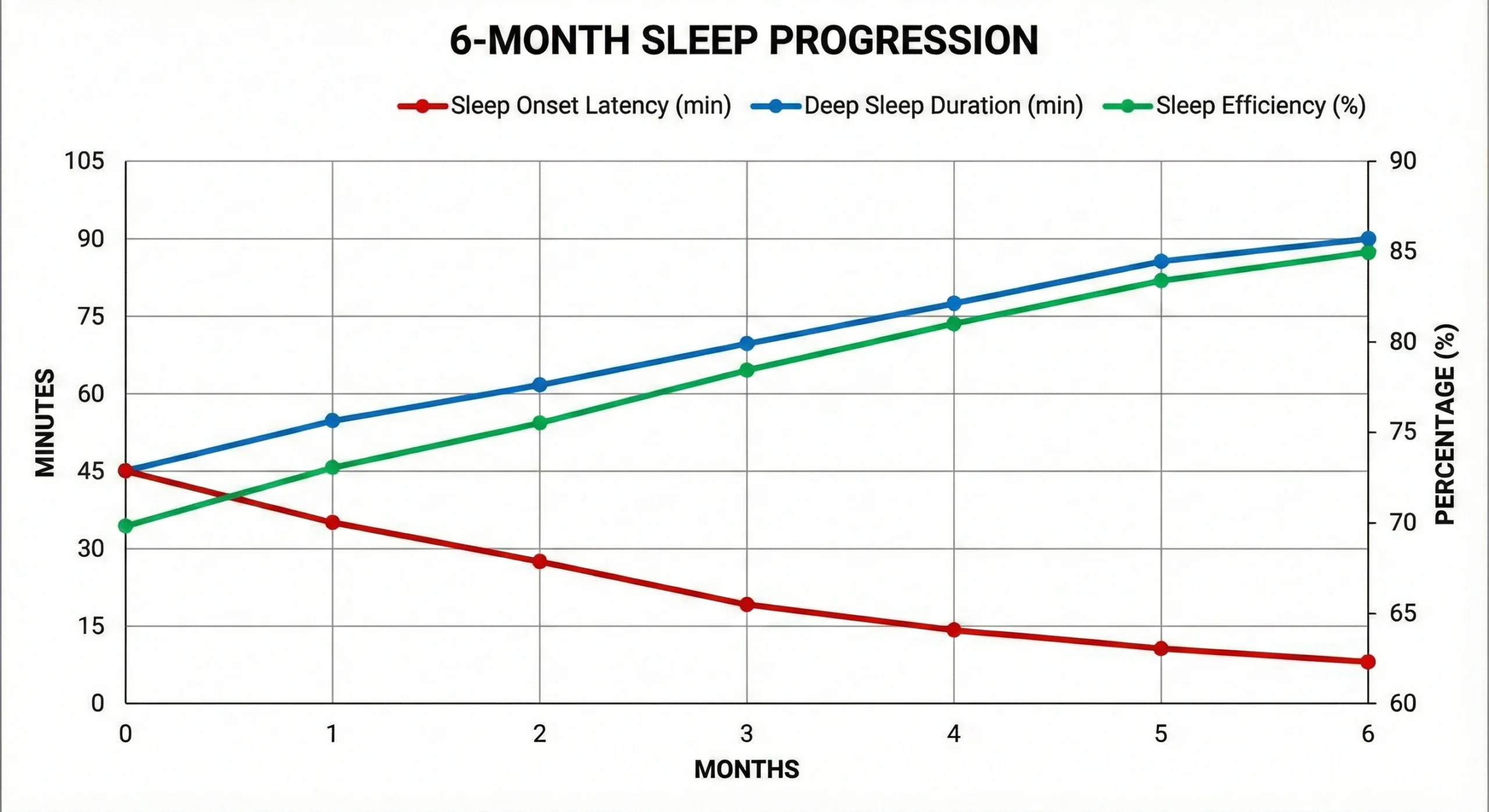
I didn’t fix everything at once. I implemented changes sequentially over 6 months, tracking results with a sleep tracker (Whoop band) and a daily log.
Month 1: Fix Light Exposure
- Bought 10,000 lux light therapy lamp ($60 on Amazon)
- Used it for 20-30 minutes every morning while eating breakfast
- Installed f.lux on computer, enabled night shift on phone (auto-dims screens at 8 PM)
- Started walking outside for 15 minutes at lunch
Result: Started feeling tired around 10:30 PM instead of midnight within 2 weeks. This was huge — I’d never experienced natural sleepiness at a reasonable hour before.
Month 2: Fix Sleep Environment
- Installed total blackout curtains (tested with light meter — <0.5 lux in bedroom at night)
- Lowered thermostat to 65°F overnight
- Covered all LEDs in bedroom with black electrical tape
- Bought white noise machine for consistent sound masking
Result: Sleep onset latency dropped from 45 minutes to 20 minutes. Deep sleep increased from 45 minutes per night to 70 minutes (based on Whoop data).
Month 3: Build Sleep Drive
- Started walking 30-45 minutes daily at lunch
- Added resistance training 3x/week in late afternoon
- Reduced caffeine from 4-5 cups to 2 cups, all before noon
Result: Falling asleep within 10 minutes most nights. Total sleep time increased to 7 hours (from 5.5 hours) because I was sleeping more efficiently and waking up less.
Month 4: Optimize Routine
- Established consistent sleep schedule (10:30 PM – 6:00 AM) even on weekends
- Added wind-down routine: dim lights at 8 PM, no screens after 9:30 PM, light stretching before bed
- Stopped eating 3 hours before bed (was eating dinner at 8-9 PM, moved to 6-7 PM)
Result: Sleep consistency improved. Weekend recovery sleep no longer needed. Waking up at 6 AM started feeling natural instead of forced.
Month 5-6: Fine-Tuning
- Experimented with magnesium glycinate (200mg before bed) — modest improvement in sleep quality
- Optimized bedroom humidity (bought small humidifier, kept humidity 40-50%)
- Replaced 10-year-old mattress with one that properly supported my spine
Final result: Averaging 7-7.5 hours of sleep with sleep efficiency >85%. Deep sleep 80-100 minutes per night. REM sleep 90-120 minutes. Waking up feeling actually refreshed most mornings.
The Metrics That Mattered
I tracked everything obsessively because I’m a data nerd. Here are the metrics that actually moved:
Sleep Onset Latency:
- Baseline: 45-60 minutes
- After fixing light: 25-30 minutes
- After fixing environment: 15-20 minutes
- After building sleep drive: 8-12 minutes
- Current: 5-10 minutes
Deep Sleep Duration:
- Baseline: 45-55 minutes per night (12-15% of sleep)
- After temperature fix: 70-80 minutes (18-20%)
- Current: 80-100 minutes (20-22%)
Number of Awakenings:
- Baseline: 5-7 conscious awakenings per night
- After environment fix: 2-3 awakenings
- Current: 0-1 awakening (usually just bathroom trip)
HRV (Heart Rate Variability):
- Baseline: 35-45 ms
- Current: 65-75 ms
- (Higher HRV indicates better recovery and lower stress)
Subjective Energy:
- Baseline: 3-4/10 most mornings
- Current: 7-8/10 most mornings
The quantitative improvements matched how I felt. I wasn’t placebo-ing myself — the data was clear.
What I Learned (Key Takeaways From My Experience)
1. Mechanisms matter more than tips
Understanding why interventions work helped me stay consistent. Once I understood that morning light physically shifts my circadian rhythm by signaling my suprachiasmatic nucleus, I never skipped my morning walk again. It wasn’t just a “tip” — it was manipulating core biology.
2. Environment trumps willpower
I spent years trying to force myself to sleep better through discipline. It never worked. Fixing my environment (light, temperature, noise) made good sleep effortless. You can’t willpower your way out of a 72°F bedroom with light pollution.
3. Sequential > simultaneous
Trying to fix everything at once was overwhelming and led to quitting. Implementing changes one at a time, giving each 2-4 weeks to stabilize, made the process sustainable.
4. Metrics prevent self-deception
I would have quit multiple times if I wasn’t tracking data. There were weeks where I felt like “nothing is working,” but my sleep tracker showed objective improvements. Data kept me honest and motivated during the slow progress phases.
5. Sleep quality > duration
I sleep 7-7.5 hours now compared to 8-9 hours before. But I wake up more refreshed because those 7.5 hours are high-quality, consolidated sleep with proper deep/REM distribution. The shift from focusing on quantity to quality was paradigm-changing.
Your Step-by-Step Sleep Optimization Protocol (Start Here)
Based on the science and my experience, here’s a prioritized protocol for beginners. Don’t try to do everything at once. Follow this sequence.
Week 1-2: Fix Your Light Exposure (Foundation)
This is the highest-leverage intervention. Start here before anything else.
Morning (within 1-2 hours of waking):
- Get outside for 15-30 minutes, no sunglasses
- If weather/time doesn’t allow, use 10,000 lux light therapy lamp for 20-30 minutes while eating breakfast or working
- Alternatively, work near a window with direct sunlight exposure
Daytime:
- Maximize indoor brightness during work hours (sit near windows, use bright overhead lights)
- Take outdoor breaks when possible (even 5-10 minutes helps)
Evening (starting 2-3 hours before bed):
- Dim overhead lights, use warm-toned lamps
- Enable “night shift” or equivalent on all devices (reduces blue light)
- Consider blue-blocking glasses if you must use screens extensively
Why this first: Light exposure timing has the largest effect on circadian alignment, which is the foundation of everything else. If your circadian rhythm is misaligned, nothing else will fully work.
How to track: Note your natural sleepiness onset time before and after 2 weeks. Most people will notice they feel tired 30-60 minutes earlier after consistent morning light exposure.
Week 3-4: Optimize Your Sleep Environment
Once light exposure is consistent, address your bedroom conditions.
Temperature:
- Set bedroom thermostat to 65-67°F (adjust based on personal comfort, but start cool)
- Use breathable bedding materials (cotton, linen, bamboo)
- If you share a bed with a partner who prefers warmer temps, consider dual-zone bedding or a fan on your side
Darkness:
- Install true blackout curtains (test with light meter or phone camera — if you can see anything, it’s not dark enough)
- Cover or remove all LEDs from devices (electronics, clocks, chargers)
- Put phone face-down or in another room (notifications emit light even through do-not-disturb)
Noise:
- Use white noise machine or fan for consistent sound masking
- Earplugs if noise is severe and white noise isn’t sufficient
- Address specific noise sources if possible (weatherstrip doors, seal windows)
Air Quality:
- Ensure adequate ventilation (slightly open window if outdoor air quality is good)
- Consider air purifier if you have allergies or live in high-pollution area
- Keep bedroom humidity at 40-50% (too dry causes nasal irritation, too humid feels stuffy)
Why after light: Light exposure sets your circadian timing, but environment determines whether you can maintain sleep once you’ve fallen asleep. Both are necessary, but sequence matters.
How to track: Most people notice reduced nighttime awakenings within 3-5 days of fixing environment. If you wake up less often, it’s working.
Week 5-6: Build Your Sleep Drive
With circadian alignment and environment optimized, now increase homeostatic sleep pressure.
Physical Activity:
- Add 30-45 minutes of moderate aerobic activity daily (walking counts)
- If you already exercise, ensure it’s not within 2-3 hours of bedtime
- Resistance training 2-3x/week in afternoon is ideal but not required
Caffeine Management:
- Limit to 2-3 cups of coffee/tea
- Consume all caffeine before 12-1 PM (half-life is 5-6 hours)
- Switch to decaf or herbal tea after noon
Activity Timing:
- Front-load cognitively demanding work to earlier in the day
- Schedule physical activity for late afternoon/early evening when possible
- Avoid intense mental work right before bed (can increase cortisol)
Why third: Sleep drive needs daily building. Once you have good circadian timing and environment, adding physical activity accelerates sleep onset and deepens sleep.
How to track: Notice how quickly you fall asleep. If you’re dropping off within 10-15 minutes consistently, sleep drive is sufficient.
Week 7-8: Establish Consistency + Wind-Down Routine
With the biological foundation in place, add behavioral consistency.
Sleep Schedule:
- Choose target sleep and wake times based on your circadian chronotype and life constraints
- Stick to this schedule 7 days per week (including weekends) for at least 4 weeks
- Consistency entrains your circadian rhythm to expect sleep at specific times
Wind-Down Routine (start 60-90 minutes before bed):
- Dim all lights in your home
- Avoid stimulating content (news, work emails, intense shows)
- Light activities: reading (paper books or e-ink reader), stretching, gentle yoga, shower/bath
- Keep routine consistent — your brain learns to associate these cues with sleep onset
Pre-Bed Rituals:
- Empty bladder immediately before bed (reduces nighttime awakenings)
- Ensure bedroom is cool before getting in bed
- Avoid large meals 3 hours before bed (light snack is fine if needed)
Why fourth: Behavioral consistency solidifies circadian alignment. Once biology is optimized, consistent timing and routines compound the effects.
How to track: After 2-3 weeks of consistent timing, you should start waking up naturally around your target time without an alarm (or just before it goes off).
Why Your Sleep Optimization Might Not Be Working (Troubleshooting)
Most people who “try sleep optimization” and see minimal results are making one or more of these mistakes. Let me address them directly.
Mistake #1: Trying to Fix Everything Simultaneously
I see this constantly. People read a comprehensive guide (like this one), get motivated, and try to implement 15 changes on day one. They last 3 days, burn out, and quit.
Why this fails: Behavior change requires sustained attention and habit formation. Your prefrontal cortex can only manage a limited number of simultaneous changes before cognitive load overwhelms you.
The fix: Pick ONE intervention at a time. Master it for 2-4 weeks until it becomes automatic, then add the next. Sequential implementation feels slower but actually produces lasting results.
Priority sequence: Light exposure → environment → sleep drive → routine. This order addresses root causes in sequence of impact.
Mistake #2: Not Tracking Baseline Metrics
Many people start making changes without knowing their actual starting point. Then they “feel like” nothing is improving, but they have no objective data.
Why this fails: Your perception of sleep is notoriously inaccurate. You might underestimate improvements or quit during temporary plateaus because you’re relying on subjective feelings.
The fix: Before changing anything, track for 1 week:
- What time you get in bed and when you actually fall asleep (sleep onset latency)
- How many times you wake up during the night (that you’re aware of)
- What time you wake up naturally vs alarm
- How you feel upon waking (1-10 scale)
If you have a sleep tracker (Oura, Whoop, Apple Watch), note baseline metrics for deep sleep, REM sleep, and sleep efficiency.
After implementing changes, compare to baseline after 2-3 weeks. Look for objective improvements even if subjective perception hasn’t caught up yet.
Mistake #3: Inconsistent Implementation
This is probably the most common failure mode. People do the protocol perfectly for 5 days, have one bad night, do it half-heartedly for 3 days, skip a weekend, then wonder why results are minimal.
Why this fails: Circadian rhythm entrainment requires consistency. Your biological clock doesn’t care about your intentions — it responds to actual light exposure patterns, sleep timing, and activity levels. Sporadic implementation sends mixed signals.
Research on circadian adaptation shows that it takes at least 7-10 days of consistent timing for circadian phase to shift measurably. Inconsistent schedules prevent this adaptation from occurring.
The fix: Commit to perfect consistency for 4 weeks minimum. This means:
- Same wake time every day (including weekends)
- Morning light exposure every day (no exceptions)
- Same evening wind-down routine every day
- Same bedtime every day (within 30-minute window)
After 4 weeks of consistency, your circadian rhythm will be entrained and you’ll have reliable data on whether the protocol works for you. Only then can you consider small variations.
Mistake #4: Ignoring Individual Chronotype
Not everyone is meant to sleep 10 PM – 6 AM. Your genetically determined chronotype influences your natural circadian phase. About 10-15% of people are true “night owls” with delayed circadian rhythms, while 10-15% are “morning larks” with advanced rhythms.
Why this fails: Fighting your chronotype requires constant effort and rarely produces good sleep quality. If you’re forcing yourself into a schedule that’s 2-3 hours off from your biological preference, you’ll struggle.
The fix:
- Identify your chronotype through observation (when do you naturally feel tired/alert on vacation with no alarm?)
- Work with your chronotype rather than against it when possible
- If work/life requires a schedule that conflicts with your chronotype, use light exposure strategically to shift your circadian phase gradually (15-30 minutes per week)
Research on chronotype demonstrates that genetic variations in clock genes like PER3 and CLOCK influence natural circadian phase preference, making some misalignment structural rather than behavioral.
My example: I’m naturally a slight night owl (chronotype would prefer 11:30 PM – 7:30 AM). My work schedule requires 6 AM wake-up. I use aggressive morning light exposure to phase-advance my rhythm by 1.5 hours, allowing me to feel tired by 10:30 PM instead of midnight. This works because I’m manipulating the zeitgeber (light) that entrains circadian phase.
If I tried to just “force” myself to sleep at 10:30 PM without shifting my circadian rhythm through light, I’d lie awake for hours every night.
Should You Track Your Sleep? (And If So, How?)
Sleep tracking is controversial. Some sleep doctors warn it can create “orthosomnia” — anxiety about achieving perfect sleep metrics. Others argue tracking is essential for optimization. Here’s my take after 2+ years of tracking.
When Sleep Tracking Helps
During initial optimization: When you’re actively trying to improve sleep, tracking provides objective feedback on what’s working. Subjective perception lags behind physiological changes by 1-2 weeks, so data keeps you motivated during slow progress phases.
For diagnosing patterns: Tracking can reveal patterns you wouldn’t notice otherwise. Maybe your deep sleep drops on days you have afternoon coffee. Maybe your sleep efficiency is significantly better on days you exercise. Without tracking, these correlations remain invisible.
For accountability: Knowing you’re collecting data increases consistency. You’re less likely to skip your morning light walk if you know tonight’s sleep data will reveal the consequence.
Useful metrics to track:
- Sleep onset latency (time to fall asleep)
- Total sleep time
- Sleep efficiency (% of time in bed actually sleeping)
- Deep sleep duration
- REM sleep duration
- Number of awakenings
- HRV (if your device measures it)
Research on sleep tracking accuracy shows that wearable devices are reasonably accurate for total sleep time and sleep/wake detection, but less reliable for specific sleep stage classification. Treat stage data as approximate trends rather than precise measurements.
When Sleep Tracking Becomes Counterproductive
If it increases sleep anxiety: Some people obsess over achieving perfect metrics to the point where worry about sleep prevents sleep. If you’re lying awake at 11 PM thinking “I need to get 8 hours, it’s already late, I’m going to be tired tomorrow,” tracking is making things worse.
If you’re past optimization phase: Once you’ve established good sleep patterns and consistency, continuing to track provides diminishing returns. At some point, you’re sleeping well and further optimization is marginal.
When to stop tracking: After 3-6 months of consistent good sleep metrics and feeling well-rested, consider taking a break from tracking. Check in periodically (once per month) to ensure things haven’t regressed, but daily tracking is no longer necessary.
My approach: I tracked obsessively for 9 months during active optimization. Once my sleep stabilized (consistently 7-7.5 hours, high efficiency, good deep/REM distribution), I switched to weekly check-ins. I’ll wear my tracker for 3-4 nights per month just to confirm I’m still on track, but I don’t look at it daily anymore.
This reduced my sleep anxiety while maintaining accountability. I know if my sleep regresses, the data will catch it before it becomes a major problem.
Once You’ve Mastered the Foundations (Advanced Techniques)
If you’ve implemented the core protocol for 3+ months and want to take sleep to the next level, these evidence-based interventions can provide marginal gains.
Strategic Napping
Naps can either enhance or destroy nighttime sleep depending on timing and duration. Research on napping shows that short naps (10-20 minutes) improve alertness without significantly impacting sleep drive, while naps longer than 30 minutes or naps after 3 PM can interfere with nighttime sleep.
Optimal nap protocol:
- Timing: Between 1-3 PM (aligned with natural circadian dip in alertness)
- Duration: 10-20 minutes maximum (set an alarm)
- Environment: Dark, quiet, slightly cool if possible
Why it works: Brief naps provide alertness boost without allowing deep sleep entry (which would clear too much adenosine and reduce nighttime sleep drive). The circadian timing (early afternoon) means you’re napping during a natural alertness dip rather than forcing sleep.
When to avoid napping: If you have insomnia or difficulty falling asleep at night, eliminate naps entirely. Build all your sleep drive for nighttime.
Temperature Manipulation
Beyond keeping your bedroom cool, you can actively manipulate core body temperature to facilitate sleep.
Evening warm bath/shower: Taking a warm bath (104-108°F) 60-90 minutes before bed raises core temperature temporarily. The subsequent cooling as you dry off and enter a cool bedroom signals sleep onset to your thermoregulatory system.
Studies on pre-sleep bathing found that bathing 1-2 hours before bed reduced sleep onset latency by an average of 10 minutes and improved sleep quality ratings.
Foot warming: Warming your extremities (wearing socks, using a heating pad on feet) promotes distal vasodilation, which helps dissipate core body heat. Sounds counterintuitive, but warming peripheries helps cool your core.
My protocol: I take a warm shower around 9 PM (90 minutes before target sleep time). My bedroom is at 65°F. As I cool down post-shower in the cool room, I feel noticeably sleepier. I wear socks to bed if my feet are cold (helps with distal vasodilation).
Supplements (Evidence-Based Options Only)
Most sleep supplements are poorly studied or show minimal effects. Here are the few with decent evidence:
Magnesium glycinate (200-400mg before bed): May improve sleep quality by modulating GABA receptors and reducing cortisol. Research shows modest improvements in subjective sleep quality and sleep onset latency in elderly adults with insomnia. Effects are subtle but consistent.
Glycine (3g before bed): An amino acid that may lower core body temperature slightly and improve sleep quality. Small studies show reduced sleep onset latency and improved subjective sleep quality.
Melatonin (0.3-0.5mg, NOT 3-10mg): Most people overdose melatonin massively. Physiological doses are 0.3-0.5mg, not the 5-10mg commonly sold. Higher doses can cause grogginess and may desensitize melatonin receptors over time.
Avoid:
- Most proprietary sleep blends (underdosed ingredients, no evidence)
- High-dose melatonin
- Antihistamines (Benadryl, etc.) — develop tolerance quickly and don’t improve sleep architecture
- Alcohol — fragments sleep and suppresses REM
My use: I take 200mg magnesium glycinate before bed. Subtle effect but consistent. I don’t use melatonin regularly (my circadian rhythm is aligned enough that I don’t need exogenous melatonin).
Supplements are the last thing to add, after everything else is optimized. They can provide 5-10% improvement at most. Fix light, environment, and behavior first.
How I Handle Travel, Stress, and Other Sleep Disruptors (Real-World Application)
The protocols I’ve shared work great when life is stable and routine. But what happens when you travel across time zones, go through a stressful period at work, or have a newborn? Real-world sleep optimization means adapting core principles to chaotic circumstances.
Let me share how I handle common disruptors, including the failures and adaptations.
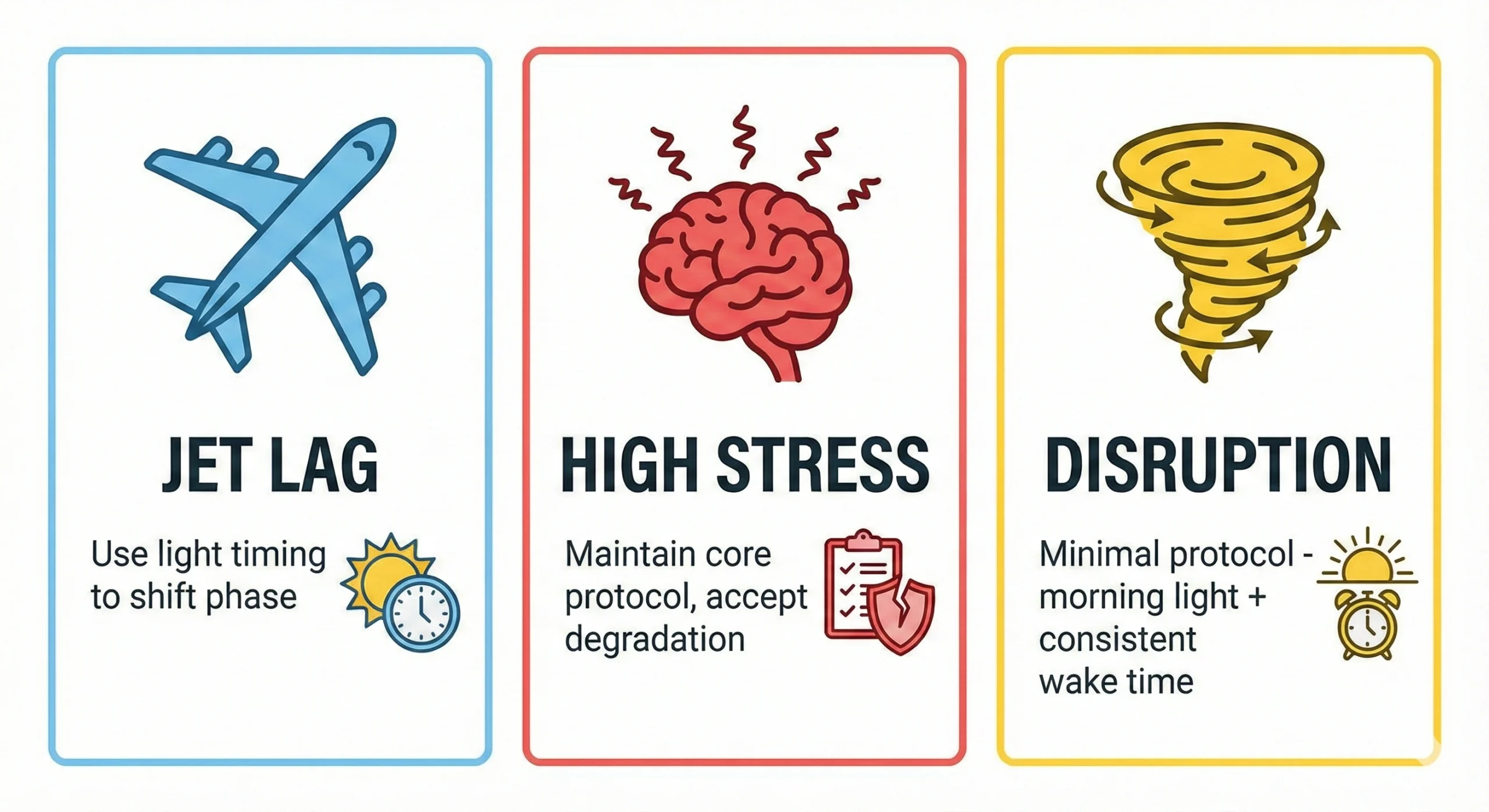
Time Zone Travel (My Jet Lag Protocol)
I travel 4-6 times per year across 1-3 time zones. Before understanding circadian biology, jet lag would wreck me for 3-5 days each trip. Now I can adapt within 24-48 hours using strategic light exposure.
Pre-travel preparation (for eastward travel):
- 3-4 days before departure, I start shifting my schedule earlier by 30-60 minutes per day
- I use morning bright light even earlier than usual (6-6:30 AM instead of 7 AM)
- I dim lights in the evening 30 minutes earlier than usual
- Goal: Phase-advance my circadian rhythm by 1-2 hours before the trip
During travel:
- If flying east, I seek bright light immediately upon landing (even if I’m exhausted)
- I resist the urge to nap upon arrival, staying awake until destination bedtime
- I eat meals on destination schedule immediately
Post-travel:
- First morning, I get outside for 30+ minutes of bright light exposure as early as possible
- I maintain destination schedule strictly for at least 3 days before allowing any flexibility
Why this works: You’re using light exposure to rapidly shift your circadian phase. Research on jet lag mitigation shows that properly timed bright light exposure can accelerate circadian adaptation by 50-70% compared to no intervention.
My success rate: Using this protocol, I now adapt to 2-3 hour time zone shifts within 36-48 hours. Previously, it took 4-5 days of feeling terrible. The difference is massive for work productivity and enjoyment of travel.
What still doesn’t work: Westward travel (traveling to a later time zone) is harder for me personally. Delaying your circadian phase is more difficult than advancing it. I’ve had less success with westward trips, still taking 3-4 days to fully adapt.
High-Stress Periods (When Sleep Gets Harder)
Stress is the #1 sleep disruptor I can’t fully control. When I’m under deadline pressure, dealing with personal issues, or going through high-stakes work situations, my sleep degrades even when I follow my protocol perfectly.
What happens physiologically: Stress increases cortisol, which is antagonistic to melatonin. High cortisol in the evening delays sleep onset and increases nighttime awakenings. Anxiety also keeps your sympathetic nervous system activated when it should be shifting to parasympathetic dominance for sleep.
My stress adaptations (what actually helps):
- I double down on the non-negotiables: morning light, cool bedroom, consistent timing. These prevent total sleep collapse.
- I add a 10-minute box breathing session before bed (4 seconds in, 4 hold, 4 out, 4 hold, repeat). This physiologically activates parasympathetic nervous system.
- I write down worries in a “worry journal” before bed. Getting them out of my head and onto paper reduces rumination.
- I accept that sleep will be slightly worse during stress periods. Aiming for 7 hours instead of 7.5 hours. Reducing expectations prevents additional stress about sleep itself.
What doesn’t help: Trying to force sleep through willpower makes it worse. Sleep requires letting go of control, which is hard when you’re stressed. Trying harder creates performance anxiety that further disrupts sleep.
Real example: Last year during a major work deadline with 3 weeks of 60+ hour work weeks, my sleep dropped from 7.5 hours averaging 85% efficiency to 6.5 hours averaging 75% efficiency. Not great, but not catastrophic. I maintained the core protocol (light, temperature, timing), accepted the degradation, and my sleep bounced back within a week after the deadline passed.
If I’d abandoned the protocol entirely during stress, the crash would have been much worse and recovery longer.
When Life Gets Chaotic (Sustainable Minimalism)
Sometimes maintaining a full protocol isn’t realistic. New parent with a crying infant. Caring for a sick family member. Temporary living situation without environmental control.
The minimal viable protocol (what to preserve when you can’t do everything):
- Morning light exposure (non-negotiable — even 10 minutes helps)
- Consistent wake time (even if bedtime varies, wake at same time)
- No bright light 2 hours before attempted sleep
- Cool sleeping environment (at least try to keep it <68°F if you can’t get to 65°F)
What you can temporarily drop:
- Perfect darkness (good blackout curtains help, but ambient light is less critical than timing and temperature)
- Exercise schedule (life happens, don’t stress if you miss workouts)
- Supplements (nice-to-have, not essential)
- Perfect wind-down routine (simplified is fine)
My experience with minimal protocol: When my apartment was being renovated for 2 weeks, I had to sleep on an air mattress in a different room with less-than-ideal conditions. I couldn’t control temperature well, didn’t have my blackout curtains, and my routine was disrupted.
I focused only on morning light exposure (walked outside with coffee every morning) and consistent wake time (still got up at 6 AM despite poor sleep). My sleep quality dropped, but I didn’t completely fall apart. Within 3 days of returning to my normal environment, sleep was back to baseline.
The lesson: Perfect conditions are ideal, but maintaining core principles (light exposure timing, circadian consistency) provides resilience during chaotic periods. Your sleep will degrade, but it won’t collapse entirely, and recovery is fast once conditions improve.
Realistic Expectations for Life Disruptions
Sleep optimization isn’t about achieving perfect sleep every night forever. It’s about:
- Making great sleep the default state when conditions allow
- Minimizing degradation during unavoidable disruptions
- Recovering quickly when conditions normalize
Some nights will suck: You’ll get sick, have a newborn, experience grief, deal with crisis, travel through multiple time zones. Your sleep will be bad. That’s life, not failure.
The goal: Good sleep 80-90% of the time. Not 100%. The 10-20% of disrupted sleep is survivable because the 80-90% of good sleep provides a resilience buffer.
My sleep is currently good 85% of nights. About 10% are slightly degraded (6-6.5 hours instead of 7-7.5, or lower efficiency). About 5% are genuinely bad (fragmented, <6 hours, feeling terrible the next day).
Two years ago, those numbers were reversed: 5% good nights, 10% okay nights, 85% terrible nights.
That improvement is life-changing, even though it’s not perfection.
What Sleep Optimization Really Means (Final Thoughts)
After walking through the science, personal experience, practical protocols, and real-world application, here’s what I want you to take away.
Sleep optimization isn’t about perfection. It’s about understanding the biological mechanisms that govern sleep and systematically addressing the factors that have the largest impact on sleep quality.
It’s not about following 47 tips. It’s about mastering three core pillars: circadian rhythm alignment (primarily through light exposure), sleep drive (through activity and lifestyle), and sleep environment (temperature, darkness, noise).
It takes time. You won’t fix years of poor sleep in one week. Expect 6-8 weeks of consistent implementation before results feel automatic. But the improvement compounds — each week is slightly better than the last.
It requires measurement. You can’t optimize what you don’t measure. Track baseline, implement changes, measure results. Objective data prevents self-deception and keeps you motivated during slow progress.
It’s worth it. Better sleep affects everything: mood, cognitive performance, physical health, relationships, work productivity, quality of life. The ROI on sleep optimization is enormous relative to effort invested.
Start with light. If you only optimize one thing from this entire guide, fix your light exposure timing. Morning bright light, evening light avoidance. That single intervention will produce 50-70% of total possible improvement.
Sleep optimization changed my life. It can change yours. Start today.
SOURCES
Research citations are embedded throughout the article as hyperlinks to PubMed. Key studies referenced:
- Sleep architecture and quality: https://pubmed.ncbi.nlm.nih.gov/17053484/
- Optimal sleep temperature: https://pubmed.ncbi.nlm.nih.gov/31105512/
- Light exposure and circadian rhythms: https://pubmed.ncbi.nlm.nih.gov/30311830/
- Physical activity and sleep: https://pubmed.ncbi.nlm.nih.gov/15364674/
- Evening light suppression of melatonin: https://pubmed.ncbi.nlm.nih.gov/21552190/
- Exercise meta-analysis: https://pubmed.ncbi.nlm.nih.gov/28919335/
- Circadian rhythm entrainment timing: https://pubmed.ncbi.nlm.nih.gov/26446948/
- Chronotype genetics: https://pubmed.ncbi.nlm.nih.gov/31102885/
- Sleep tracking accuracy: https://pubmed.ncbi.nlm.nih.gov/30689930/
- Napping research: https://pubmed.ncbi.nlm.nih.gov/25669182/
- Pre-sleep bathing: https://pubmed.ncbi.nlm.nih.gov/31102877/
- Magnesium and sleep: https://pubmed.ncbi.nlm.nih.gov/23853635/