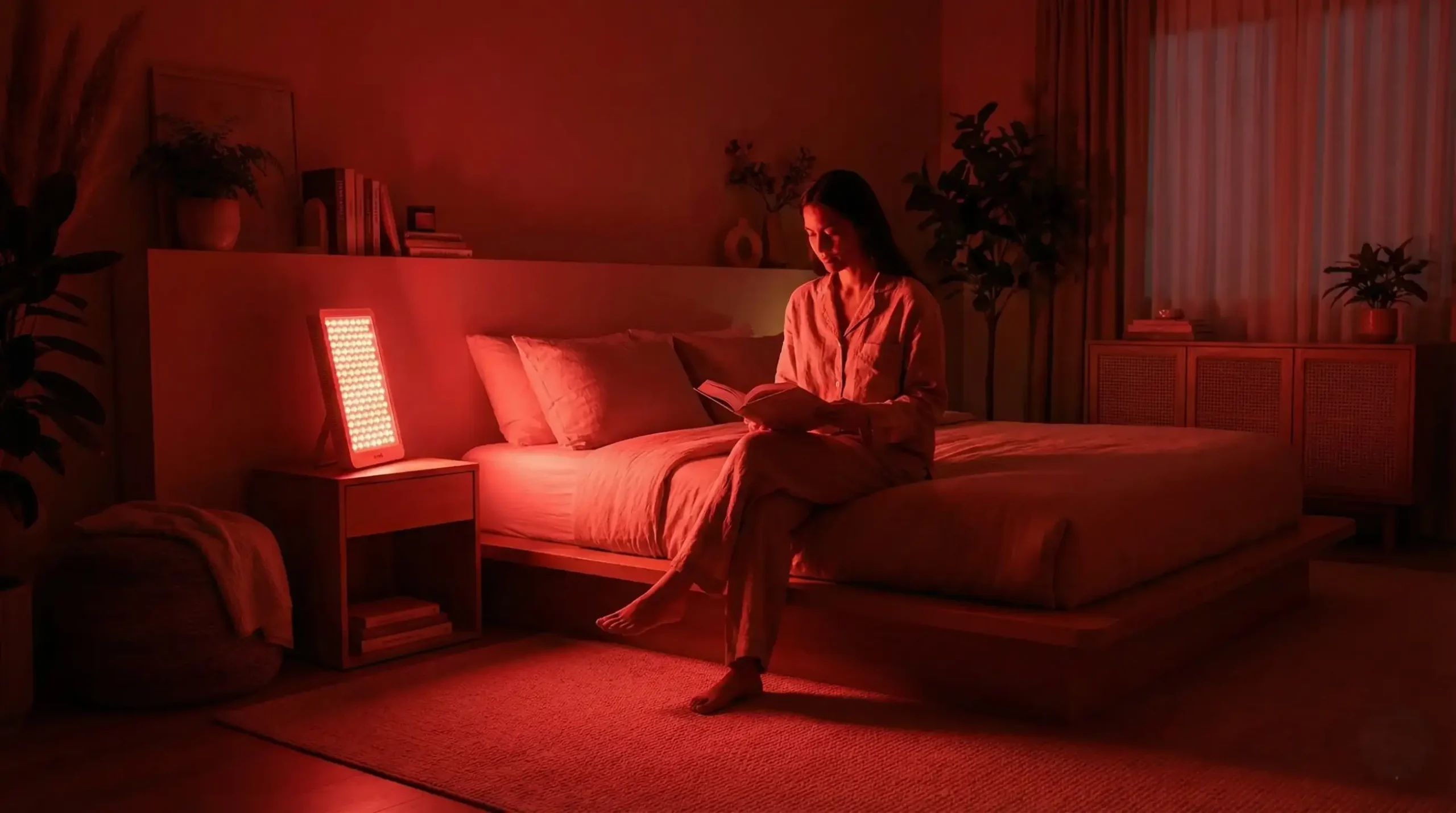
If you walk into my bedroom after 8:00 PM, you might think I’m developing photos. The room is bathed in deep red light. No overhead LEDs, no phone screens, just a crimson glow.
This isn’t an aesthetic choice. It’s a biological necessity. While most people obsess over blocking blue light (which is important), few realize that adding the right spectrum of light is the missing half of the equation for optimizing Deep Sleep.
Here is the science of why red light is the “start button” for your sleep cycle.
Want Better Sleep Stats?
Theory is good, but tools get results. See the exact stack (mask, tape, supplements) I use to get 2+ hours of Deep Sleep every night.
🌙 Does Red Light Therapy Improve Sleep? (Quick Answer)
Yes, but indirectly. It doesn’t “knock you out” like a sleeping pill. Instead, it aligns your circadian rhythm:
- Morning Use: Anchors your cortisol to wake you up (so you get tired earlier).
- Evening Use: Helps relaxation without suppressing melatonin (unlike blue light).
- Best Timing: Upon waking (bright mode) OR 1 hour before bed (ambient mode).
The Enemy: How Blue Light Breaks Your Clock
To understand why red light works, you have to understand what it’s replacing. Your eyes have specific sensors called ipRGCs (intrinsically photosensitive retinal ganglion cells). These sensors have one job: to detect “daytime.” They are maximally sensitive to blue and green wavelengths (460–480nm). When these sensors catch even a glimpse of blue light from your bathroom LED or phone screen at night, they send a panic signal to your brain’s master clock (the SCN). The message is clear: “It’s noon. Cancel the melatonin.”
Research shows that even dim room light can suppress melatonin production by more than 50% and shorten sleep duration.
The Solution: The “Red Light” Loophole
Here is the loophole in human biology: Your eyes are almost blind to red light. Wavelengths above 600nm (orange to deep red) have almost zero impact on the ipRGC sensors. This means you can have red lights on, see clearly enough to read or get ready for bed, and your brain will still think it is pitch black. You are effectively cheating the system: getting the utility of vision without the hormonal penalty of light.
Does Red Light Increase Melatonin?
There is a common myth that red light magically injects melatonin into your system. That’s not quite true. Red light doesn’t create melatonin; it protects it. By switching to red light, you remove the brake pedal (blue light suppression), allowing your body’s natural melatonin production to ramp up exactly as evolution intended. However, some emerging research suggests a more direct benefit. A 2012 study on endurance athletes found that 30 minutes of red light irradiation significantly improved sleep quality and serum melatonin levels compared to placebo.
The Solution: The “Red Light” Loophole
You don’t need an expensive $1,000 medical panel to get 80% of the benefits (though panels are great for mitochondrial health). For sleep, we just need the right wavelength.
Level 1: The “Smart” Switch (Easy)
Use Philips Hue or LIFX bulbs in your bedside lamps. Set them to pure red (not just “warm white”) at 8:00 PM.
- Cost: Low
- Effectiveness: Good for preserving melatonin.
Level 2: Dedicated Red Bulbs (Better)
Buy specific “sleep bulbs” that emit light strictly in the 600nm+ range and block all blue/green spectrum.
- Cost: Low ($10-20 per bulb)
- Effectiveness: High.
Level 3: The Biohacker Panel (Best)
Using a dedicated Red Light Therapy device (like a Joovv or generic panel) tailored to 660nm (Red) and 850nm (Near-Infrared). I use a small panel for 10 minutes while reading. The high intensity of red light has a soothing effect on the nervous system, potentially lowering cortisol via mitochondrial activation.
Best Time to Use Red Light Therapy for Sleep
| Goal | Timing | Protocol |
|---|---|---|
| Fix Circadian Rhythm (Hard Reset) | Morning (0-60 mins after waking) | Bright light, 10–15 mins, close to face (6–12 inches). Signals “Daytime”. |
| Fall Asleep Faster (Relaxation) | Evening (1–2 hours before bed) | Ambient/Dim light, 20 mins, further away (18–24 inches). Replaces overhead lights. |
| Deep Sleep Boost | Afternoon / Early Eve | Standard body session to lower inflammation before sleep. |
Summary: The Sunset Rule
Your body evolved to see a sunset (fading from white to orange to red) before sleep. Modern life gives us a “second sun” (screens) instead. Recreating that red sunset indoors is the single most effective environmental change you can make for your sleep quality.
Lighting is just one pillar of recovery. To see how to combine red light with temperature and caffeine timing for the perfect night, follow the full system: The Ultimate Sleep Optimization Protocol: A 24-Hour Checklist
Frequently Asked Questions
Does red light therapy help with insomnia?
Yes. Research suggests red light therapy can increase serum melatonin levels and improve sleep endurance. However, for insomnia, consistency is key—it typically takes 2–3 weeks of daily use to see a shift in sleep quality.
What color LED light is best for sleeping?
Pure red (620nm–670nm) and Amber. These wavelengths have the least impact on melatonin suppression. Avoid blue, white, and bright green lights at least 2 hours before bed, as they signal your brain to stay awake.
Will red light keep me awake if used at night?
It depends on the brightness. While the red spectrum is safe, intense brightness (lux) can still be stimulating. At night, use your device in “ambient mode” or stand further away so the light is a gentle glow, not a blinding beam.