Best form for sleep: Magnesium Glycinate — highly absorbable, calming glycine attachment, no laxative effect.
How much: 200-400mg elemental magnesium, taken 30-60 minutes before bed.
How it works: Activates GABA receptors, relaxes muscles, regulates melatonin, reduces cortisol.
Timeline: Subtle effects in 3-5 days, full benefits in 2-4 weeks of consistent use.
Why magnesium matters for sleep: 50-60% of adults are magnesium deficient due to depleted soil, processed foods, and stress (which depletes magnesium). Low magnesium causes muscle tension, restless legs, anxiety, and poor sleep. Supplementing—especially with the right form—restores this critical mineral and dramatically improves sleep onset and depth. But form matters enormously: magnesium oxide is cheap but barely absorbed (causes diarrhea), while magnesium glycinate is absorbed efficiently and actually promotes relaxation through its glycine component.
Want Better Sleep Stats?
Theory is good, but tools get results. See the exact stack (mask, tape, supplements) I use to get 2+ hours of Deep Sleep every night.
Open Sleep HubWhy Most People Are Magnesium Deficient (And How It Ruins Sleep)
Magnesium is involved in over 300 enzymatic reactions in your body, including those that regulate your nervous system, muscle function, and sleep-wake cycles. Despite its importance, magnesium deficiency is remarkably common—estimates suggest 50-70% of adults don’t get adequate magnesium from diet alone.
How Deficiency Happens
Modern diet problems: Processed foods are stripped of magnesium during refining. White bread, white rice, and processed snacks contain almost no magnesium compared to whole grains and vegetables. Even if you eat well, agricultural practices have depleted soil magnesium levels, meaning fruits and vegetables contain 20-40% less magnesium than they did 50 years ago.
Stress depletes magnesium: Your body uses magnesium to manage the stress response. Chronic stress causes magnesium to be excreted more rapidly through urine—creating a vicious cycle where stress causes deficiency, and deficiency makes you more sensitive to stress.
Medications reduce absorption: Common medications like proton pump inhibitors (for acid reflux), diuretics, and some antibiotics interfere with magnesium absorption or increase excretion.
Caffeine and alcohol: Both increase magnesium excretion through the kidneys. If you drink multiple coffees daily or regularly consume alcohol, you’re losing magnesium faster than you’re replacing it.
Exercise increases needs: Athletes need 10-20% more magnesium than sedentary people because magnesium is lost through sweat and is required for muscle function and recovery.
How Deficiency Affects Sleep
Low magnesium manifests in several sleep-disrupting ways:
Muscle tension and cramps: Magnesium is required for muscle relaxation. Without adequate magnesium, muscles stay in a semi-contracted state, causing tension, twitching, and cramps—particularly in the legs. This is why restless legs syndrome often improves with magnesium supplementation.
Nervous system hyperexcitability: Magnesium acts as a “brake” on your nervous system by regulating glutamate (an excitatory neurotransmitter) and activating GABA (an inhibitory neurotransmitter). Deficiency leaves your nervous system in a state of overactivation—you feel “wired,” anxious, and unable to calm down for sleep.
Impaired melatonin production: Magnesium is a cofactor for enzymes that synthesize melatonin. Low magnesium means less melatonin production, which delays sleep onset and reduces sleep depth.
Elevated cortisol: Deficiency is associated with higher baseline cortisol levels and exaggerated cortisol responses to stress. Since cortisol is a “wake-up” hormone, elevated evening cortisol prevents the transition into sleep.
Poor sleep architecture: Studies show that magnesium deficiency is associated with reduced slow-wave sleep (deep sleep) and increased nighttime awakenings. Even if you sleep 8 hours, the quality is poor.
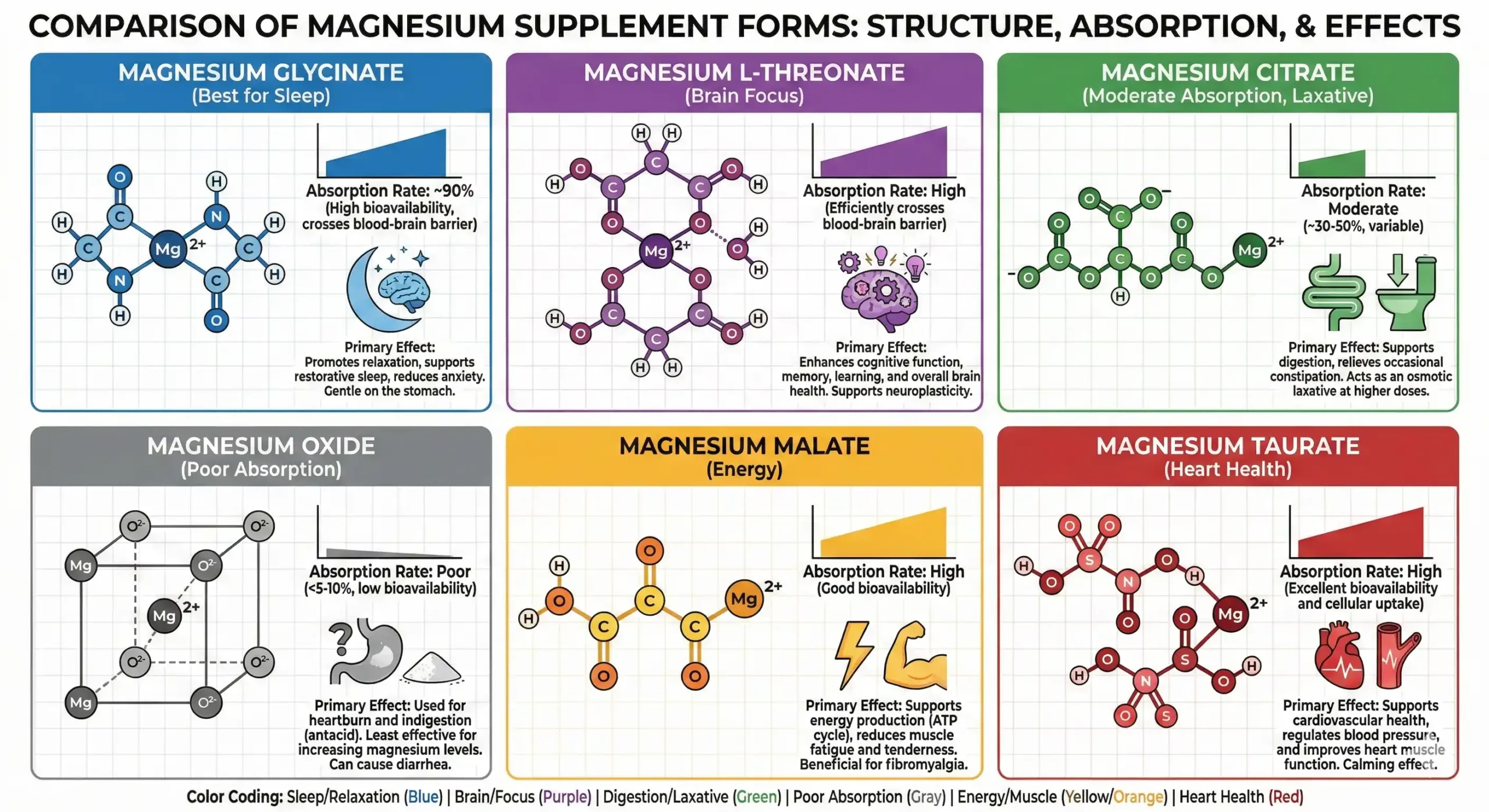
The 6 Forms of Magnesium: What Works for Sleep?
Not all magnesium supplements are created equal. The form matters enormously for absorption, effects, and side effects. Here’s the complete breakdown:
1. Magnesium Glycinate (BEST FOR SLEEP)
What it is: Magnesium bound to glycine, an amino acid with its own calming properties.
Absorption: Excellent (80-90% bioavailability)
Why it works for sleep:
- The glycine component independently promotes relaxation and improves sleep quality by activating GABA receptors
- Chelated form (magnesium bound to amino acid) is absorbed intact, minimizing digestive issues
- Crosses into tissues efficiently, reaching muscles and nervous system where it’s needed
- No laxative effect at normal doses (200-400mg)
Dose for sleep: 200-400mg elemental magnesium (check label—supplement may say 2000mg magnesium glycinate, but only 200mg is elemental magnesium)
Timing: 30-60 minutes before bed
Best for: People whose sleep issues involve muscle tension, restless legs, or anxiety/racing thoughts. This is the gold standard for sleep supplementation.
Downside: Slightly more expensive than other forms ($15-25 for a month’s supply vs. $8-12 for cheaper forms)
2. Magnesium Threonate (BEST FOR BRAIN/COGNITION)
What it is: Magnesium bound to threonic acid, a metabolite of vitamin C.
Absorption: Excellent, specifically crosses the blood-brain barrier
Why it’s different:
- Designed to increase brain magnesium levels more than other forms
- May enhance memory, learning, and cognitive function
- Some people report improved sleep quality, likely through enhanced brain function and stress resilience
Dose: 1,500-2,000mg total (providing ~140-200mg elemental magnesium)
Timing: Can be taken in divided doses (morning and evening) or all at night
Best for: People interested in both sleep and cognitive enhancement, or those with age-related cognitive decline. Also useful for migraine prevention.
Downside: Expensive ($30-50 per month). Not specifically optimized for sleep like glycinate.
3. Magnesium Citrate (MODERATE ABSORPTION, LAXATIVE EFFECT)
What it is: Magnesium bound to citric acid.
Absorption: Good (50-60% bioavailability)
Effects:
- Well-absorbed, but has notable laxative effect even at moderate doses
- Often used medically as a bowel prep for colonoscopies
- Can improve sleep if constipation was keeping you uncomfortable at night
Dose: 200-400mg, but start low (100-200mg) to assess digestive tolerance
Timing: Evening, but not right before bed (give 2-3 hours in case of bowel urgency)
Best for: People who have both sleep issues and constipation. Two birds, one stone.
Downside: Diarrhea, cramping, or urgent bowel movements are common, especially at higher doses. Not ideal if you just want sleep support without the digestive “cleanse.”
4. Magnesium Oxide (CHEAP BUT POORLY ABSORBED)
What it is: Magnesium bound to oxygen—the cheapest, most common form.
Absorption: Very poor (only 4-10% bioavailability)
Why it’s problematic:
- Most of the magnesium isn’t absorbed—it sits in your intestines and draws water in (osmotic effect), causing diarrhea
- Marketed as “500mg magnesium” but you’re only absorbing 20-50mg
- Cheap for manufacturers, but ineffective for users
Best for: Nothing, really. Possibly as a laxative if you need that effect, but there are better options.
Downside: You’re essentially paying for expensive diarrhea. Avoid for sleep supplementation.
5. Magnesium Malate (BEST FOR ENERGY, NOT SLEEP)
What it is: Magnesium bound to malic acid, which is involved in ATP (energy) production.
Absorption: Good (similar to citrate, ~50%)
Effects:
- Supports energy production and may reduce muscle pain
- Often used for chronic fatigue or fibromyalgia
- Can be stimulating rather than calming for some people
Best for: Daytime use for people with fatigue or muscle pain. Not ideal for nighttime sleep support.
Downside: May increase energy/alertness, which is counterproductive if taken before bed.
6. Magnesium Taurate (BEST FOR HEART HEALTH)
What it is: Magnesium bound to taurine, an amino acid important for cardiovascular function.
Absorption: Good (~50-60%)
Effects:
- Supports heart rhythm regulation and blood pressure
- Taurine has mild calming effects, though less than glycine
- Can support sleep indirectly through cardiovascular benefits
Best for: People with heart conditions, high blood pressure, or palpitations that disrupt sleep. Secondary benefit for general sleep support.
Downside: Not as specifically targeted for sleep as glycinate.
Comparison Table: Magnesium Forms
| Form | Absorption | Sleep Support | Side Effects | Best Use | Cost |
|---|---|---|---|---|---|
| Glycinate | 80-90% | ⭐⭐⭐⭐⭐ Excellent | Minimal | Sleep, anxiety, muscle tension | $$ |
| Threonate | 70-80% (brain) | ⭐⭐⭐⭐ Good | Minimal | Sleep + cognition, migraines | $$$ |
| Citrate | 50-60% | ⭐⭐⭐ Moderate | Laxative | Sleep + constipation | $ |
| Oxide | 4-10% | ⭐ Poor | Severe laxative | Not recommended | $ |
| Malate | 50% | ⭐⭐ Poor (stimulating) | Minimal | Energy, not sleep | $$ |
| Taurate | 50-60% | ⭐⭐⭐ Moderate | Minimal | Heart health + sleep | $$ |
Bottom line: For sleep specifically, magnesium glycinate is the clear winner. If budget allows and you want cognitive benefits too, threonate is a good alternative. Avoid oxide entirely.
How to Use Magnesium for Sleep: Complete Protocol
Step-by-Step Implementation
Week 1 (Start Low):
- Begin with 200mg magnesium glycinate taken 60 minutes before bed
- Assess tolerance and effects
- Track: Do you fall asleep easier? Fewer leg cramps? Less restless?
Week 2-3 (Optimize Dose):
- If 200mg helped but effects are subtle, increase to 300-400mg
- If 200mg worked well, continue at that dose
- Continue tracking improvements
Week 4+ (Maintain):
- Settle into your optimal dose (usually 200-400mg)
- Can be taken nightly indefinitely—magnesium supplementation is safe long-term
- If you go several weeks without it and sleep quality drops, that’s confirmation you benefit from continued use
Timing Strategies
Standard protocol: 30-60 minutes before bed. This allows time for absorption and gives you the relaxation effects right when you need them.
Split dosing: Some people do 200mg at dinner and 200mg before bed. This can help with evening muscle relaxation and provides sustained magnesium levels overnight.
With food or empty stomach: Either works. Taking with food may slow absorption slightly but reduces any (rare) digestive discomfort. Most people take it on an empty stomach before bed for faster effects.
Combining Magnesium With Other Sleep Supplements
Magnesium + L-Theanine: Excellent combination. Magnesium calms the body (muscles, nervous system), L-Theanine calms the mind (anxiety, racing thoughts). Take both 30-60 min before bed. See our L-Theanine guide for more details.
Magnesium + Melatonin: Can be combined. Magnesium supports natural melatonin production, supplemental melatonin adds to that effect. Take magnesium 30 min before bed, melatonin 60-90 min before bed.
Magnesium + Ashwagandha: Both reduce cortisol and support stress resilience. Synergistic for stress-driven insomnia. Some people find this combination very sedating—start with lower doses of each.
Magnesium + Calcium: Old advice said to balance magnesium with calcium, but most people get plenty of calcium from diet. Unless you’re specifically calcium-deficient, you don’t need to supplement both. In fact, too much calcium can interfere with magnesium absorption.
How Long Until You See Results?
Magnesium isn’t like a sleeping pill—you won’t feel dramatically different the first night. Here’s the realistic timeline:
Days 1-3: Minimal noticeable change. Your body is restoring depleted magnesium stores in muscles, bones, and cells. Behind the scenes, magnesium is being incorporated into enzymes and receptors.
Days 4-7: Subtle improvements. You might notice slightly less muscle tension, easier time falling asleep, or less nighttime restlessness. Morning stiffness may reduce.
Weeks 2-4: Clear benefits emerge. If magnesium deficiency was contributing to your sleep issues, you’ll see noticeable improvements: falling asleep 10-20 minutes faster, fewer nighttime awakenings, waking up more refreshed.
Week 4+: Full effects. Magnesium stores are replenished, and you’re experiencing the ongoing benefits of adequate magnesium status. Sleep architecture (time in deep sleep) may improve measurably.
If you stop: Effects gradually diminish over 1-2 weeks as your body depletes stores again. This is actually useful information—if stopping magnesium makes your sleep worse again, you know you were benefiting from it.
Signs Magnesium Is Helping
Subjective improvements:
- Fall asleep faster (10-30 minutes quicker)
- Feel more physically relaxed at bedtime
- Fewer muscle twitches, cramps, or restless legs
- Less anxiety or racing thoughts in bed
- Wake up feeling more refreshed
Objective improvements (if tracking):
- Sleep tracker shows increased deep sleep percentage
- Fewer recorded awakenings
- Higher HRV (heart rate variability) during sleep
- Lower resting heart rate
Who Needs Magnesium Supplementation?
High-Priority Candidates
People with muscle cramps or restless legs: This is a classic sign of magnesium deficiency. If your legs twitch, cramp, or feel “restless” at night, try magnesium glycinate for 2 weeks—many people see dramatic improvement.
Stressed-out individuals: Chronic stress depletes magnesium. If you’re in a high-stress period (work deadlines, life transitions) and sleep is suffering, magnesium can buffer the impact.
Athletes and active individuals: Exercise increases magnesium needs. If you train regularly and sleep quality has declined, magnesium deficiency is likely.
People who consume little magnesium-rich food: If your diet is low in leafy greens, nuts, seeds, whole grains, and legumes, you’re probably not getting the 310-420mg daily recommended intake.
Older adults: Magnesium absorption declines with age, and many older adults are deficient. Sleep problems in older adults often improve with magnesium supplementation.
People on certain medications: PPIs (Prilosec, Nexium), diuretics, some antibiotics—all can deplete magnesium. If you’re on these meds and have sleep issues, talk to your doctor about magnesium supplementation.
People Who Might Not Need It
Those already getting adequate dietary magnesium: If you eat a diet rich in whole foods (lots of leafy greens, nuts, seeds), you might already have adequate magnesium. You can try supplementing to see if it helps, but the benefits might be minimal.
People with kidney disease: Magnesium is excreted through kidneys. If you have impaired kidney function, magnesium can accumulate to dangerous levels. Check with your doctor before supplementing.
People whose sleep problems aren’t magnesium-related: If your insomnia is purely circadian (you’re a night owl trying to sleep too early) or due to sleep apnea, magnesium alone won’t fix those issues. It can be part of the solution, but address the root causes too.
Side Effects and Safety Considerations
Magnesium supplementation is very safe for most people, but there are a few considerations:
Common (Mild) Side Effects
Digestive upset: Loose stools or diarrhea, especially with citrate or oxide forms. Solution: Switch to glycinate, or lower your dose. Taking with food can also help.
Magnesium “flush”: Some people experience a warm, flushed feeling shortly after taking magnesium. This is harmless and usually goes away as your body adjusts.
Rare Side Effects
Excessive sedation: Very high doses (800mg+) might make you feel too drowsy or groggy. Solution: Reduce dose.
Interactions with medications: Magnesium can interact with some antibiotics (tetracyclines, quinolones), bisphosphonates (for osteoporosis), and muscle relaxants. Take magnesium at least 2 hours apart from these medications, or consult your doctor.
Who Should Avoid or Use Caution
Kidney disease: As mentioned, impaired kidney function prevents proper magnesium excretion. Get medical clearance before supplementing.
Heart block or severe heart disease: High-dose magnesium can affect heart rhythm in rare cases. If you have significant heart conditions, consult a cardiologist.
Pregnancy and breastfeeding: Magnesium is generally safe during pregnancy (in fact, often recommended for leg cramps and pre-eclampsia prevention), but discuss with your OB-GYN before starting any supplement.
Common Questions About Magnesium for Sleep
Can I get enough magnesium from food, or do I need supplements?
Theoretically, yes — if you eat a diet rich in magnesium-containing foods like spinach, pumpkin seeds, almonds, black beans, avocados, and dark chocolate. But realistically, most people don’t. The RDA for magnesium is 310-420mg depending on age and sex, and surveys show most adults get only 50-70% of that from diet. Supplementing 200-400mg daily fills the gap reliably and is much easier than trying to eat perfectly every single day. If you want to try food first, track your intake for a week using a nutrition app — if you’re consistently below 300mg/day, supplementation makes sense.
Is magnesium better than prescription sleep medications?
They work through completely different mechanisms and aren’t directly comparable. Prescription sleep meds (Ambien, benzos) are powerful sedatives that force sleep but come with risks: dependence, tolerance, rebound insomnia, next-day impairment, and potential cognitive effects. Magnesium is a nutrient that supports natural sleep by addressing an underlying deficiency — it’s gentle, safe for long-term use, and doesn’t cause dependence. For mild-to-moderate sleep issues, especially those involving muscle tension or stress, magnesium is a great first-line intervention. For severe, chronic insomnia, prescription meds may be necessary short-term (while you address root causes), but magnesium should still be part of the long-term plan.
Can magnesium help with sleep apnea or snoring?
Not directly. Sleep apnea is a structural/airway problem (tissue obstructing breathing), and snoring is usually related to airway anatomy or congestion. Magnesium won’t change your airway structure. However, some people with mild sleep apnea or snoring find that magnesium helps with sleep quality in other ways (deeper sleep, less restlessness), which can make the overall impact of the apnea slightly less severe subjectively. But if you have sleep apnea, treat it properly (CPAP, dental device, or surgery) rather than relying on supplements alone.
How long can I take magnesium safely? Is there a tolerance buildup?
Magnesium can be taken indefinitely. Unlike some supplements or medications, you don’t develop tolerance where you need higher and higher doses to get the same effect. Your body uses what it needs and excretes the excess (which is why very high doses just cause diarrhea—your body can’t absorb it all). Many people take magnesium nightly for years with continued benefits. If you want to check if you still need it, stop for 2 weeks and see if sleep quality declines—if it does, that’s confirmation you benefit from continued supplementation.
INTERNAL LINKS
To build a complete sleep optimization strategy with magnesium:
- Combine with other interventions in ultimate sleep protocol
- Address stress-driven insomnia in why you can’t fall asleep
- Fix circadian timing issues in circadian rhythm reset
- Improve overall sleep quality with comprehensive sleep optimization guide
- Stack with L-Theanine for anxiety-driven sleep issues in L-Theanine for sleep
SOURCES
- Magnesium deficiency prevalence and effects: Rosanoff, A., et al. “Suboptimal magnesium status in the United States: are the health consequences underestimated?” Nutrition Reviews, 2012. https://pubmed.ncbi.nlm.nih.gov/22364157/
- Magnesium and sleep quality: Abbasi, B., et al. “The effect of magnesium supplementation on primary insomnia in elderly: A double-blind placebo-controlled clinical trial.” Journal of Research in Medical Sciences, 2012. https://pubmed.ncbi.nlm.nih.gov/23853635/
- GABA receptor modulation: Held, K., et al. “Oral Mg2+ supplementation reverses age-related neuroendocrine and sleep EEG changes in humans.” Pharmacopsychiatry, 2002. https://pubmed.ncbi.nlm.nih.gov/12163983/
- Magnesium forms and bioavailability: Schwalfenberg, G.K., & Genuis, S.J. “The importance of magnesium in clinical healthcare.” Scientifica, 2017. https://pubmed.ncbi.nlm.nih.gov/29093983/
- Glycinate vs other forms for sleep: Nielsen, F.H., et al. “Magnesium supplementation improves indicators of low magnesium status and inflammatory stress.” Magnesium Research, 2010. https://pubmed.ncbi.nlm.nih.gov/20228001/