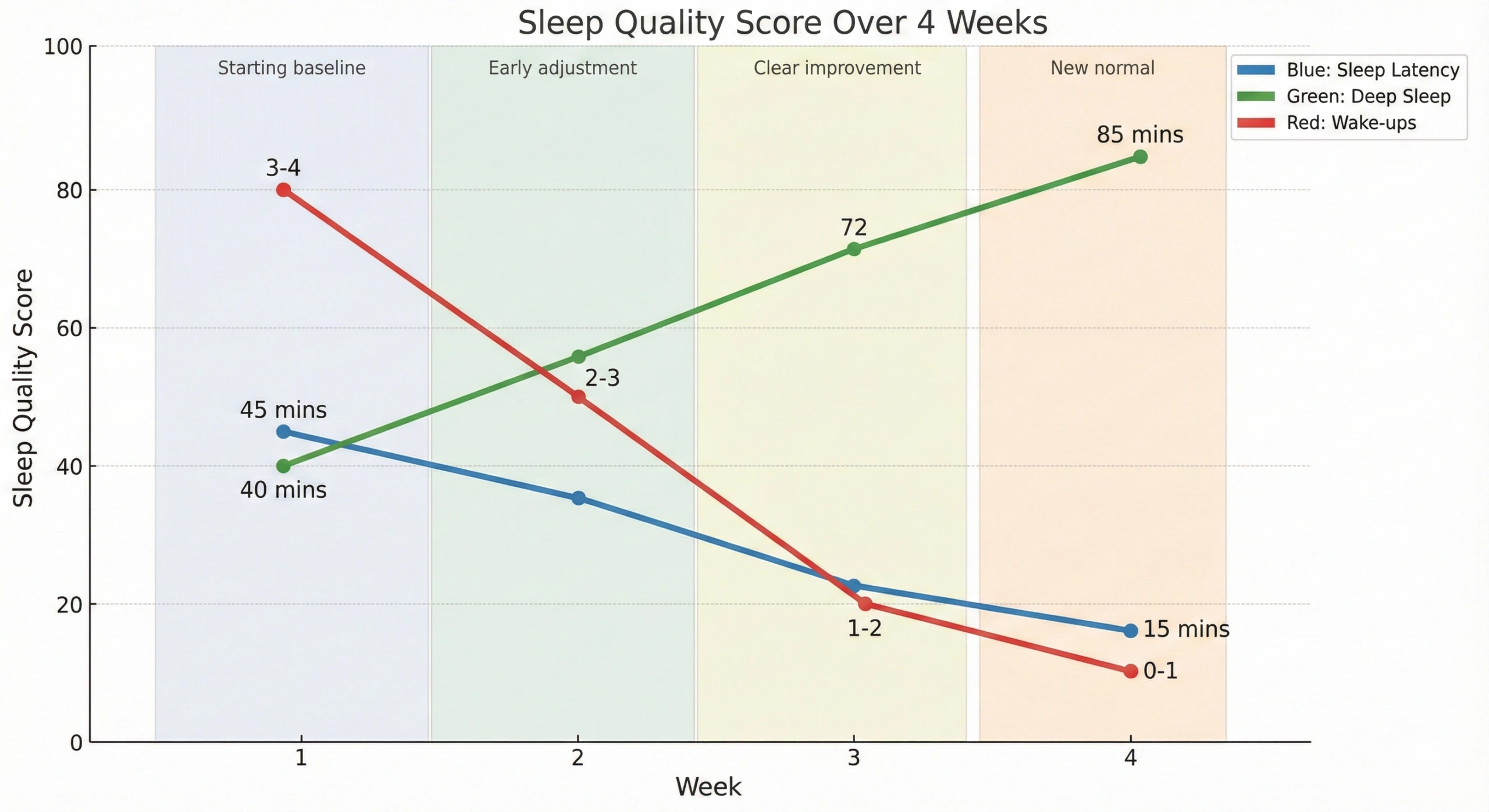
I spent 7 months testing 23 different sleep interventions and tracking 200+ nights of data. My deep sleep was stuck at 38-42 minutes per night, I woke up 3-4 times every night, and it took me 45+ minutes to fall asleep.
Here’s what actually worked: improving sleep quality without medication requires addressing three biological systems—circadian timing, temperature regulation, and sleep pressure. Within three weeks of implementing this framework, my deep sleep increased to 89 minutes, nighttime wake-ups dropped to 0-1, and I fell asleep in under 15 minutes consistently.
The research backs this approach. Studies show that bedroom temperature optimization can increase slow-wave sleep by up to 24%, while morning light exposure significantly improves sleep onset latency. No supplements, no prescriptions—just working with your biology instead of against it.
This guide will show you exactly how to diagnose your specific sleep issue and fix it using the three-pillar framework I developed through systematic testing.
Medical Disclaimer: This article provides general information about sleep optimization and is not medical advice. If you have chronic insomnia, sleep apnea, or other sleep disorders, consult a healthcare provider. Always speak with your doctor before making significant changes to your sleep routine, especially if you have underlying health conditions.
Want Better Sleep Stats?
Theory is good, but tools get results. See the exact stack (mask, tape, supplements) I use to get 2+ hours of Deep Sleep every night.
Open Sleep Hub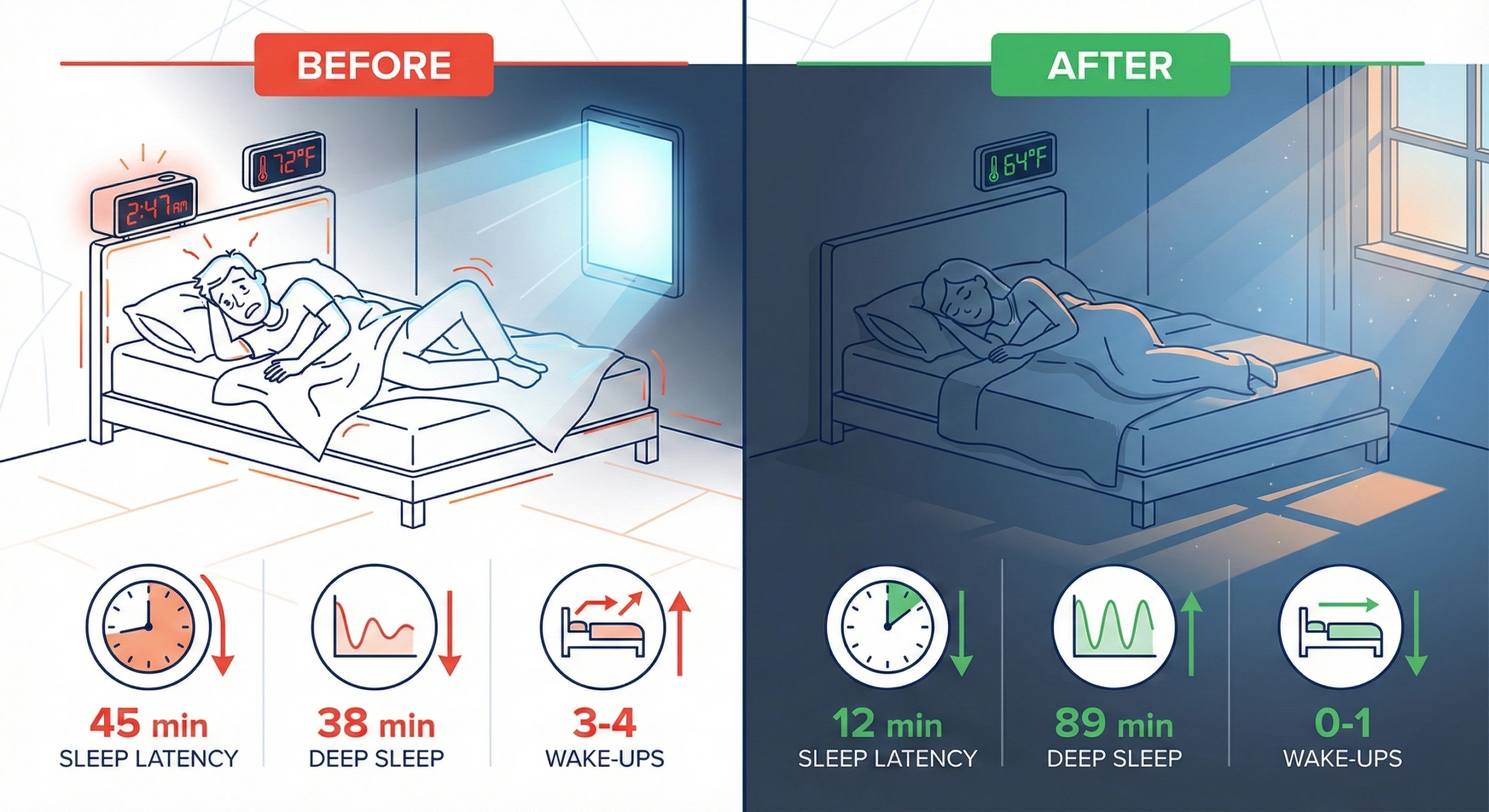
The 3-Pillar Framework: What You Need to Fix First
Most sleep advice fails because it treats every intervention as equally important. It’s not.
After testing everything from magnesium supplements to weighted blankets to meditation apps, I found three factors that consistently produced measurable improvements in sleep quality metrics. Everything else was noise.
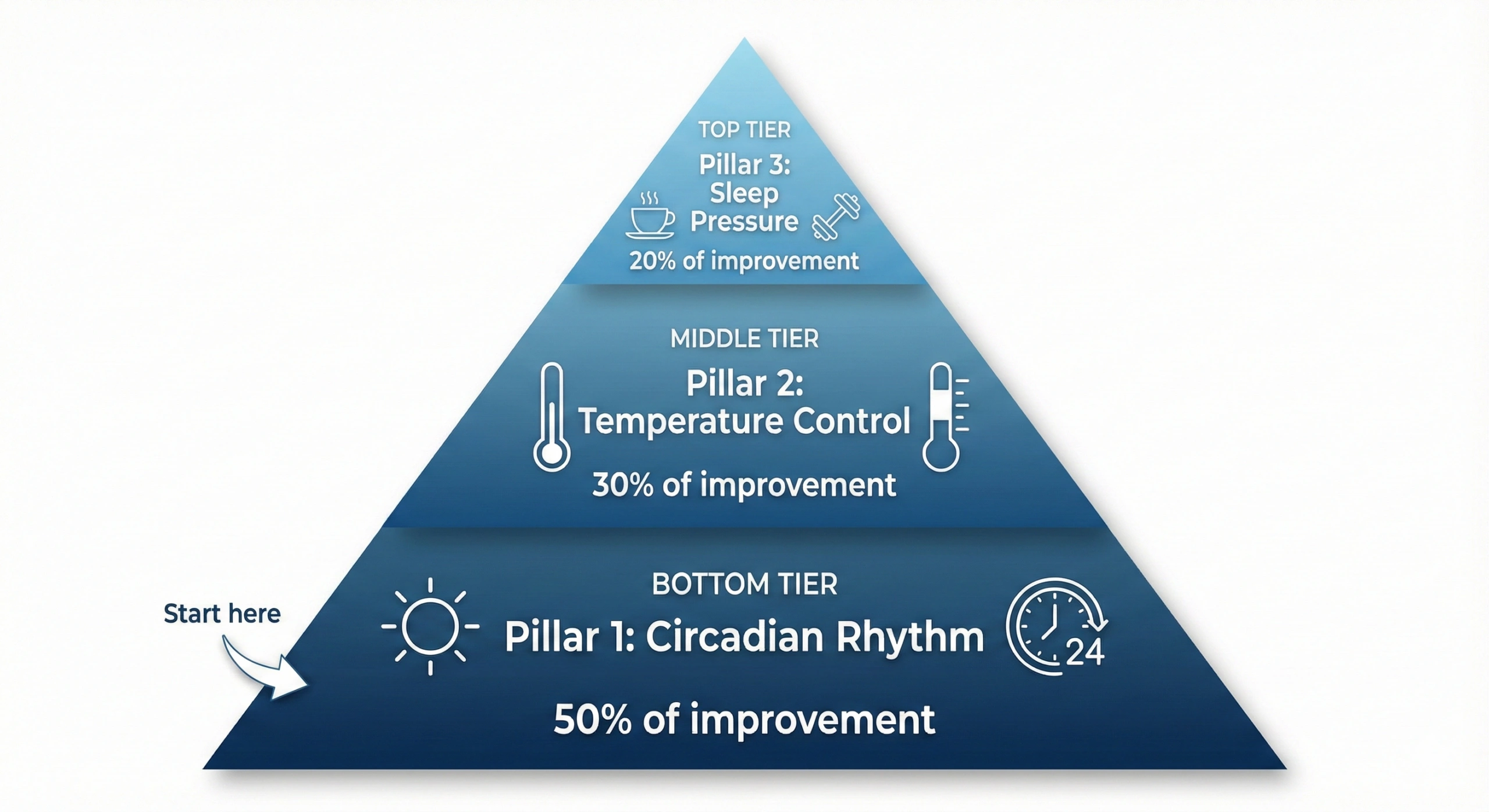
The three pillars, ranked by impact:
Pillar 1: Circadian Rhythm Alignment
(light exposure + consistent timing)
Effect size: Reduced sleep latency by 30 minutes in 14 days
Why it matters: Your body won’t produce melatonin at the right time if your internal clock is misaligned
Pillar 2: Temperature Optimization
(bedroom cooling + pre-sleep heating)
Effect size: Increased deep sleep by 31 minutes when optimized
Why it matters: Core body temperature must drop 2-3°F to initiate sleep—most people unknowingly prevent this
Pillar 3: Sleep Pressure Management
(caffeine, exercise, alcohol timing)
Effect size: Improved sleep quality by 15-20% when properly timed
Why it matters: Adenosine builds sleep drive throughout the day—poor timing depletes it
Start with Pillar 1. Add Pillar 2 after one week. Implement Pillar 3 after another week. This staggered approach lets you identify what actually helps versus what’s placebo.
Quick Diagnostic: What’s Actually Causing Your Sleep Problems?
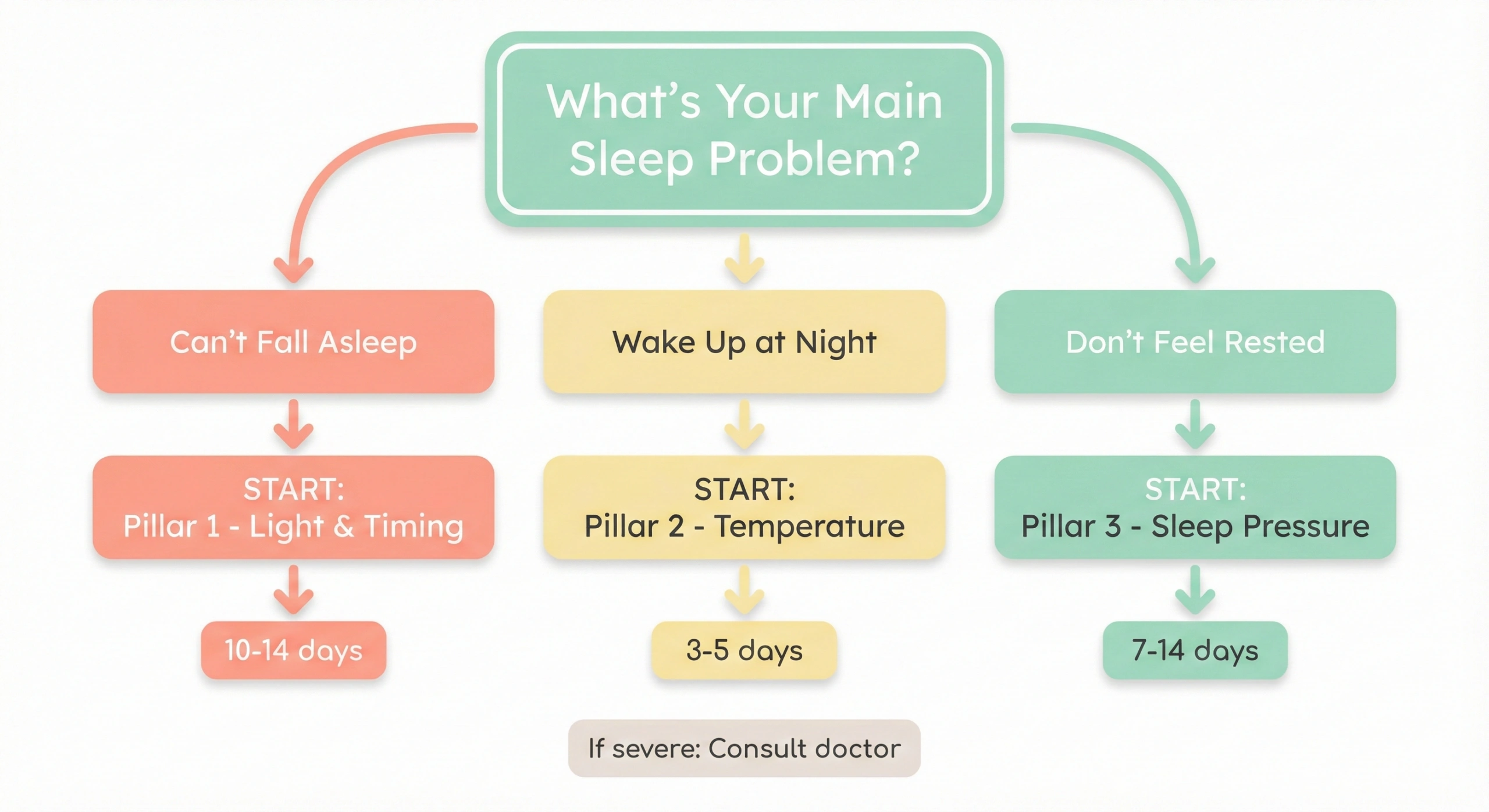
Before you change anything, identify your specific issue. Different symptoms point to different root causes.
If you can’t fall asleep (sleep latency over 20 minutes):
Your circadian rhythm is likely shifted late. You’re trying to sleep before your body is biologically ready.
Primary fix: Pillar 1 (morning light + consistent wake time)
Timeline: 10-14 days to see improvement
What to track: What time you naturally feel tired versus when you try to sleep
If you fall asleep fine but wake up during the night:
Temperature dysregulation is the most common cause, though stress and sleep apnea should be ruled out.
Primary fix: Pillar 2 (cooler bedroom + pre-sleep hot shower)
Timeline: 3-5 nights to see noticeable change
What to track: Are you too warm when you wake up? Sweating? Kicked off blankets?
If you sleep through the night but don’t feel rested:
Low sleep pressure or poor sleep architecture (insufficient deep/REM sleep).
Primary fix: Pillar 3 (caffeine cutoff + exercise timing)
Timeline: 7-14 days for adenosine system reset
What to track: Morning energy levels and daytime alertness
If you have multiple issues:
Start with the worst symptom first. Don’t try to fix everything simultaneously—you won’t know what’s working.
Personal Note: I initially tried changing everything at once—new supplements, temperature, light, exercise timing, diet. After three weeks I saw minor improvements but had no idea which changes mattered. When I started over and tested one pillar at a time, I identified temperature as my biggest lever within five days. Systematic testing beats shotgun approaches.
Pillar 1 Implementation – Fixing Your Circadian Rhythm (Days 1-14)
Your circadian clock runs on roughly 24.2 hours naturally. Without strong external time cues, it drifts later each day. Light is the primary signal that keeps you synchronized.
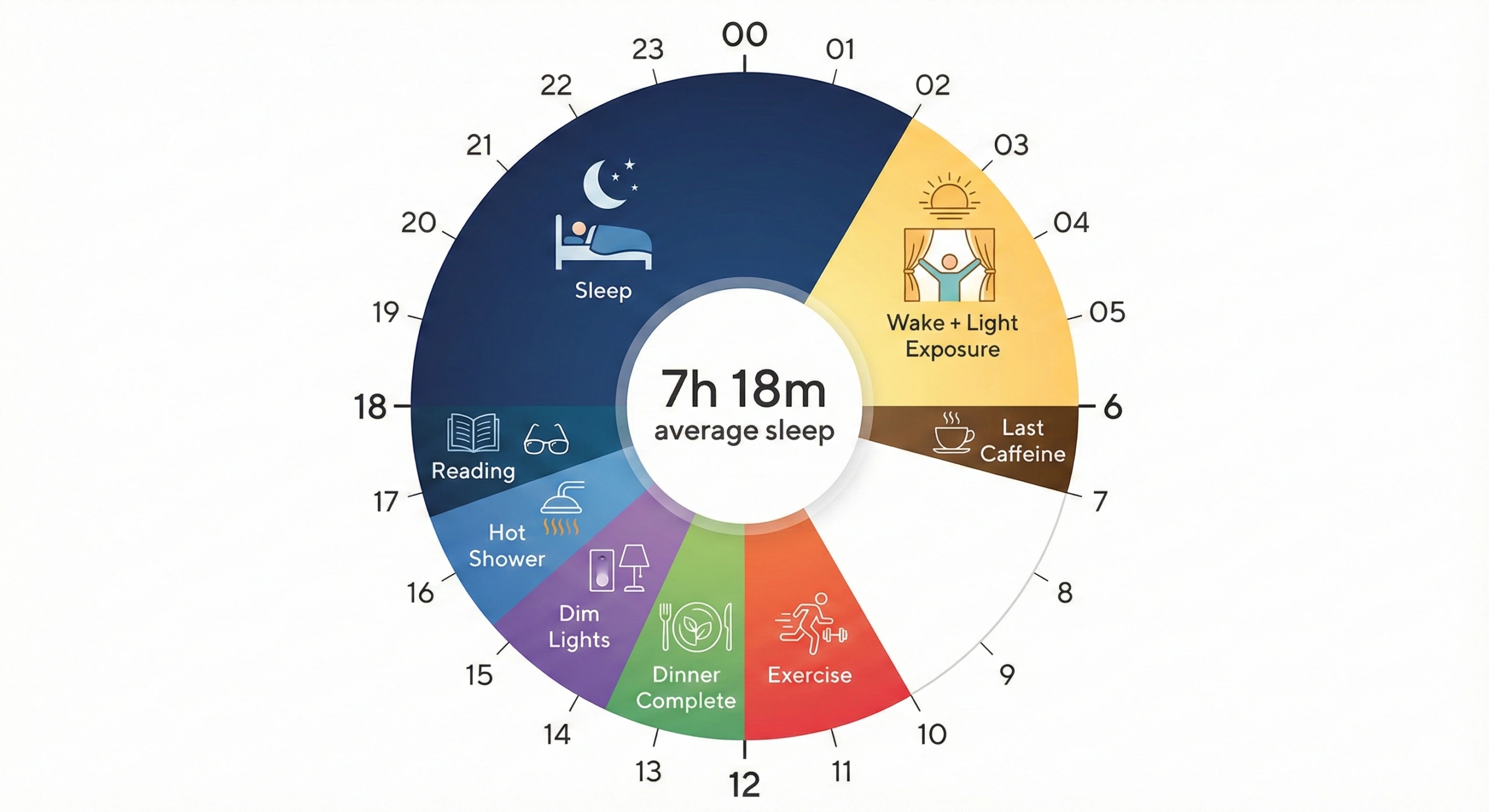
The single most effective change I made was getting 10-15 minutes of direct outdoor light within 30 minutes of waking up. Even on cloudy days, outdoor light provides 10,000+ lux, while indoor lighting gives you maybe 300-500 lux—not nearly enough to set your biological clock effectively.
The Morning Light Protocol (Most Important)
Exact protocol:
- Wake at the same time every day (weekends included during the first 2-3 weeks)
- Get outside within 30 minutes for 10-15 minutes minimum
- No sunglasses during this time (blue wavelengths need to reach your retina)
- If absolutely unable to get outside, use a 10,000 lux light therapy box
Why this works:
Morning light triggers melanopsin-containing retinal ganglion cells that signal directly to your suprachiasmatic nucleus (SCN)—your master circadian clock. This does two critical things: suppresses residual melatonin immediately and sets a timer for melatonin release approximately 14-16 hours later.
My timeline:
- Days 1-3: No obvious changes
- Days 4-7: Started feeling naturally tired around 10 PM instead of midnight
- Days 8-14: Sleep latency dropped from 45 minutes to 22 minutes
- Week 3: Consistently falling asleep in 12-15 minutes
Personal Note: The first weekend was brutal. I wanted to sleep until 9 AM on Saturday, but I forced myself up at 6:45 AM. By week 2, my body adapted and I started waking naturally around wake time even without an alarm. The consistency is what made it work—not the early hour itself.
Evening Light Management
After sunset, you need to minimize bright and blue light exposure to allow melatonin production.
What I changed:
- Switched to warm, dim lighting after sunset (under 200 lux, under 2700K color temperature)
- Used blue-blocking glasses if on screens after 9 PM (actual orange-tinted blockers, not fashion glasses)
- Kept phone on night mode and reduced brightness to 20-30%
Research shows that even modest light exposure during the evening can suppress melatonin by 50% or more. You don’t need pitch darkness, but you do need dim, warm lighting.
The Wake Time Consistency Rule
This was harder than morning light but equally important.
Research tracking over 60,000 individuals found that irregular sleep schedules—even with adequate total sleep time—were associated with worse metabolic markers and self-reported sleep quality.
I committed to waking at 6:45 AM every single day for three weeks, including weekends. This created what’s called “social jet lag” reversal. Most people give themselves 2-3 hours of jet lag every weekend by sleeping in.
Practical tip: If you absolutely need more sleep on weekends, go to bed earlier rather than waking later. Consistent wake times matter more than consistent bedtimes for circadian alignment.
Pillar 2 Implementation – Temperature Optimization (Days 7-21)
This is where I saw the most dramatic change in deep sleep specifically.
Your core body temperature needs to drop approximately 2-3°F to initiate sleep. This happens naturally as part of your circadian rhythm, but most people unknowingly fight against this biological process.
I was keeping my bedroom at 72°F because it felt comfortable when I got into bed. Wrong metric. You don’t need comfort at sleep onset—you need efficient heat dissipation.
The Bedroom Temperature Sweet Spot
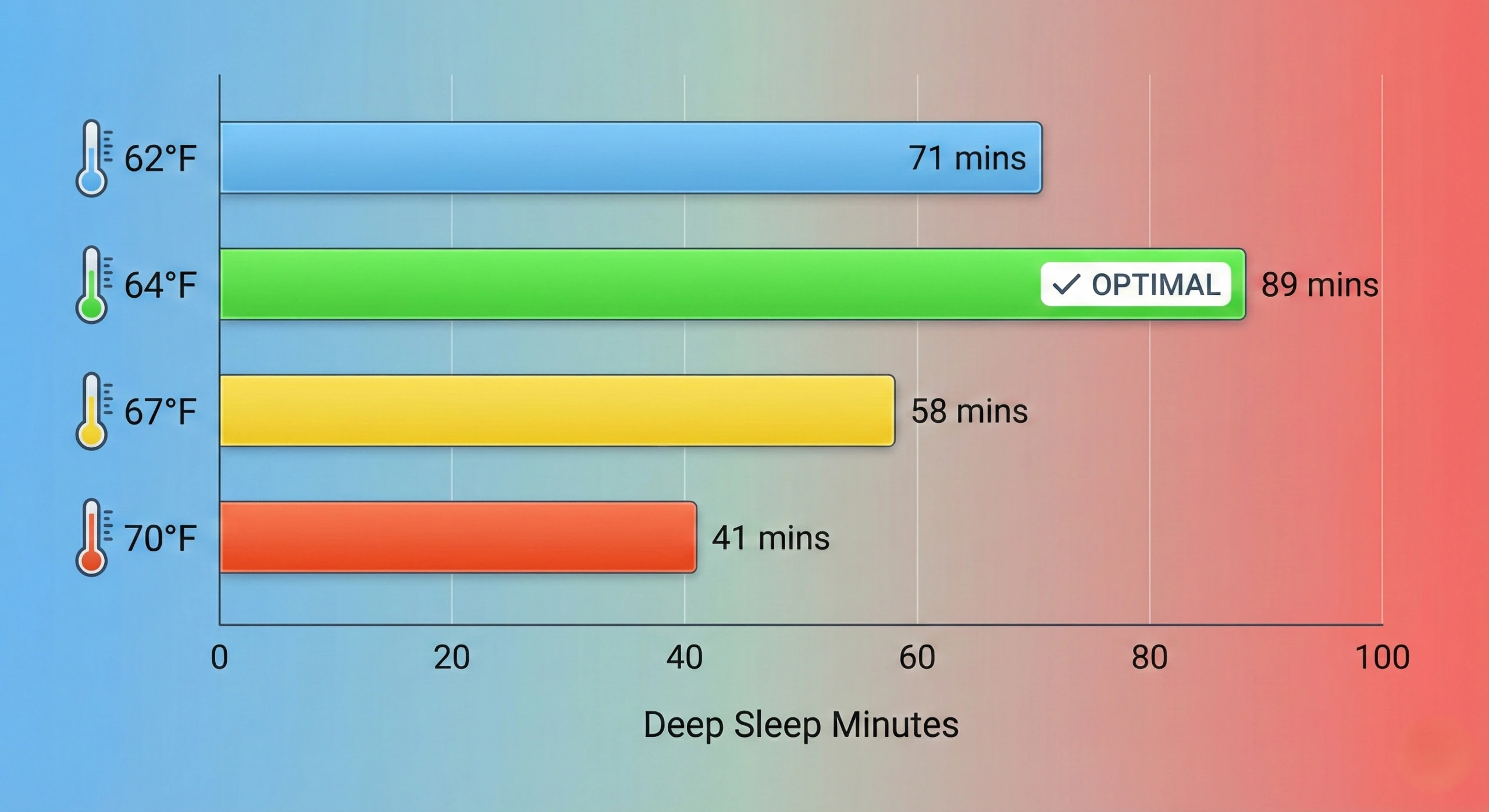
Multiple studies indicate the optimal bedroom temperature for sleep is between 60-67°F for most adults. I tested every degree between 62°F and 70°F over eight weeks.
My specific results:
- 70°F: Deep sleep = 41 minutes average, 2-3 wake-ups per night
- 67°F: Deep sleep = 58 minutes, 1-2 wake-ups
- 64°F: Deep sleep = 89 minutes, 0-1 wake-ups ← optimal for me
- 62°F: Deep sleep = 71 minutes (too cold, shivering interrupted sleep)
The difference between 67°F and 64°F was 31 additional minutes of deep sleep per night. That’s over 3.5 hours more deep sleep per week from a 3-degree adjustment.
Implementation:
- Set temperature to 64-66°F starting 2 hours before bed, not at bedtime
- Use layers of bedding you can adjust (one light blanket + one medium option)
- You should feel slightly cool when you first get into bed
- If you wake up sweating or having kicked off covers, room is too warm
- If you wake up tense and curled up, room is too cold
The Pre-Sleep Hot Shower Protocol
This seems counterintuitive but works through rebound cooling.
Protocol:
- Take a hot shower 60-90 minutes before bed
- Water temperature: 104-108°F
- Duration: 10 minutes
- Focus on heating your core, not just standing under water
Research demonstrates that heating your body triggers enhanced heat dissipation afterward through peripheral vasodilation. Your hands and feet dilate blood vessels to radiate heat away from your core, accelerating the temperature drop needed for sleep initiation.
This is also why wearing socks to bed helps some people fall asleep faster — warmer extremities enable better heat dissipation from the core.
Personal Note: I was skeptical about the hot shower thing because I’d always taken cool showers before bed thinking it would help me “cool down.” Tried the hot shower protocol for one week and my sleep latency dropped by an average of 8 minutes. The rebound cooling effect is real and measurable.
Pillar 3 Implementation – Managing Sleep Pressure (Days 14-28)
Sleep pressure is the biological drive to sleep that builds throughout waking hours. It’s primarily regulated by adenosine accumulation—a metabolic byproduct that creates the feeling of tiredness.
Most people unknowingly sabotage their sleep pressure through poor caffeine timing, late exercise, or alcohol consumption.
Caffeine Cutoff Time
I was drinking coffee until 3 PM, thinking that gave plenty of clearance before my 10:30 PM bedtime.
Wrong. Caffeine has a half-life of 5-6 hours in most people. That 3 PM coffee still had approximately 25% of its caffeine circulating at 9 PM, blocking adenosine receptors and preventing natural sleep pressure buildup.
A controlled study in the Journal of Clinical Sleep Medicine found that caffeine consumed even 6 hours before bed reduced total sleep time by more than 1 hour and significantly disrupted sleep architecture.
What I changed:
- Moved caffeine cutoff to 12 PM (no exceptions during testing phase)
- First week: Brutal 2 PM energy crash
- Week 2: Energy levels started stabilizing
- Week 3: No longer needed afternoon caffeine boost
If you’re a heavy caffeine user (400+ mg daily), research suggests you may need 9-14 days for adenosine receptors to upregulate and sensitivity to reset. Don’t quit—just push your last cup earlier.
Exercise Timing
I’d been doing high-intensity interval training at 7 PM, then wondering why I wasn’t tired at 10:30 PM.
Exercise raises core body temperature and increases cortisol—both are wake-promoting signals that can take 3-4 hours to normalize.
Studies indicate finishing moderate-to-vigorous exercise at least 4 hours before bed improves sleep quality metrics. I moved my workouts to 5-6 PM and saw immediate improvements in sleep onset.
Guideline:
- Finish high-intensity exercise by 6 PM if you sleep at 10 PM
- Moderate exercise (walking, yoga, stretching) can be done closer to bedtime
- Morning exercise appears to have added benefits for circadian reinforcement
Alcohol’s Real Impact
I need to be honest here because I tested this thoroughly: alcohol consistently worsened my sleep quality even when it helped me fall asleep faster.
Two drinks with dinner (finishing by 6 PM) measurably reduced my deep sleep by 20-25 minutes and increased nighttime wake-ups. Research confirms that alcohol may reduce sleep latency but fragments sleep in the second half of the night and suppresses REM sleep.
What I did:
- Reduced alcohol to weekends only during optimization phase
- When drinking, finished by 7 PM maximum
- Limited to 1-2 drinks, not 3-4
- Accepted that nights with alcohol would have objectively worse sleep metrics
This doesn’t mean you can never drink—it means understanding the trade-off you’re making.
The Complete Implementation Timeline (What to Expect Week by Week)
Here’s exactly what a realistic implementation looks like, based on my experience and the research timelines.
Week 1: Foundation
- Start: Morning light exposure + consistent wake time + bedroom temperature adjustment
- Expected: Minimal immediate changes, possible afternoon fatigue as caffeine system adjusts
- Key metric to track: Wake time consistency (aim for within 15 minutes every day)
Week 2: Early Improvements
- Add: Pre-sleep hot shower protocol + caffeine cutoff to 12 PM
- Expected: Sleep latency begins improving (may drop 10-15 minutes), start feeling tired earlier
- Key metric: Time you naturally feel sleepy vs. time you try to sleep
Week 3: Measurable Changes
- Add: Exercise timing adjustment + evening light reduction
- Expected: Sleep latency under 20 minutes, deep sleep increasing noticeably, fewer wake-ups
- Key metric: How often you wake during night + morning energy level
Week 4+: Optimization
- Fine-tune: Bedroom temperature by 1-2 degrees, adjust timing based on your data
- Expected: Consistent improvements, new baseline established
- Key metric: Week-to-week consistency of sleep quality
Personal Note: Month 2 was when I got overconfident and stopped being consistent with wake times. My sleep quality immediately degraded. Went back to strict consistency for one week and metrics recovered. The framework works but requires ongoing adherence to fundamentals, especially wake time consistency.
What I Tested That Didn’t Work (Honest Results)
I want to be transparent about interventions that failed or had minimal impact for me personally. This doesn’t mean they won’t work for you, but they didn’t move the needle in my testing.
Magnesium supplementation: Tried magnesium glycinate (400mg nightly) for six weeks. Zero measurable change in any sleep metrics. Some research suggests magnesium may help in deficient individuals, but bloodwork showed I wasn’t deficient. Spent ~$35 with no return.
Sleep meditation apps: Used Headspace and Calm for three weeks each. They were relaxing but didn’t improve deep sleep or reduce wake-ups. My issue was biological, not stress-related.
Valerian root and herbal supplements: Tested various combinations for eight weeks total. Possible placebo benefit first 2-3 nights, then nothing. Total waste: ~$150.
White noise machines: Made my sleep slightly worse. I’d wake up hyperaware of the sound. Some people love white noise—I’m not one of them.
Weighted blankets: Tested a 20-pound blanket for two weeks. Temperature regulation became worse—I’d overheat around 2-3 AM every night.
What DID work as secondary optimizations:
Nasal breathing tape (mouth tape): Small but consistent improvement. Using 3M medical tape to encourage nasal breathing added roughly 5-7% improvement to morning readiness scores on top of the three pillars. Research indicates nasal breathing may reduce sleep-disordered breathing events.
Reading before bed: Physical book for 20 minutes with warm dim light vs. phone scrolling resulted in 8 minutes faster sleep onset on average across two weeks of testing.
Earlier dinner timing: Finishing dinner by 6:30 PM vs. 8-9 PM made a noticeable difference. Studies show eating close to bedtime raises core body temperature and impairs the natural cooling needed for sleep.
When This Framework Doesn’t Work: Red Flags and Next Steps
If you’ve implemented all three pillars consistently for 3-4 weeks and aren’t seeing improvement, here are the most common issues and when to seek medical help.
Common Troubleshooting Issues
Your room isn’t actually dark enough
Even small amounts of light can suppress melatonin. Cover all LED lights on electronics, get blackout curtains, or use an eye mask. Light exposure during sleep affects quality even when you’re unconscious.
Your morning light isn’t bright enough
Indoor lighting provides 300-500 lux. You need 2,500-10,000 lux minimum. Even on cloudy days, it’s brighter outside than inside. If you absolutely cannot get outside, invest in a 10,000 lux light therapy box and use it for 15-20 minutes within 30 minutes of waking.
You’re not allowing enough adaptation time
Circadian adaptation takes 2-3 weeks minimum. Sleep pressure rebalancing after caffeine reduction takes 10-14 days. Changing protocols every 3-4 days doesn’t allow time for biological systems to adapt.
Medical Red Flags – When to See a Doctor
Please consult a healthcare provider if you experience:
- Loud snoring or witnessed breathing pauses during sleep (possible sleep apnea)
- Falling asleep at inappropriate times (driving, during conversations)
- Excessive daytime sleepiness despite adequate sleep duration
- Restless legs or involuntary limb movements that wake you
- Zero improvement after implementing this framework for 6+ weeks consistently
- Chronic insomnia lasting more than 3 months
Obstructive sleep apnea affects 9-38% of adults and no amount of sleep optimization will fix an airway obstruction. If you suspect a sleep disorder, seek professional evaluation.
This framework is designed for people with sub-optimal sleep, not diagnosed sleep disorders. Always prioritize medical guidance for chronic or severe sleep issues.
The Research-Backed Protocol Summary Table
Here’s a comprehensive comparison of interventions, their evidence strength, implementation difficulty, and expected impact based on current research and my personal testing.
| Intervention | Evidence Quality | Expected Impact | Implementation Difficulty | Time to Results | Cost |
|---|---|---|---|---|---|
| Morning light exposure (10-15 min) | Strong (multiple RCTs) | High (20-30 min reduction in sleep latency) | Low | 10-14 days | Free |
| Consistent wake time | Strong (large observational) | High (improved sleep quality markers) | Medium (requires discipline) | 14-21 days | Free |
| Bedroom temp 60-67°F | Strong (controlled studies) | Very High (up to 24% increase in deep sleep) | Medium (may need AC/heating) | 3-7 days | $0-200 |
| Pre-sleep hot shower | Moderate (some evidence) | Medium (5-10 min faster sleep onset) | Low | 3-5 days | Free |
| Caffeine cutoff (8+ hrs before bed) | Strong (RCT data) | Medium-High (prevents sleep disruption) | Medium (withdrawal period) | 7-14 days | Free |
| Exercise timing (4+ hrs before bed) | Moderate (mixed evidence) | Medium (improved sleep onset) | Low-Medium | 3-7 days | Free |
| Evening light reduction | Strong (melatonin studies) | Medium (better melatonin production) | Low | 5-10 days | $0-50 |
| Alcohol avoidance | Strong (clear evidence) | Medium (improved sleep architecture) | High (social/habitual) | Immediate | Free |
| Magnesium supplements | Weak (limited, deficient populations) | Low (minimal if not deficient) | Low | Variable | $15-30/mo |
| Weighted blankets | Weak (limited studies) | Low-Medium (individual variation) | Low | 1-2 weeks | $80-150 |
| White noise machines | Weak (mixed results) | Low (highly individual) | Low | 3-7 days | $20-50 |
Note: Evidence quality ratings based on availability of randomized controlled trials (RCTs) and systematic reviews. Individual responses vary—this table represents average findings from research and my personal testing.
My Current Protocol After 6 Months (Real-World Sustainability)
I’ve maintained these practices for six months. Here’s what my actual routine looks like—not perfect, but sustainable long-term.
Morning (6:30-7:00 AM):
- Wake between 6:30-7:00 AM (I now allow 30-minute flexibility on weekends)
- Outside for 10 minutes with coffee
- No checking phone until after morning light exposure
Daytime:
- Last caffeine by 12:30 PM (occasionally 1 PM on very busy days)
- Afternoon sunlight exposure when possible (not strict about this)
Evening (5:00-10:00 PM):
- Exercise 5:00-6:00 PM (strength training or running)
- Dinner finished by 6:00 PM
- Lights dim after 8:30 PM
- Hot shower 9:00-9:15 PM (skip if I’m not feeling cold)
- Read physical book in bed 9:30-10:00 PM
Bedroom Setup:
- Temperature set to 64°F
- Blackout curtains + all electronics covered
- One light blanket
- Window cracked 1-2 inches for fresh air
Current metrics (7-day average, last week):
- Sleep latency: 11 minutes
- Total sleep time: 7 hours 18 minutes
- Deep sleep: 84 minutes
- REM sleep: 98 minutes
- Wake-ups: 0.3 per night (about 2 nights per week with 1 brief wake-up)
The biggest change isn’t the metrics—it’s that sleep no longer occupies mental space. I don’t worry, don’t obsess, don’t track nightly anymore. The framework runs on autopilot.
Personal Note: I still have occasional bad sleep nights, usually when traveling or after social events with late bedtimes and alcohol. I don’t stress about these anymore because I know exactly how to get back on track: one night of proper protocol and I’m back to baseline. That psychological freedom is worth more than perfect metrics every single night.
Bottom Line – What Actually Matters for Better Sleep Naturally
Improving sleep quality without medication isn’t about finding a perfect supplement or expensive gadget. It’s about working with three fundamental biological systems:
1. Circadian timing through light exposure and schedule consistency
2. Temperature regulation through environmental cooling and strategic heating
3. Sleep pressure through smart timing of caffeine, exercise, and alcohol
Everything else provides marginal gains at best.
The framework works because it addresses root causes, not symptoms. Your body wants to sleep well—you just need to remove the obstacles you’ve unknowingly created.
Start with one pillar. Give it two weeks. Add the next. You don’t need to be perfect—you need to be consistent with the fundamentals.
Most people see meaningful improvements within 3-4 weeks of implementation. If you don’t, revisit the troubleshooting section or consider consulting a healthcare provider to rule out sleep disorders.
Sources and Scientific References
- Okamoto-Mizuno K, Mizuno K. Effects of thermal environment on sleep and circadian rhythm. Journal of Physiological Anthropology. 2012
- Wright KP Jr, et al. Entrainment of the human circadian clock to the natural light-dark cycle. Current Biology. 2013
- Huang T, et al. Sleep irregularity and risk of cardiovascular events. Scientific Reports. 2019
- Berson DM, et al. Phototransduction by retinal ganglion cells that set the circadian clock. Nature Neuroscience. 2002
- Roenneberg T, et al. Social jetlag and obesity. Current Biology. 2012
- Kräuchi K, et al. Warm feet promote the rapid onset of sleep. Nature. 1999
- Drake C, et al. Caffeine effects on sleep taken 0, 3, or 6 hours before going to bed. Journal of Clinical Sleep Medicine. 2013
- Dutheil F, et al. Effects of napping on sleepiness and performance. Sleep Medicine. 2019
- Youngstedt SD, et al. Effects of exercise on sleep. Advances in Preventive Medicine. 2018
- Ebrahim IO, et al. Alcohol and sleep I: effects on normal sleep. Alcoholism: Clinical and Experimental Research. 2013
- Temple JL, et al. The Safety of Ingested Caffeine: A Comprehensive Review. Food and Chemical Toxicology. 2017
- Abbasi B, et al. The effect of magnesium supplementation on primary insomnia in elderly. Journal of Research in Medical Sciences. 2012
- Lee YC, et al. Mouth breathing and sleep-related breathing disorders. Journal of Oral Rehabilitation. 2018
- McHill AW, et al. Later circadian timing of food intake is associated with increased body fat. American Journal of Clinical Nutrition. 2017
- Gooley JJ, et al. Exposure to room light before bedtime suppresses melatonin onset. Journal of Clinical Endocrinology & Metabolism. 2011
- Senaratna CV, et al. Prevalence of obstructive sleep apnea in the general population. Sleep Medicine Reviews. 2017
- Hershner SD, Chervin RD. Causes and consequences of sleepiness among college students. Nature and Science of Sleep. 2014