The illusion: Alcohol feels like it helps you fall asleep faster (it does—by 5-15 minutes), but destroys sleep quality throughout the night.
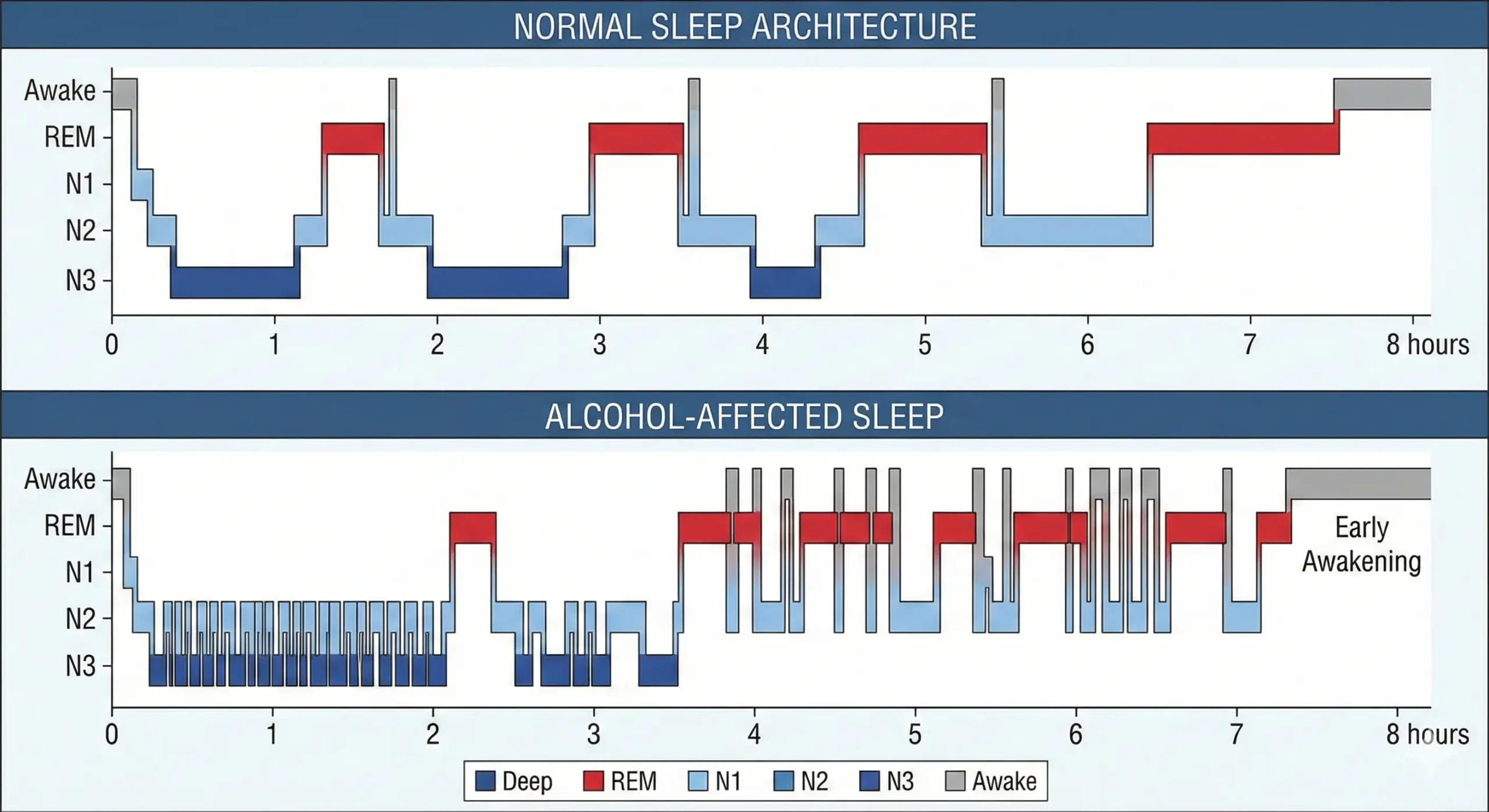
REM suppression: Even 2 drinks reduce REM sleep by 30-40% in the first half of the night, causing fragmented sleep and early waking.
The rebound effect: Hours 3-6 after drinking = REM rebound, vivid dreams, frequent awakenings, cortisol spike, light sleep.
Timeline to clear: Alcohol metabolizes at ~1 drink per hour; plan 3-4 hour gap between last drink and bedtime to minimize damage.
What’s actually happening: Alcohol is a sedative, not a sleep aid. It suppresses your central nervous system and makes you pass out faster, but this isn’t natural sleep—it’s closer to anesthesia. Your brain never enters the proper sleep architecture: deep sleep (NREM) is somewhat preserved in early night, but REM sleep (critical for memory, emotion regulation, cognitive function) is severely suppressed. Then, as alcohol metabolizes around 3-4 AM, your brain experiences a REM rebound—trying to “catch up” on missed REM, causing vivid dreams, sweating, anxiety, and fragmented light sleep. You might sleep 7-8 hours, but sleep quality is equivalent to 4-5 hours of sober sleep.
Want Better Sleep Stats?
Theory is good, but tools get results. See the exact stack (mask, tape, supplements) I use to get 2+ hours of Deep Sleep every night.
Open Sleep HubThe 4-Stage Breakdown: What Alcohol Does to Your Sleep
Stage 1: Hours 0-2 (The Fake Sleep)
What you feel: Fast sleep onset, deep sedation, feeling “knocked out”
What’s actually happening:
- Alcohol activates GABA receptors and inhibits glutamate (excitatory neurotransmitter), creating sedation
- You fall asleep 5-15 minutes faster than sober baseline
- Deep sleep (stage N3) is initially enhanced—you spend more time in slow-wave sleep during the first sleep cycle
- REM sleep is severely suppressed—first REM period is delayed or skipped entirely
- You’re not waking up because you’re sedated, but sleep quality is already compromised
Brain activity: Your brain is not cycling through normal sleep stages. It’s stuck in deep NREM sleep longer than normal, skipping the REM periods that should occur every 90 minutes.
Why this feels “good”: Deep sleep is restorative for physical recovery, so you’re getting some benefit. But you’re missing REM, which is essential for:
- Memory consolidation (transferring short-term memories to long-term storage)
- Emotional processing (regulating mood, processing emotions)
- Cognitive function (creativity, problem-solving)
- Neural pruning (clearing unnecessary neural connections)
The hidden cost: Even though you feel deeply asleep, your brain is not doing critical REM-dependent processes. This is why you can “sleep” 8 hours after drinking but wake up mentally foggy.
Stage 2: Hours 2-4 (The Quiet Before the Storm)
What you feel: Still asleep, possibly shifting positions more
What’s actually happening:
- Alcohol is metabolizing (average rate: 1 standard drink per hour)
- Blood alcohol concentration (BAC) is declining
- GABA sedation is wearing off
- Your brain is starting to “wake up” from the artificial suppression
- REM sleep is still suppressed, but less severely than Stage 1
- You’re transitioning from deep sleep to lighter sleep stages
Physiological changes:
- Body temperature starts fluctuating (alcohol disrupts thermoregulation)
- Heart rate variability (HRV) is lower than normal—indicating stress response
- Cortisol levels begin rising (normally cortisol is low during sleep and rises near morning)
- Adenosine levels decline faster than normal (adenosine = sleep pressure chemical)
Why this stage matters: This is when your body realizes it’s been chemically sedated and starts trying to normalize. The withdrawal of alcohol’s sedating effects triggers a mild stress response even while you’re still asleep.
Stage 3: Hours 4-6 (The REM Rebound and Fragmentation)
What you feel: Waking up frequently, tossing and turning, hot/sweaty, vivid or disturbing dreams, anxiety
What’s actually happening:
- Alcohol is mostly metabolized (depending on how much you drank)
- Your brain attempts a REM rebound—trying to “catch up” on the REM sleep it missed earlier
- But instead of smooth, consolidated REM periods, you get fragmented, intense REM bursts
- You cycle rapidly between REM and light sleep (stage N2), waking up multiple times
- Cortisol peaks prematurely (should peak near wake time, but alcohol causes early spike)
- Sympathetic nervous system activates (fight-or-flight mode)
Physical symptoms:
- Night sweats (thermoregulation disrupted)
- Heart racing (sympathetic activation)
- Dry mouth, thirst (dehydration from alcohol’s diuretic effect)
- Need to urinate (bladder filled from fluid intake and diuresis)
- Anxiety or “racing thoughts” (cortisol spike + REM rebound)
Dream patterns: REM rebound causes vivid, intense, often disturbing dreams. You might remember more dreams than usual after drinking, but not in a good way—these dreams are often anxious, bizarre, or unpleasant because your brain is in a hyperactive, dysregulated REM state.
Micro-awakenings: Sleep tracking devices show 20-40+ brief awakenings during this stage (you may not consciously remember most of them). Each awakening disrupts sleep continuity and prevents you from reaching restorative deep sleep again.
Stage 4: Hours 6-8 (The Morning Aftermath)
What you feel: Early waking (3-6 AM), inability to fall back to sleep, grogginess, “hangover fog”
What’s actually happening:
- Sleep pressure is depleted (adenosine is low)
- Cortisol is elevated (causing wakefulness)
- You’ve had fragmented, low-quality sleep for the past 2-3 hours
- Total sleep time might look okay (7-8 hours), but sleep efficiency is terrible (lots of time awake in bed)
- Morning blood sugar may be dysregulated (alcohol affects glucose metabolism)
Why you can’t fall back asleep: The combination of low adenosine (sleep pressure), high cortisol (wake signal), and REM rebound exhaustion creates a state where you’re tired but can’t sleep. Your brain has exited deep sleep and can’t re-enter it.
The cognitive deficit: Even if you eventually fall back into light sleep, you wake up with:
- Brain fog (missed REM = impaired cognitive function)
- Mood dysregulation (missed REM = poor emotional processing)
- Fatigue (sleep fragmentation = not restorative)
- Increased anxiety or irritability (cortisol spike + sympathetic activation)
The Data: How Much Alcohol Destroys Sleep?
Research shows a clear dose-response relationship: more alcohol = worse sleep disruption.
Light Drinking (1-2 drinks)
Effects:
- Sleep latency: 5-10 min faster (you fall asleep quicker)
- Deep sleep (N3): Slight increase in first half of night (+5-10%)
- REM sleep: Reduced by 15-25% overall
- Awakenings: 2-3x more than sober baseline
- Sleep efficiency: 75-80% (normal is 85-90%)
Who this affects most: Even “light” drinking before bed reduces REM by 15-25%. For someone who needs 90-120 minutes of REM per night (normal), this means losing 15-30 minutes of critical REM sleep.
Subjective feeling: Many people don’t notice major disruption with 1-2 drinks—you still feel “okay” in the morning. But objective measurements (sleep trackers, lab studies) show clear impairment.
Moderate Drinking (3-5 drinks)
Effects:
- Sleep latency: 10-15 min faster
- Deep sleep (N3): Maintained or slightly increased early night, then drops off
- REM sleep: Reduced by 35-50% overall
- Awakenings: 5-8x more than sober
- Sleep efficiency: 60-70%
- HRV: Significantly reduced (20-30% lower than baseline)
Who this affects most: This is where most people clearly notice poor sleep quality. You wake up multiple times, have vivid/disturbing dreams, and feel unrested despite “sleeping” 7-8 hours.
The morning deficit: Waking up after 3-5 drinks feels like you slept 4-5 hours even if you were in bed for 8. Cognitive function, reaction time, and mood are noticeably impaired.
Heavy Drinking (6+ drinks or binge drinking)
Effects:
- Sleep latency: 15-20 min faster (passing out, not falling asleep)
- Deep sleep: Initially high, then crashes
- REM sleep: Reduced by 50-70%+ overall—some cycles have zero REM
- Awakenings: 10-20+ times (highly fragmented)
- Sleep efficiency: 40-60% (terrible quality)
- Next-day hangover: Severe sleep deprivation + alcohol withdrawal symptoms
Who this affects: Everyone. Heavy drinking is unequivocally destructive to sleep. Even chronic heavy drinkers don’t “adapt”—their sleep remains disrupted (and often worsens over time).
Long-term consequences: Repeated heavy drinking disrupts circadian rhythms, reduces sleep drive (adenosine system dysregulation), and can cause chronic insomnia that persists even when sober.
Sleep Tracking Data: What Your Device Shows
If you wear a sleep tracker (Oura, Whoop, Apple Watch, Fitbit), you’ll see these patterns after drinking:
Metrics That Get Worse
REM Sleep: Drops by 30-70% depending on alcohol amount
- Normal: 90-120 min (20-25% of total sleep)
- After 2-3 drinks: 40-70 min (10-15% of total sleep)
- After 5+ drinks: 20-40 min (5-10% of total sleep)
Heart Rate Variability (HRV): Significantly reduced
- Normal: 50-80 ms (varies by age/fitness)
- After drinking: 20-40 ms (indicates stress/poor recovery)
- HRV stays depressed for 12-24 hours after drinking
Resting Heart Rate: Elevated by 5-15 bpm
- Your heart works harder all night because alcohol is a cardiovascular stressor
Sleep Stages Graph: Shows fragmented pattern
- Missing REM blocks in early night (first 1-3 sleep cycles)
- Excessive light sleep in late night (hours 4-7)
- Multiple “awake” segments throughout
Sleep Score: Drops by 20-50 points
- Oura, Whoop, and other trackers heavily penalize alcohol nights
- Even if total sleep time is normal, quality metrics tank
Timeline: How Long to Wait Between Drinking and Bed
The key question: If you’re going to drink, how much time should you allow before sleep?
Alcohol Metabolism Rate
Average rate: 1 standard drink per hour
- 1 standard drink = 12 oz beer (5% ABV), 5 oz wine (12% ABV), 1.5 oz spirits (40% ABV)
- This rate varies by body weight, sex, genetics, food intake, but 1 drink/hour is a good baseline
Example calculations:
- 2 drinks → 2 hours to metabolize
- 4 drinks → 4 hours to metabolize
- 6 drinks → 6 hours to metabolize
Minimum clearance time: Add 1-2 hours beyond metabolism time for your body to stabilize.
Practical Recommendations
If you had 2 drinks:
- Minimum gap: 3 hours before bed
- Better gap: 4 hours
- Example: Stop drinking at 8 PM if bed is at midnight
If you had 4 drinks:
- Minimum gap: 5 hours
- Better gap: 6 hours
- Example: Stop drinking at 6 PM if bed is at midnight
- Realistically, you probably won’t achieve this—accept that sleep will be compromised
If you had 6+ drinks:
- Your sleep will be disrupted regardless of timing
- Damage control: hydrate, don’t compound with caffeine or late eating
- Next-day recovery will be needed
The hard truth: If you drink more than 2-3 drinks in an evening, your sleep that night will be impaired no matter what you do. The metabolism timeline just determines how bad it will be.
Strategies to Minimize Damage (Harm Reduction)
If you’re going to drink, here’s how to reduce (but not eliminate) the sleep impact:
Before Drinking
Eat substantial food: Having food in your stomach slows alcohol absorption, resulting in lower peak BAC and slightly less sleep disruption. Focus on protein and healthy fats.
Hydrate well: Drink 16-20 oz water before you start drinking. Dehydration compounds sleep disruption.
Plan your timing: Decide what time you’ll stop drinking based on your bedtime. Stick to it.
During Drinking
Alternate water and alcohol: For every alcoholic drink, drink 8-12 oz water. This slows total intake and prevents dehydration.
Drink slowly: Pace yourself to 1 drink per hour or slower. This keeps BAC lower and gives your body time to metabolize.
Avoid sugary mixers: Sugar + alcohol = worse blood sugar disruption during sleep. Stick to clear spirits with soda water and lime, or dry wine.
Stop 3-4 hours before bed: Set a hard cutoff. The more time between last drink and sleep, the less disruption.
Before Bed (After Drinking)
Hydrate aggressively: 16-32 oz water before bed. Yes, you’ll wake to urinate, but dehydration is worse for sleep quality.
Electrolytes: If you drank heavily, add electrolytes (sodium, potassium, magnesium) to your water. Dehydration + electrolyte imbalance worsens next-day symptoms.
Avoid heavy food right before bed: Don’t compound alcohol sleep disruption with late-night digestion. If you need food, keep it light.
Cool room: Alcohol disrupts thermoregulation. Keep your bedroom cooler than usual (65-68°F) to counteract night sweats.
Consider magnesium glycinate: 200-400mg magnesium glycinate may help with sleep quality and reduce muscle tension. It won’t fix alcohol’s damage but might help marginally. See our magnesium for sleep guide.
Next Day (Recovery)
Prioritize hydration: Continue drinking water throughout the next day.
Avoid caffeine excess: You’ll be tempted to over-caffeinate due to fatigue, but this will further disrupt sleep the next night. Limit to morning caffeine only.
Light exercise if possible: Gentle movement (walking, yoga) can help normalize cortisol and improve mood. Avoid intense training—you’re sleep-deprived and recovery is impaired.
Nap if needed, but keep it short: 20-30 min power nap max. Longer naps will disrupt that night’s sleep.
Get morning sunlight: 10-15 min outside soon after waking helps reset your circadian rhythm after the previous night’s disruption.
Don’t drink again that night: Give your body 48+ hours to fully recover before drinking again.
Does “Drinking Before Bed Helps Me Sleep” Mean I Have a Problem?
If you regularly use alcohol to fall asleep, this is a red flag for several reasons:
Tolerance builds: Over time, you need more alcohol to get the same sedating effect. What starts as 1 glass of wine becomes 2, then 3.
Sleep debt accumulates: Even though you’re “sleeping,” you’re chronically REM-deprived. This leads to:
- Cognitive decline
- Mood disorders (anxiety, depression)
- Impaired memory
- Weakened immune function
Dependence risk: Using alcohol as a sleep aid can progress to alcohol dependence. Your brain adapts to expect alcohol for sleep, and you struggle to fall asleep sober.
Masking underlying issues: If you can’t fall asleep without alcohol, there’s likely an underlying problem: anxiety, circadian misalignment, poor sleep hygiene, stress. Alcohol masks this instead of fixing it.
When to Seek Help
Consider talking to a healthcare provider if:
- You drink nightly to fall asleep
- You can’t fall asleep without alcohol
- You’re increasing the amount you drink over time
- You wake up anxious or shaky
- Family or friends have expressed concern
- You’ve tried to cut back and can’t
Resources:
- Talk to your doctor about sleep issues (there are better solutions than alcohol)
- Consider cognitive behavioral therapy for insomnia (CBT-I)—highly effective, no medications
- If alcohol use is concerning, explore support options: therapy, support groups, treatment programs
Common Questions About Alcohol and Sleep
I drink a glass of wine with dinner (6-7 PM) and sleep at 11 PM. Is that okay?
This timing (4-5 hours before bed) is about as good as it gets for alcohol and sleep. Most of the alcohol will be metabolized by bedtime, minimizing sleep disruption. You might still see slightly reduced REM compared to no alcohol, but the impact will be much smaller than drinking closer to bedtime. If you’re going to drink, this timing is ideal. However, if you have sleep problems or are tracking sleep quality, experiment with a week alcohol-free to see if there’s any difference.
Does red wine help sleep because of resveratrol or melatonin?
No. Wine contains tiny amounts of melatonin and resveratrol, but nowhere near therapeutic doses. The amount of melatonin in wine (nanograms) is 1000x lower than a typical melatonin supplement dose (1-3 mg). Any perceived sleep benefit from red wine is purely from alcohol’s sedating effect—which, as explained, is counterproductive to actual sleep quality. The “red wine helps sleep” myth is popular but scientifically unsupported. The alcohol harm outweighs any theoretical polyphenol benefit.
I sleep fine after drinking. Am I immune to alcohol’s effects?
You’re almost certainly not immune—you’re just not consciously aware of the disruption. Sleep trackers consistently show impaired REM, fragmented sleep, and reduced HRV even in people who subjectively report “sleeping fine” after drinking. You might not wake up fully or remember the micro-awakenings, but they’re happening. The cognitive and mood effects the next day (even subtle ones) are evidence of disrupted sleep. Try wearing a sleep tracker for a week with alcohol and a week without—you’ll see the difference objectively even if you don’t feel it subjectively.
What about nightcap culture or “a drink to unwind”—is that really that bad?
Cultural traditions don’t change biology. Yes, alcohol provides short-term stress relief and relaxation, which is why people use it to “unwind.” But there’s a huge difference between relaxing and sleeping well. A nightcap might help you transition from work stress to bedtime, but it will disrupt your sleep quality throughout the night. Better alternatives for unwinding: herbal tea, light stretching, reading, meditation, magnesium supplement, or L-Theanine—all provide relaxation without destroying REM sleep.
INTERNAL LINKS
To optimize sleep without relying on alcohol:
- Address stress-driven insomnia with why you can’t fall asleep guide
- Fix nighttime awakenings in why you wake up at 3-4 AM
- Try natural relaxation with L-Theanine for sleep
- Understand full sleep architecture in how sleep works
- Create complete sleep protocol in ultimate sleep optimization guide
SOURCES
- Alcohol effects on sleep architecture: Ebrahim, I.O., et al. “Alcohol and sleep I: effects on normal sleep.” Alcoholism: Clinical and Experimental Research, 2013. https://pubmed.ncbi.nlm.nih.gov/23347102/
- REM suppression and rebound: Roehrs, T., & Roth, T. “Sleep, sleepiness, and alcohol use.” Alcohol Research & Health, 2001. https://pubmed.ncbi.nlm.nih.gov/11810957/
- Dose-response relationship: Landolt, H.P., & Gillin, J.C. “Sleep abnormalities during abstinence in alcohol-dependent patients.” Biological Psychiatry, 2001. https://pubmed.ncbi.nlm.nih.gov/11376694/
- HRV and alcohol effects: Sagawa, Y., et al. “Alcohol has a dose-related effect on parasympathetic nerve activity during sleep.” Alcoholism: Clinical and Experimental Research, 2011. https://pubmed.ncbi.nlm.nih.gov/21426372/
- Long-term sleep disruption from alcohol: Brower, K.J. “Insomnia, alcoholism and relapse.” Sleep Medicine Reviews, 2003. https://pubmed.ncbi.nlm.nih.gov/12856214/