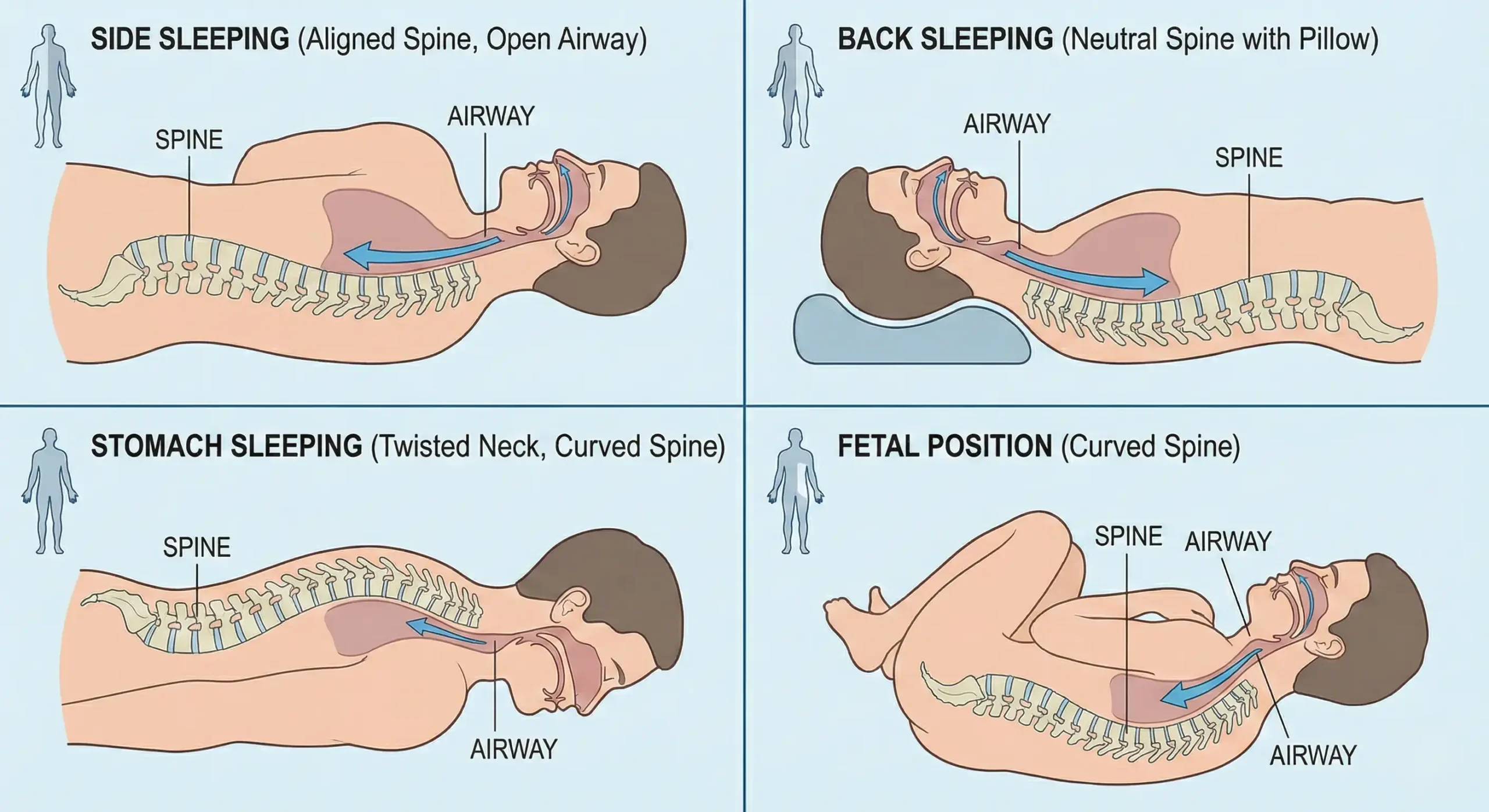
Best overall: Side sleeping (particularly left side) — reduces snoring, supports spine, improves breathing, promotes lymphatic drainage.
Best for back pain: Back sleeping with pillow under knees — maintains natural spine curve.
Best for pregnancy: Left side — improves blood flow to placenta, reduces pressure on organs.
Worst position: Stomach sleeping — causes neck strain, restricts breathing, worst for spine alignment.
The surprising reality: Your sleep position affects more than just comfort—it influences breathing efficiency, spinal alignment, lymphatic drainage, snoring intensity, acid reflux, and even long-term wrinkle formation. Most people naturally gravitate toward one position, but that position might be undermining sleep quality without them realizing it. The science consistently points to side sleeping (especially left side) as optimal for most people, but individual factors—back pain, sleep apnea, pregnancy, shoulder issues—can change the recommendation.
Want Better Sleep Stats?
Theory is good, but tools get results. See the exact stack (mask, tape, supplements) I use to get 2+ hours of Deep Sleep every night.
Open Sleep HubWhy Sleep Position Matters (More Than You Think)
Sleep position isn’t just about comfort—it has measurable effects on multiple physiological systems during the 7-9 hours you spend unconscious each night.
The Spine and Nervous System Connection
Your spine houses your spinal cord, and maintaining proper alignment during sleep prevents nerve compression that can cause pain, numbness, or dysfunction. Poor sleep position creates sustained pressure on nerve roots exiting your spine, which can manifest as:
- Lower back pain (from lumbar spine misalignment)
- Neck pain and headaches (from cervical spine strain)
- Shoulder pain (from compression in side sleepers)
- Sciatica symptoms (from prolonged hip/lower back pressure)
Additionally, spinal fluid (cerebrospinal fluid) circulates around your brain and spinal cord to remove metabolic waste—a process that happens primarily during deep sleep. Positions that compress or twist your spine may impair this waste clearance process, potentially contributing to brain fog and cognitive decline over time.
Breathing and Sleep Apnea
Sleep position dramatically affects your airway. When lying on your back, gravity pulls your tongue and soft tissues backward toward your throat, which can partially or completely obstruct breathing—especially in people with:
- Excess weight
- Anatomical factors (large tongue, small jaw, enlarged tonsils)
- Relaxed throat muscles (common in older adults or after alcohol consumption)
This is why back sleeping significantly worsens obstructive sleep apnea. Studies show that 50-60% of sleep apnea events occur exclusively during back sleeping. Simply switching to side sleeping can reduce apnea events by 50% or more in positional sleep apnea patients.
Acid Reflux and Digestive Function
The anatomy of your stomach’s connection to your esophagus (the gastroesophageal junction) is not centered—it’s positioned slightly to the right. This creates an important positional effect:
Left side sleeping: The stomach hangs below the esophagus, making it harder for acid to reflux upward. Studies show significantly fewer reflux episodes in left-side sleepers compared to right-side or back sleepers.
Right side sleeping: The gastroesophageal junction is above stomach acid, making reflux easier. People with GERD often notice worse symptoms when sleeping on their right side.
Back sleeping: Gravity no longer helps keep acid down. Reflux is more likely and can be more severe.
Lymphatic Drainage and Brain Waste Clearance
Your brain has a waste clearance system called the glymphatic system, which is most active during sleep. Recent research suggests that side sleeping (particularly left side) may optimize this waste removal process because:
- The position allows better cerebrospinal fluid flow
- Lymphatic drainage from the brain is enhanced
- Metabolic waste products (like beta-amyloid, linked to Alzheimer’s) are cleared more efficiently
While this research is still emerging, it provides another data point favoring side sleeping for long-term brain health.
The 4 Main Sleep Positions: Pros, Cons, and Who They’re Best For
1. Side Sleeping (Left or Right)
Percentage of people: 40-50% naturally prefer side sleeping
Overall rating for sleep quality: ⭐⭐⭐⭐⭐ (Best for most people)
Pros:
- Reduces snoring and sleep apnea: Keeps airways open, prevents tongue from falling back
- Good for spine alignment: When properly supported with pillow, spine stays neutral
- Best for pregnant women: Especially left side—improves blood flow to placenta
- Reduces acid reflux: Especially left side—anatomy favors keeping acid down
- May enhance brain waste clearance: Emerging research on glymphatic drainage
- Reduces lower back pressure: Compared to stomach sleeping
Cons:
- Shoulder pain: Sustained pressure on bottom shoulder can cause discomfort, especially in side sleepers with previous injuries
- Arm numbness: Bottom arm can fall asleep if positioned poorly
- Facial wrinkles: Sustained pressure on one side of face may contribute to asymmetric wrinkle formation over decades (cosmetic, not health issue)
- Hip pain: In people with arthritis or bursitis, side sleeping can aggravate hip pain
Left Side vs Right Side:
Left side is superior for:
- Acid reflux (anatomy favors left)
- Pregnancy (better blood flow to fetus)
- Heart health (some evidence for reduced cardiac strain)
- Digestion (follows natural flow of digestive system)
Right side is fine for:
- People without reflux issues
- Those with left shoulder pain
- Most general purposes
Recommendation: Default to left side unless you have specific reasons to choose right (shoulder pain, personal comfort).
How to Optimize Side Sleeping:
Pillow height: Your head pillow should fill the gap between your ear and the mattress, keeping your spine in a straight line from neck to tailbone. Too high = neck bent upward. Too low = neck bent downward. For most people, this means a medium-thickness pillow (4-6 inches loft).
Knee pillow: Place a pillow between your knees to prevent your top leg from pulling your spine out of alignment. This is crucial for preventing hip and lower back pain. The pillow should be thick enough to keep your top hip level with your bottom hip.
Arm position: Bottom arm can go in several positions:
- Extended under the pillow (can cause shoulder strain for some)
- Wrapped around a body pillow (distributes pressure)
- Hugging a pillow in front of you (prevents rolling onto stomach)
2. Back Sleeping (Supine)
Percentage of people: 35-40% naturally prefer back sleeping
Overall rating: ⭐⭐⭐⭐ (Good, with caveats)
Pros:
- Best for spinal alignment: Natural curves of neck and lower back are supported
- Reduces facial wrinkles: No sustained pressure on face (cosmetic benefit)
- Reduces shoulder pain: No compression of either shoulder
- Good for TMJ/jaw pain: No pressure on jaw structures
- Easiest to maintain symmetrical alignment: Body naturally stays centered
Cons:
- Worst for snoring and sleep apnea: Gravity pulls tongue backward, obstructing airway
- Can worsen acid reflux: Gravity doesn’t help keep acid down
- Lower back pain in some people: If mattress is too soft or pillow is wrong height, lower back can hyperextend
- Not safe during late pregnancy: Reduces blood flow to fetus in third trimester
Who Should Back Sleep:
- People without sleep apnea or snoring issues
- Those with shoulder pain or rotator cuff injuries
- People with neck pain (when properly supported)
- Those recovering from certain spine surgeries
- People who want to minimize facial wrinkles (cosmetic consideration)
How to Optimize Back Sleeping:
Pillow under knees: This is critical. A pillow or rolled towel under your knees slightly flexes your hips and flattens your lower back against the mattress, preventing hyperextension and lower back pain. Use a medium-sized pillow or a specialized knee wedge.
Head pillow: Should support the natural curve of your neck without pushing your head too far forward. For most people, a thin-to-medium pillow works best—typically 3-4 inches loft. Your head should not be pushed forward (chin toward chest) or hyperextended back.
Arms: Can rest on your stomach, at your sides, or raised above your head (though above-head position can cause shoulder issues for some).
Mattress firmness: Back sleepers generally do best on medium-firm mattresses that support the spine without allowing excessive sinking at the hips.
3. Stomach Sleeping (Prone)
Percentage of people: 10-15% naturally prefer stomach sleeping
Overall rating: ⭐⭐ (Worst for most people)
Pros:
- Reduces snoring: Gravity pulls tongue forward, keeping airway open
- Some people with sleep apnea feel better: For a subset of positional apnea sufferers, prone sleeping can reduce events (though CPAP or side sleeping is usually better)
- Comfort: Some people simply can’t sleep any other way and have done so for decades without issue
Cons:
- Terrible for neck: You must turn your head 90 degrees to breathe, causing sustained cervical spine rotation and strain
- Flattens lumbar curve: Forces your lower back into hyperextension, increasing pressure on facet joints and discs
- Restricts breathing: Chest compression makes diaphragmatic breathing harder
- Numbness and tingling: Arm and hand numbness common due to nerve compression
- Jaw pain: Can aggravate TMJ disorders
- Worst for facial wrinkles: Sustained face pressure
Who Might Stomach Sleep Despite Drawbacks:
- People with severe positional sleep apnea who refuse CPAP and can’t tolerate side sleeping (rare)
- Those with very specific spine conditions where prone position is therapeutic (must be doctor-recommended)
- People who’ve always done it and have no pain (habit can be hard to break, though transitioning is healthier long-term)
If You Must Stomach Sleep (Harm Reduction):
Pillow height: Use the thinnest possible pillow or no pillow at all. This minimizes neck rotation angle. Some stomach sleepers use a very flat pillow or just place their forehead on a folded towel.
Pillow under hips: Place a thin pillow under your pelvis to reduce lower back hyperextension.
Consider transitioning: If you’re experiencing neck or back pain, work on gradually transitioning to side sleeping using pillows to prevent rolling onto your stomach.
4. Fetal Position (Extreme Side Curl)
Percentage of people: 15-20% naturally sleep in tight fetal position
Overall rating: ⭐⭐⭐ (Moderate—worse than proper side sleeping)
The fetal position is technically a variation of side sleeping, but with knees pulled up tightly toward the chest and spine curled. This is distinct from neutral side sleeping.
Pros:
- Similar benefits to side sleeping: Reduces snoring, keeps airways open
- Provides sense of security: Some people find the curled position comforting
- Good for late pregnancy: Reduces pressure on uterus
Cons:
- Restricts diaphragm: Tight curl makes deep breathing harder
- Spine misalignment: Excessive curving can strain spine
- Neck and shoulder issues: Often involves head pushed forward and shoulders rounded
- Hip and knee pain: Extreme flexion can be painful for people with arthritis
How to Improve Fetal Position:
Don’t curl too tightly: Keep a more moderate curl—knees bent 90-120 degrees, not pulled all the way to chest Use pillow between knees: Prevents excessive hip rotation Adjust head pillow: Make sure neck is supported and not pushed forward
Comparison Table: Sleep Positions by Condition
| Condition/Goal | Best Position | Second Best | Worst Position |
|---|---|---|---|
| Snoring/Sleep Apnea | Left side | Right side | Back |
| Acid Reflux/GERD | Left side | Right side | Back, Stomach |
| Lower Back Pain | Back (with knee pillow) | Side (with pillow between knees) | Stomach |
| Neck Pain | Back (proper pillow) | Side (proper pillow height) | Stomach |
| Shoulder Pain | Back or opposite side | Side (with body pillow for support) | Side (on affected shoulder) |
| Pregnancy (2nd/3rd trimester) | Left side | Right side | Back, Stomach |
| Post-Heart Surgery | Varies (follow surgeon’s orders) | — | — |
| General Sleep Quality | Left side | Right side | Stomach |
| Facial Wrinkle Prevention | Back | — | Side, Stomach |
How to Train Yourself to Sleep in a Different Position
If your current position is causing problems (neck pain, snoring, etc.), you can retrain yourself over 2-4 weeks.
Transition Strategy
Week 1: Conditioning
- Practice lying in the new position for 15-20 minutes before sleep, then allow yourself to move to your preferred position
- Get familiar with how the new position feels
- Adjust pillow height and support until reasonably comfortable
Week 2: Barriers
- Use pillows to physically prevent rolling into old position:
- Side → Back: Place body pillow behind back
- Back → Side: Remove back support pillows
- Stomach → Side: Hug body pillow in front, wear sleep shirt with tennis ball sewn into front pocket (makes stomach sleeping uncomfortable)
- You’ll wake up when you try to roll into old position—this is good
Week 3-4: Reinforcement
- New position should start feeling more natural
- Continue using positioning pillows as needed
- Most people adapt within 3-4 weeks if consistent
Specific Transition Tips
Stomach → Side:
- Hug a body pillow to prevent rolling
- Place another pillow behind your back for security
- The tennis ball trick works: sew a tennis ball into a pocket on the front of a t-shirt—makes stomach sleeping painful, forces you to side sleep
Back → Side:
- Remove the pillow from under your knees (this makes back sleeping less comfortable)
- Place a body pillow alongside you that you can hug
- Wear a rucksack with soft items in it (makes back sleeping impossible—positional therapy for sleep apnea)
Side → Back:
- Use a cervical pillow designed for back sleepers
- Place pillow under knees immediately
- Remove side-sleeping body pillows
Special Considerations
Pregnancy
First trimester: Any position is fine Second trimester: Start transitioning to side sleeping (left preferred) Third trimester: Left side strongly recommended
- Improves blood flow to placenta
- Reduces pressure on inferior vena cava (major vein)
- Decreases risk of stillbirth in some studies
- Use pregnancy pillow (C-shaped or U-shaped) for full-body support
Avoid: Back sleeping after 20 weeks (can compress vena cava)
Sleep Apnea
Positional therapy is often effective:
- 50-60% of sleep apnea patients have “positional” apnea (worse when on back)
- Side sleeping reduces apnea events by 50%+ in these patients
- CPAP is still gold standard for moderate-severe OSA, but positional therapy can be adjunctive or sufficient for mild cases
Tools: Positional devices (vibrating sensors that alert you when on back), tennis ball shirts, specialized sleep vests
Acid Reflux (GERD)
Left side sleeping is strongly recommended:
- Reduces reflux episodes by 60-80% compared to right side
- Elevate head of bed 6-8 inches (not just pillow—entire bed angle)
- Avoid eating within 3 hours of bedtime
Chronic Pain Conditions
Arthritis: Side sleeping with proper support usually best Fibromyalgia: Mattress quality and support pillows matter more than position; many prefer side Spinal stenosis: Back sleeping often most comfortable Herniated disc: Varies by location—consult physical therapist
Common Questions About Sleep Position
Does it matter which side I sleep on if I’m a side sleeper?
Yes, left side is generally superior to right side for most people. Left side benefits: better for acid reflux (stomach anatomy), improved circulation during pregnancy, may reduce heart strain, follows natural digestive tract flow. Right side is fine if you don’t have reflux issues or pregnancy concerns, or if your left shoulder hurts. The difference is meaningful but not huge—side sleeping on either side is far better than stomach sleeping.
I wake up on my back even though I start on my side. Is this bad?
It’s normal to shift positions 10-20 times per night during natural sleep cycles. You’re not meant to stay in one position all night—movement prevents pressure sores and stiffness. The position you fall asleep in and spend the majority of the night in matters most. If you have sleep apnea and you’re waking up on your back gasping, then it’s a problem—use positional therapy tools. Otherwise, some position variation is healthy.
Can sleep position cause headaches?
Yes, poor sleep position is a common cause of tension headaches and migraines. Stomach sleeping is the worst offender—sustained neck rotation for 7-8 hours causes muscle tension that radiates to your head. Back sleeping with too-high pillow pushes your head forward, straining neck muscles. Solution: Proper pillow height for your position, and consider switching away from stomach sleeping if you have frequent morning headaches.
I’m a side sleeper and my arm falls asleep every night. How do I fix this?
This happens when your bottom arm is compressed, cutting off blood flow and compressing nerves. Solutions: (1) Don’t put your bottom arm under your pillow or head—extend it downward along the mattress, (2) Hug a body pillow so your top arm rests on it instead of on your bottom arm, (3) Try the “yearning” position—both arms extended forward, hugging a pillow, (4) Switch sides more frequently during the night.
INTERNAL LINKS
To optimize sleep beyond just position:
- Create the complete sleep environment in ultimate sleep protocol
- Fix nighttime awakenings in why you wake up at 3-4 AM
- Improve circadian timing in circadian rhythm reset guide
- Reduce nighttime anxiety in why you can’t fall asleep
- Optimize temperature for better sleep in sleep in heat guide
SOURCES
- Sleep position and sleep quality: Gordon, S.J., et al. “Sleep position, age, gender, sleep quality and waking cervico-thoracic symptoms.” Internet Journal of Allied Health Sciences and Practice, 2007. https://nsuworks.nova.edu/ijahsp/vol5/iss1/6/
- Left-side sleeping and acid reflux: Katz, P.O., et al. “Gastric acidity and acid breakthrough with twice-daily omeprazole.” Alimentary Pharmacology & Therapeutics, 2004. https://pubmed.ncbi.nlm.nih.gov/15274662/
- Sleep position and sleep apnea: Oksenberg, A., et al. “Positional vs nonpositional obstructive sleep apnea patients.” Chest, 1997. https://pubmed.ncbi.nlm.nih.gov/9171498/
- Glymphatic clearance and sleep position: Lee, H., et al. “The effect of body posture on brain glymphatic transport.” Journal of Neuroscience, 2015. https://pubmed.ncbi.nlm.nih.gov/26224839/
- Pregnancy sleep position and outcomes: Stacey, T., et al. “Association between maternal sleep practices and late stillbirth.” BMJ, 2011. https://pubmed.ncbi.nlm.nih.gov/21685438/