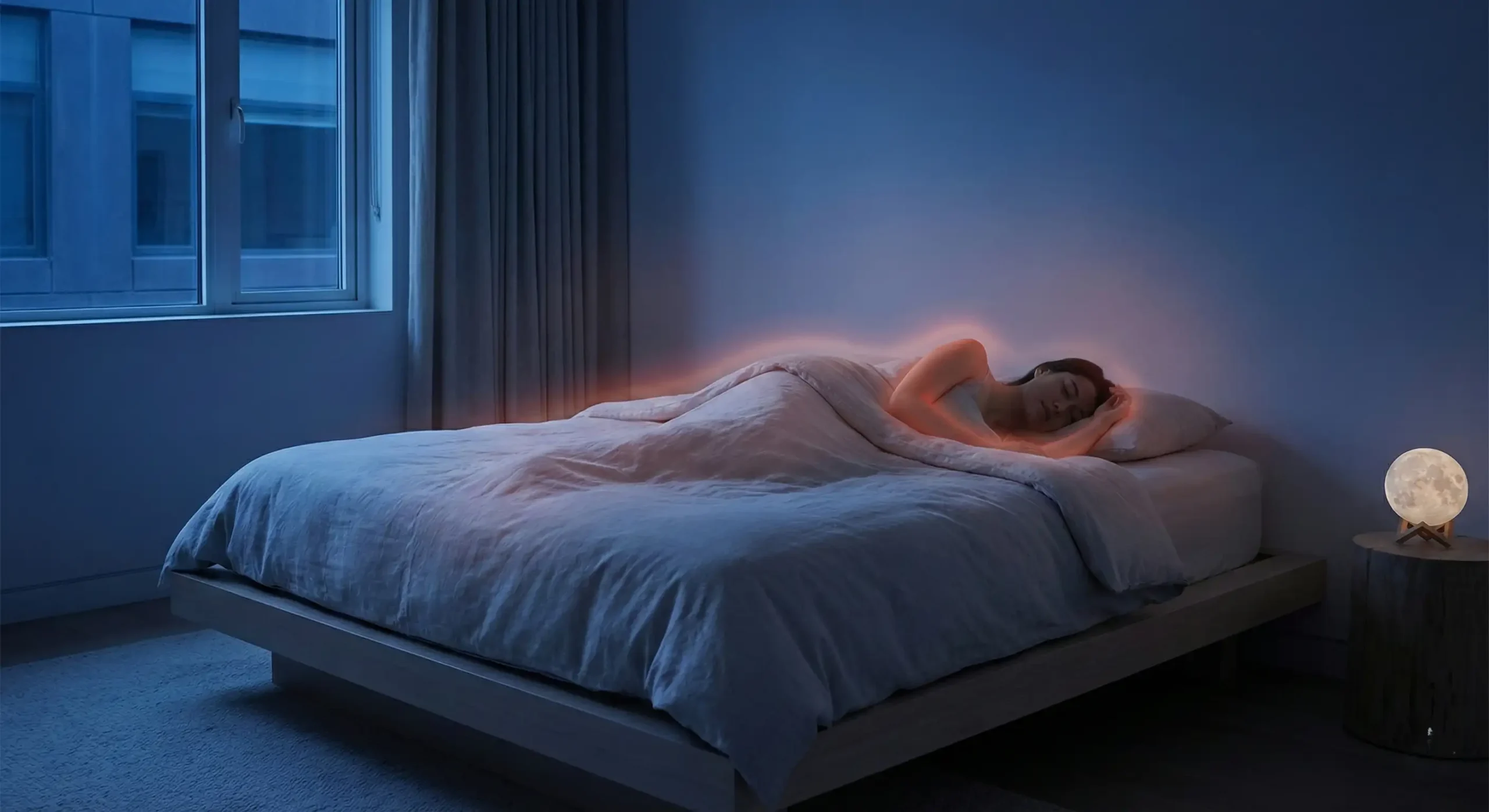
Deep sleep requires a reduction in core body temperature of approximately 1–2°C.
If the body cannot dissipate heat efficiently, melatonin release is delayed, cortisol increases, and nighttime awakenings become more likely.
Want Better Sleep Stats?
Theory is good, but tools get results. See the exact stack (mask, tape, supplements) I use to get 2+ hours of Deep Sleep every night.
Open Sleep HubSleep Is a Thermoregulatory Process
Falling asleep is not passive. It requires active heat loss from the body’s core to the skin and extremities.
Hands and feet act as radiators, releasing heat to signal the brain that it is safe to enter sleep.
Scientific reference: Human thermoregulation and sleep
Ideal Sleeping Temperature — What Research Suggests
Most adults sleep best when:
- Bedroom temperature: 16–20°C (60–68°F)
- Humidity is moderate
- Airflow supports evaporation
Importantly, individual variation matters.
Why You Wake Up Hot at 3AM
Common causes include:
- Impaired heat dissipation
- Elevated nighttime cortisol
- REM-related thermoregulation shutdown
This pattern is frequently discussed in:
Why You Can’t Fall Asleep
The Glymphatic System and Deep Sleep
The glymphatic system clears metabolic waste from the brain and functions primarily during slow-wave sleep.
Overheating reduces deep sleep time, impairing this process.
Scientific reference: Glymphatic system and sleep
The Warm Shower Paradox
A warm shower before bed:
- Dilates skin blood vessels
- Accelerates heat loss afterward
- Promotes melatonin onset
This is counterintuitive but well-documented.
Cooling Tools — Do They Help?
| Tool | Evidence | Notes |
|---|---|---|
| Cooling mattress pad | Moderate | Improves heat dissipation |
| Fan | Variable | Depends on humidity |
| Cold shower | Low | May increase alertness |
FAQ
What is the best temperature for deep sleep?
For most people, 16–20°C is optimal.
Why do I wake up sweating at night?
Often linked to cortisol spikes or impaired heat release.
Does temperature affect melatonin?
Yes — cooling is a major melatonin signal.
Can breathing patterns affect body temperature?
Yes. Nasal breathing improves heat regulation efficiency.
Sources
- Thermoregulation and sleep
https://pubmed.ncbi.nlm.nih.gov/11327588/ - Glymphatic system function
https://pubmed.ncbi.nlm.nih.gov/25967695/